
拍賣筆記 vol.322 蘇富比紐約2026:南宋官窯青釉葵口盤,估價120-180萬美元,鴻禧美術館舊藏 - Sotheby’s NY 2026, A 'Guan' Lobed Dish, Southern Song dynasty, Chang Foundation Taipei
- SACA

- Mar 8
- 13 min read

Chinese Art
現場拍賣 25 March 2026|09:30 EDT
New York
鴻禧美術館(Chang Foundation)位於台北,1988年由企業家張添根創辦,是台灣重要的私人美術館,專注收藏中國古代陶瓷、青銅器及書畫。其陶瓷收藏以宋代名窯(汝、官、哥、定、鈞)為核心,尤以南宋官窯最具代表性,藏品多經國際拍場或知名藏家流轉,品質極高。美術館不僅展示珍品,還出版權威圖錄,如《中國歷代陶瓷選集》,為學術研究提供重要參考。
南宋官窯斷代與比較
南宋官窯青釉葵口盤(如本件,直徑14 cm)因胎釉特徵(紫口鐵足、細密開片)多定為南宋,部分學者因釉色偏灰或器型稍厚,傾向斷代南宋晚期至元代(13世紀末)。與2025年蘇富比香港伊勢專場Harry Garner舊藏(拍品編號5022,成交約700萬美元)相比,後者更偏南宋早期,修足更細、釉色偏藍,呈現「雨過天青」雅致風格。本件則釉色略灰、器型稍渾厚,反映南宋晚期風格,品質雖略有差異,但傳承顯赫,價值仍高。

左:鴻禧美術館(本拍品);右:伊勢彥信、Harry Garner,蘇富比2025年5588.5萬港元售出
梅耶收藏(Frederick M. Mayer)與傳承
本件葵口盤出自Frederick M. Mayer(1899-1974)收藏,他是20世紀著名英國古董商與藏家,專精中國陶瓷與玉器,其收藏多為博物館級珍品。據王秋生在財新的文章《帮我买下整场吧!佳士得伦敦1974年梅耶专场拍卖风云|国际拍场》,Mayer收藏於1974年6月24-25日倫敦佳士得上拍(本件為編號59),震驚當時拍場,奠定其傳承地位。其後經Spink & Son Ltd.(倫敦古董商)與鴻禧美術館收藏,傳承清晰無暇,顯赫背景為本件估價120-180萬美元增添說服力。
南宋 官窰青釉葵口盤
高估價拍品
Premium Lots
估價
1,200,000 - 1,800,000 USD
Diameter 5½ in., 14 cm
狀況報告
整體品相良好,外口沿見幾處細微小磕,最大一處約0.5公分寬。

出處
Frederick M. Mayer (1899-1974) 收藏
上拍於倫敦佳士得1974年6月24日至25日,編號59
Spink & Son Ltd.,倫敦,1990年之前
鴻禧美術館,台北
著錄
史彬士,《中國歷代陶瓷選集》, 鴻禧美術館,台北,1990年,圖版41
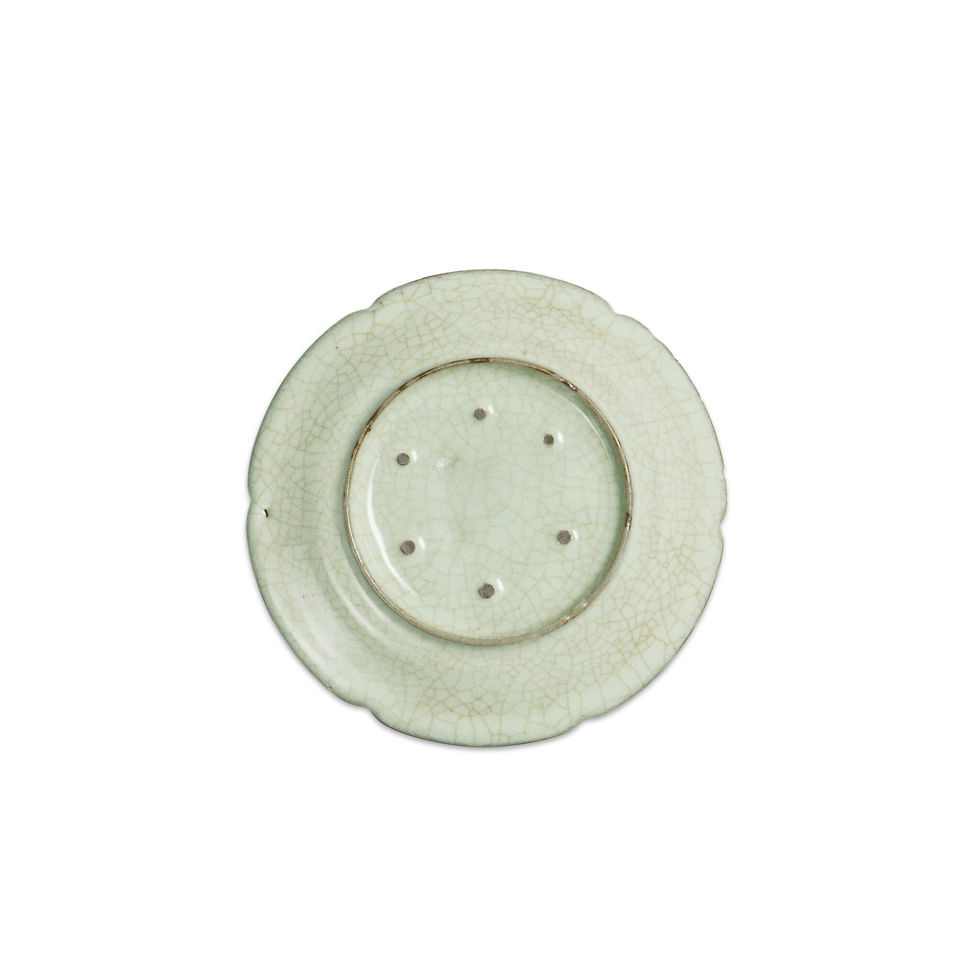

圖錄說明
官窰瓷之誕生,本末始終隱秘未明,後世對之想像益增。官窰瓷,始燒於十二世紀時時局多艱之時,實為勢所迫,應必要而生。官窰器物傳世殊罕,今僅見於海內外重要收藏,歷來備受推崇,公認為歷代御瓷中最為珍貴、最具代表性品類之一。
為宮廷特別燒造瓷器之制度,並非始於官窰。自唐(618–907年)至北宋(960–1127年),朝廷均有敕令頂尖藝匠及瓷窰,為宮廷燒製瓷器。從浙江越窰至河北定窰,審美各異其趣,反映歷代帝王品味。至北宋晚期,宮廷美學趨於秀雅內斂,此一風尚,與當時盛行之佛教思想及新儒家學説同步發展,宋徽宗(1100–1126年在位)喜愛文人簡約美學,崇尚取法自然,寫意含蓄之美,尤為其中代表。宋徽宗曾斥前朝宮廷風格過於繁縟(參考 Patricia Buckley Ebrey,《Accumulating Culture: The Collections of Emperor Huizong》,西雅圖,2008 年,頁 344f),北宋晚期宮廷藝術則趨向文人審美傳統,崇尚清簡秀逸之氣韻。
瓷器當中最能展示如此審美者,莫過於河南寶豐汝窰。汝瓷器型簡約,釉色仿若「雨過天青雲破處」,符合宋人對素淡雅致、追求平衡之審美。至北宋末年,汝窰或僅為宮廷專屬燒造。然而,汝窰燒製御瓷之時期短暫,1125 年女真所建金朝入侵中國北部,宋室 1127 年南遷,自汴梁(今開封)退至臨安(今杭州),於臨安延續國祚逾百年。南遷之後,宋代宮廷亟欲宣示其乃中華正統之中心地位,而因無法沿用北方御窰,遂於新址設官窰,仿燒汝瓷,延續北宋審美傳統。
南宋官窰造型質感,最初承襲汝窰及其他北方瓷器,但隨時日發展,自成一格。官窰以細密開片紋為特徵,而最受推崇處,乃其氣韻及觸感。開片,最初或因釉層冷卻時意外形成、其後則屬有意營造,透過反覆施釉及精準控制窰燒及冷卻過程,使釉面綻裂如玉石紋理,又似寒霜覆石。官窰瓷「紫口鐵足」,口沿或近足處釉層較薄,露出富鐵質深色瓷胎,效果深受宮廷珍重,視為官窰含蓄秀美之其中特徵;其厚潤釉質觀之悅目,把玩於手中,觸感宜人。
與北宋瓷器比較,官窰器型釉色亦更多變,創思更見自由,不拘一格。釉色有天青、油灰、米黄等,開片紋理呈蛛網狀,每品皆珍貴難得。單以六瓣葵式盤爲例,其中變化便已非常多樣:有以支釘架燒者,亦有不用支釘;器型相同之官窰,有成組燒製而釉色尺寸不同之例,變化甚廣,尺寸大約介乎直徑 18.7 至 23 公分之間,顯示瓷匠隨創思製器,或因官窰突然肩負燒造御瓷之重任,而無汝窰瓷匠技藝世代相傳之成規。

因此,官窰瓷器變化繁多,每品均具獨特個性,但亦因如此,後人辨別官窰器時較為困難。官窰瓷厚釉青瓷,釉面開片,明代文人因而常將之與元代哥窰相作比較。杭州老虎洞元代亦燒哥窰,故其與官窰如何分辨,至今仍未明確。14世紀曹昭《格古要論》將官、哥列為不同品類,形容兩者皆「色青,濃淡不一,亦有紫口鐵足」之特徵,但官窰釉色略帶粉紅,哥窰胎質較粗、釉色亦較淡。學者辨別官、哥瓷器,至今仍然沿用曹昭此論,然而如此色調差異,或僅為器物在窰中位置不同所致,未必具有系統性。
官窰之謎,亦因其在後世備受珍重而更形複雜。無論宮廷珍藏、或考古發掘,南宋之後仍有發現官窰瓷器,顯示其價值歷久不衰。南京中華門外,明初重臣汪興祖(1338–1371年)墓出土12盤例,器型與釉色特徵與典型官窰器及本件葵口盤幾無二致。該組瓷器青釉瑩潤,開片雅緻,盤口及足處露胎之特徵,亦與杭州出土南宋官窰一致。該組瓷器現藏於南京博物院與北京故宮博物院,雖部分研究斷代元朝,然而亦不排除為南宋瓷器,或經鑒藏,或為明器,歷代傳承至明朝。
時至清代,官窰之崇高地位已無可動搖。官窰瓷器,宮廷御藏數量甚多,從宮廷檔案記載,可見其備受珍視,其中此類葵口盤尤為顯赫。可比較1728年編著《古玩圖》,記錄清雍正朝御藏,所錄四件相近作例,現藏大英博物館(館藏編號 PDF,X.01)(圖一),以及雍正朝1729年記錄四例,現藏維多利亞與亞伯特博物館(館藏編號 E.59-1911)。乾隆皇帝尤其喜愛官窰瓷器,乾隆199首御製詩中,讚詠官窰者多達70首,六首仍刻於現藏北京故宮博物院之瓷器(參見高曉然,〈乾隆御製詩瓷器考論〉,《故宮學刊》,2011 年,頁 294–309)。
官窰珍罕,乃其備受推崇之一個重要原因。根據現時所知,清宮舊藏當中,僅約30件同類盤例藏於台北故宮博物院,另有六例藏於北京故宮博物院,多斷定為哥窰器,《故宮博物院藏文物珍品全集・兩宋瓷器(下)》則斷代南宋(北京,1996 年,圖版 74、78、82、84、85、91)。台北故宮之例,首次大型展覽為1989 年《宋官窰特展》,自此曾斷代宋、宋-元或元朝,其秀雅靜謐之丰采則無疑問。此盤六瓣葵式,盤足精緻而綫條明快,器形起伏宛若花朵浮於水面,仿佛邀請觀者伸手輕觸,秀雅宜人。
除宮廷舊藏之外,流傳至今之同類作例極為罕見。可資比較者,包括一例現藏紐約大都會藝術博物館(館藏編號 24.172.1),金屬口,錄於 Suzanne Valenstein,《A Handbook of Chinese Ceramics》,紐約,大都會藝術博物館,1975 年,圖版 61(圖二);另有七件現存於倫敦大英博物館,出自大維德爵士收藏,著錄於 畢宗陶,《Illustrated Catalogue of Ru, Guan, Jun, Guangdong and Yixing Wares in the Percival David Foundation of Chinese Art》,倫敦,1999 年,編號 13、14、A32、28、56、89 及 A39,前三件帶乾隆御題詩,其餘數件亦可能乃清宮舊藏(圖三);另比兩件,迦納爵士收藏,一為殘片,現藏劍橋菲茨威廉博物館(館藏編號 C.6-1978),著錄於 Basil Gray,《Sung Porcelain and Stoneware》,倫敦,1984 年,圖版 103;尚有一例,最近期現身香港蘇富比拍賣,出自伊勢收藏,2025 年 9 月 9 日,拍品編號 5022(圖四);此外,尚有一例出自瓊肯收藏,曾於香港蘇富比拍賣售出,2017 年 4 月 4 日,拍品編號 1106(圖五)。
Overview of the Chang Foundation
The Chang Foundation (鴻禧美術館), established in Taipei in 1988 by entrepreneur Chang Tien-ken, is one of Taiwan’s premier private museums, dedicated to Chinese antiquities, including ceramics, bronzes, and paintings. Its ceramic collection focuses on Song dynasty masterpieces (Ru, Guan, Ge, Ding, Jun), with Southern Song Guan ware as a highlight. Many pieces, sourced from international auctions or renowned collectors, are museum-grade, and the Foundation’s publications, such as Selected Chinese Ceramics from Han to Qing Dynasties, are key references for scholars.
Dating and Comparison of Southern Song Guan Ware
Southern Song Guan lobed dishes, like this piece (diameter 14 cm), are typically attributed to the Southern Song dynasty due to features like purple mouth, iron foot, and fine crackle. However, some scholars, noting a greyer glaze or thicker form, suggest a late Southern Song to Yuan dynasty date (late 13th century). Compared to the Harry Garner piece from the Ise Collection (Sotheby’s Hong Kong, 2025, lot 5022, sold for ~USD 7 million), which reflects early Southern Song aesthetics with finer foot and bluer “rain-cleared sky” glaze, this dish has a slightly greyer, sturdier profile, indicative of late Southern Song style. Despite subtle quality differences, its exceptional provenance elevates its value.
Frederick M. Mayer Collection and Provenance This dish hails from the collection of Frederick M. Mayer (1899–1974), a prominent 20th-century British dealer and collector renowned for museum-quality Chinese ceramics and jades. As reported by Caixin columnist Wang Qiusheng, Mayer’s collection, including this piece (lot 59), was auctioned at Christie’s London on June 24–25, 1974, causing a sensation in the art market. Subsequently passing through Spink & Son Ltd. (London dealers) and the Chang Foundation, its impeccable provenance, combined with its rarity, justifies the USD 1.2–1.8 million estimate.
Condition Report
In overall excellent condition, except for a few minute nicks to the outer rim, the largest measuring approx. 0.5 cm wide.
Provenance
Collection of Frederick M. Mayer (1899-1974).
Christie’s London, 24th-25th June 1974, lot 59 (offered).
Spink & Son Ltd., London, prior to 1990.
Chang Foundation, Taipei.
Literature
James Spencer, Zhongguo lidai taoci xuanji / Selected Chinese Ceramics from Han to Qing Dynasties, Chang Foundation, Taipei, 1990, pl. 41.
Catalogue Note
The story of guan (‘official’) ware is one of mystery and delight. Born from necessity amidst the chaos of the twelfth century, these extraordinary pieces survive today in minuscule numbers in the world’s most important collections and are celebrated as among the most beloved and iconic Imperial ceramics ever produced.
The phenomenon of ceramics specifically commissioned for the Chinese court was not born with guan ware. Starting in the Tang dynasty (618–907) and culminating in the Northern Song (960–1127), the ruling dynasties of China turned to the finest artisans and kiln sites of their day to furnish their palaces with tribute pieces. From the Yue kilns of Zhejiang to the Ding kilns of Hebei, successive rulers left their mark on the visual history of China in their patronage of kiln sites and endorsement of certain aesthetics. By the late Northern Song dynasty, this aesthetic was one of refinement. Developing in tandem with the Buddhist and Neo-Confucianist teachings of the day, Northern Song emperors – and particularly the penultimate Emperor Huizong (r. 1100–1126) – endorsed a literati aesthetic of radical minimalism, embracing the spontaneity and understated beauty of the natural world. Unlike the more elaborate decoration of preceding rulers, dubbed as 'gaudy as jewelry' by Emperor Huizong (see Patricia Buckley Ebrey, Accumulating Culture. The Collections of Emperor Huizong, Seattle, 2008, p. 344f), the late Northern Song court saw the development of the rich tradition of scholarly art, dominated by restraint and modesty over glamour and ostentatiousness.
In the realm of ceramics, this aesthetic had been embodied by the famous Ru wares of Baofeng, Henan. Of simple forms with a plain glaze said to mimic the 'blue of the sky after rain,' Ru ware aligned perfectly with Song views of subtlety, balance and unstatement and, in the latter years of the Northern Song, appears to have been produced specifically and exclusively to the orders of the court. However, this patronage was to be short-lived. Following the invasion of northern China by the Jurchen-led Jin dynasty in 1125, the Song court was forced to flee from its capital of Bianliang (modern-day Kaifeng) and settle in Lin’an (Hangzhou) in 1127, where it was to remain for more than a century. Divorced from their imperial kilns and keen to establish themselves as the undisputed center of Chinese civilization, the emperors of the nascent Southern Song clung to the aesthetics of their predecessors and founded new official (guan) kilns to imitate their beloved Ru.
While the forms and textures of the new guan wares may have been inspired by those of Ru and other Northern wares, before long, Southern guan ware had developed into its own established artform. Suffused with rich networks of crackle caused by the cooling glaze, guan ware is celebrated for its atmospheric subtlety and refined tactile presence. Although perhaps initially produced accidentally, potters soon deliberately sought to reproduce this enchanting crackle, applying multiple layers of glaze that, when fired and cooled, would enliven the surface with crazing reminiscent of veins in jade or frost on stone. When the glaze thinned at the rim or foot, the iron-rich dark stoneware body appeared as a 'purple mouth and iron foot,' a hallmark look prized by court collectors as part of the ware’s introspective beauty, while its rich unctuous glaze proved as enchanting to hold as it was to look upon.
In a similar departure from its northern predecessors, guan ware also displays a remarkable level of variation and lack of restraint in its forms and colors. From rich silvery greens to warm cream tones and dark grey cobweb-like crazing, each piece of guan ware in the Palace collections and beyond is a unique work of art. Even among related hexalobed dishes of this form, for example, a wide variation exists. From those fired on firing spurs to those fired directly on their rim; guan dishes of this design were produced in series of varying colors and sizes (from ca. 18.7 cm to 23 cm), seemingly at the whims of their ancient craftsmen who – unlike their Ru predecessors – had the task of producing imperial wares thrust upon them without the generations of developed practice.
This variation, while lending each piece a unique quality, has also led to some questions as to the attribution and dating of guan ware. With a thick celadon glaze suffused with crackles, guan was often compared by Ming scholars with a related Ge (‘older brother’) ware attributed to the Yuan dynasty (1271–1368). Produced at least one of the same kiln sites as guan (Laohudong) in the Yuan dynasty, the question of how Ge wares are distinguished from guan remains pernicious. In the fourteenth century Gegu yaolun (Important discussions about assessing antiques), for example, scholar Cao Zhao cites Ge and guan wares as distinct but describes both as of an uneven celadon tone with ‘purple mouth’ and ‘iron foot’, distinguishing guan for its slightly pinker glaze and Ge for its more coarse clay body and ‘weaker’ color. This color distinction, relied on by scholars until today may, however, be more a case of a piece’s positioning in the kiln than anything systematic.
This mystery is only further compounded by the importance placed on guan wares in the ensuing centuries. Preserved in court collections and uncovered in archaeological contexts, the discovery of guan pieces in later contexts illustrates the continued esteem in which they were held, even long after the Southern Song. A group of twelve dishes unearthed from the early Ming tomb of official Wang Xingzu (1338–1371) outside Zhonghua Gate, Nanjing, for example, shows forms and glaze characteristics almost indistinguishable from canonical guan wares and the present dish. With a rich celadon color, subtle crackle and dark stoneware body that reveals itself at rims and feet, consistent with Southern Song guan excavated in Hangzhou contexts, the Wang Xingzu dishes (now preserved between the Nanjing Museum and Palace Museum, Beijing), while variously attributed to the Yuan dynasty, may well be products of the Southern Song, passed into elite collections and even burial contexts well into the Ming period.
By the Qing dynasty, the primacy of guan ware was unquestionable. Preserved in great number in the imperial collections, guan wares – and specifically dishes of this design – appear prominently in catalogues of the imperial collections. Compare four hexalobed dishes of related form depicted in the 1728 catalogue of the collection of the Yongzheng Emperor (r. 1723-1735), the Guwan tu (Pictures of Ancient Playthings), preserved in the British Museum, London (accession no. PDF,X.01) (Fig. 1) and another four in the 1729 volume at the Victoria and Albert Museum, London (accession no. E.59-1911). Yongzheng’s successor, the Qianlong Emperor (r. 1736-1795) was a particularly ardent admirer of guan. Of the hundred and ninety-nine recorded poems composed by the Emperor in praise of ceramics, more than a third (seventy) are in praise of his beloved guan wares and six of these are still found on vessels preserved in the collection of the Palace Museum, Beijing; see Gao Xiaoran, ‘Qianlong yuzhi shi ciqi kaolun / Studies of Ceramics with Inscriptions of “Imperial Poems” Composed by Emperor Qianlong’, Gugong Xuekan, 2011, pp 294-309.
Certainly one reason for this imperial esteem is guan ware’s exceptional rarity. Today just thirty closely related dishes are preserved from the Qing court in the National Palace Museum, Taipei and six in the Palace Museum, Beijing, generally catalogued as Ge ware but attributed to the Southern Song dynasty in The Complete Collection of Treasures of the Palace Museum. Porcelain of the Song Dynasty, vol. 2, Beijing, 1996, pls 74, 78, 82, 84, 85, 91. While the Taipei examples similarly have been variously attributed as ‘Song’, ‘Song - Yuan’ or ‘Yuan’ since their first major exhibition in 1989 (Song Guan yao tezhan / Catalogue of the Special Exhibition of Sung Dynasty Kuan Ware, National Palace Museum, Taipei, 1989), the splendor and enchanting quality of these dishes has remained undeniable. With six simple notches carved into the rim and a gently fluted form rising from a crisp delicate foot, the dish is rendered like a blossom floating on the surface of the water, inviting the beholder to touch.
Beyond the Palace collections, surviving examples of related form are exceedingly rare. Compare a closely related dish with a metal-bound rim preserved in the Metropolitan Museum of Art, New York (accession no. 24.172.1), in Suzanne Valenstein, A Handbook of Chinese Ceramics, The Metropolitan Museum of Art, New York, 1975, pl. 61 (Fig. 2); seven from the collection of Sir Percival David in the British Museum, London, illustrated in Stacey Pierson, Illustrated catalogue of Ru, Guan, Jun, Guangdong and Yixing wares in the Percival David Foundation of Chinese Art, London, 1999, cat. nos 13, 14, A32, 28, 56, 89 and A39, the first three with Qianlong inscriptions and others likely with Qing court provenance (Fig. 3); two from the collection of Sir Harry Garner: one broken and preserved in the Fitzwilliam Museum, Cambridge (accession no. C.6-1978) in Basil Gray, Sung Porcelain and Stoneware, London, 1984, pl 103; and the other most recently sold in our Hong Kong rooms as part of the Ise Collection, 9th September 2025, lot 5022 (Fig. 4); and another from the Junkunc Collection, sold more recently in our Hong Kong rooms, 4th April 2017, lot 1106 (Fig. 5).


Comments