
拍賣筆記 vol.323 蘇富比香港2025:5588.5萬售出,南宋官窯青釉葵口盤,伊勢彥信、哈利·戛納舊藏 - Sotheby’s HK 2025, A 'Guan' Lobed Dish, Southern Song dynasty, Ise, Harry Garner Collection
- SACA

- Mar 8
- 16 min read
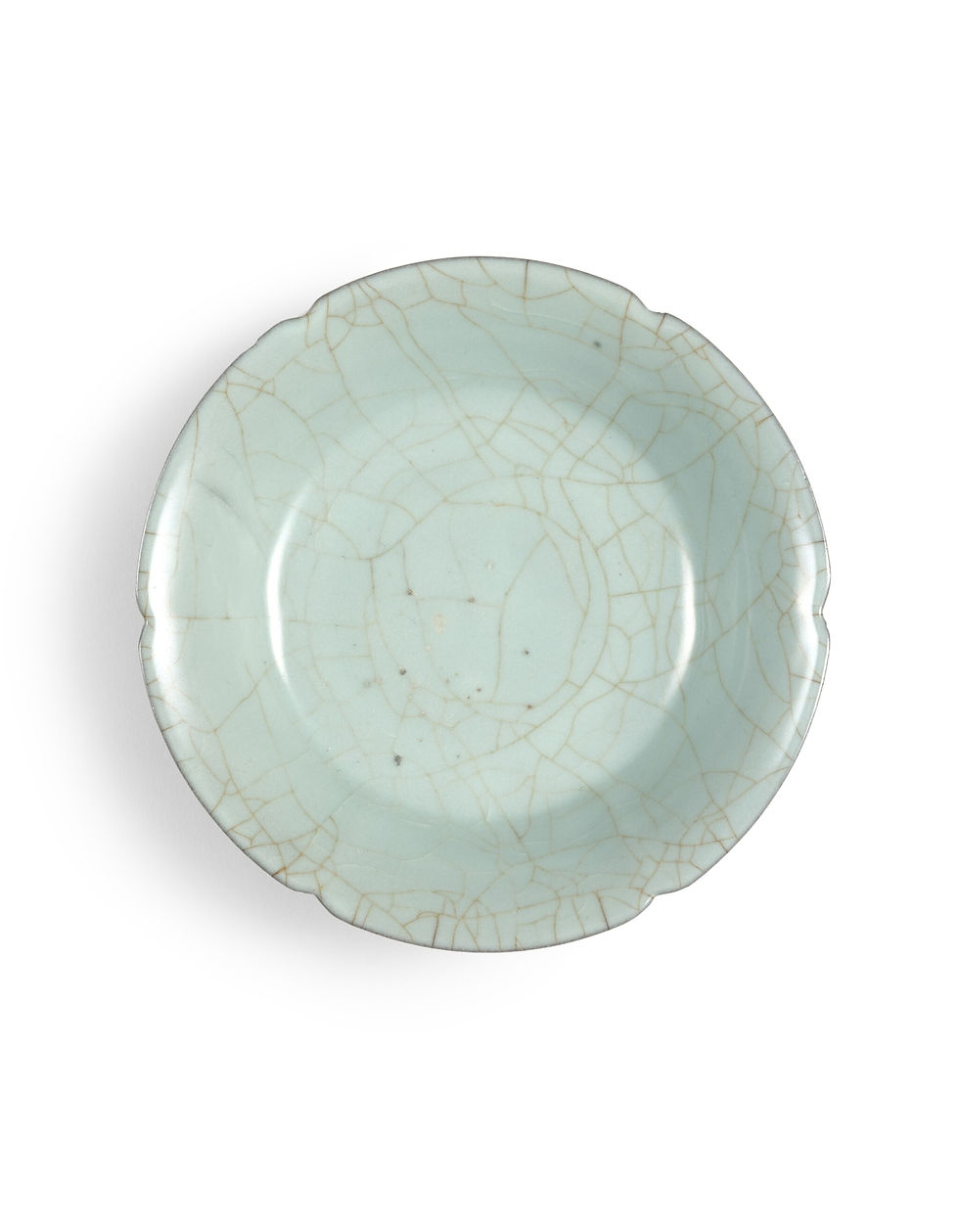


伊勢彥信這件南宋官窯可能是近10年來質量最高的南宋官窯碟,胎體非常輕薄,釉色十分瑩潤,開片有著名的「玉津園」的金絲審美,開大片。成交價格5588.5萬港元給市場帶來了一劑強心針,雖然受經濟影響預期不如經濟上行期1億左右的價格,但依然給市場帶來了正面信號。
Masterpieces of Chinese Ceramics from the Ise Collection
9 September 2025|10:00 HKT|Hong Kong
南宋 官窰青釉葵口盤
An exceptionally rare and important heirloom Guan lobed dish, Southern Song dynasty
高估價拍品
Premium Lots
Guaranteed Property
Irrevocable Bids
拍賣已結束
September 9, 07:30 PM HKT
估價
25,000,000 - 50,000,000 HKD
拍品已售
55,885,000 HKD


描述
elegantly potted with wide flaring sides rising at an angle from a low tapered foot, the rim gracefully divided into six lobes, the body unctuously enveloped in a thick lustrous bluish-celadon glaze thinning at the rim, the glaze suffused with a network of attractive golden-beige crackles, save for the neatly trimmed footring unglazed revealing the dark brown body, Japanese double wood box
19.2 cm
狀況報告
The dish is in very good overall condition. There is a retouched shallow flake to the outer mouth-rim, measuring approx. 0.7 cm. There are also expected minor firing imperfections, including a lightly retouched small grit to the interior, a faint vertical hairline developed from firing, and a superficial kiln flake to the inner footring, as visible in the catalogue image.
整體品相良好。口沿一處約0.7公分淺磕經潤飾;偶見窰燒瑕疵,如圖所示包括盤心小處窰粘經潤飾,盤口一垂直原生細線,以及足圈小處原生淺磕痕。
If a condition report is provided to assist you with assessing the condition of the lot, it is for guidance purposes only. Such condition report may not refer to all faults, restoration, alterations, or adaptations because Sotheby's is not a professional conservator or restorer but rather a condition report is a statement of subjective, qualified opinion genuinely held by Sotheby's. For these reasons, any such condition report is not an alternative to taking your own professional advice regarding the condition of the lot. Prospective buyers should also refer to the Guide for Buyers at Auction which includes important notices concerning the type of property in this sale.


出處
Collection of Sir Harry M. Garner (1891-1977).
Bluett & Sons Ltd, London.
Mayuyama & Co., Ltd, Tokyo, acquired from the above on 14th June 1978.
A Japanese private collection.
Mayuyama & Co., Ltd, Tokyo.
展出
Ju and Kuan Wares, The Oriental Ceramic Society at Bluett’s, London, 1952, cat. no. 36, illustrated pl. 3 (with metal rim).
The Arts of the Sung Dynasty, The Oriental Ceramic Society at the Arts Council Galleries, London, 1960, cat. no. 163 (with metal rim).
The Ceramic Art of China, The Oriental Ceramic Society at the Victoria & Albert Museum, London, 1971, cat. no. 107, illustrated pl. 25 (with metal rim).
On loan to the Victoria and Albert Museum, London, from 1976 to 1977.
Chugoku Toji Meihin Ten Ise Korekushon no Shiho / Masterpieces of Chinese Ceramic Art Exhibition, Ishikawa Prefectural Museum of Art, Ishikawa, 2012, cat. no. 36.
Seiji no Ima –Uketugareta Waza to bi Nan So Kara Gendai Made / Celadon Now: Techniques and Beauty Handed Down from Southern Song to Today, Tokyo, 2014, cat. no. 1 - 03.
Porcelaine. Chefs-d'œuvre de la Collection Ise, Musée Guimet, Paris, 2017, cat. no. 23.
Ise Korekushon Sekai wo Miryoshita Chugokutoji / The Enchanting Chinese Ceramics from the Ise Collection, Museum of Oriental Ceramics, Osaka, 2017, cat. no. 30.
著錄
‘Ju and Kuan Wares’, Transactions of the Oriental Ceramic Society, vol. 27, 1951-53, pl. 3, no. 36 (with metal rim).
Harry M. Garner, ‘Ju and Kuan Wares of the Sung Dynasty’, The Burlington Magazine, vol. 94, no. 597, December 1952, pp. 348-53, pl. 63.
G.St.G.M. Gompertz, Chinese Celadon Wares, London, 1958, pl. 56B (with metal rim).
‘The Arts of the Sung Dynasty’, Transactions of the Oriental Ceramic Society, vol. 32, 1959-60, pl. 61, no. 163 (with metal rim).
‘The Ceramic Art of China’, Transactions of the Oriental Ceramic Society, vol. 38, 1969-71, pl. 71, no. 107 (with metal rim).
Chugoku Toji. Ise Korekushon / Chinese Ceramics. The Ise Collection, Tokyo, 2012, pp. 38-39.
Nagomi [A Monthly Magazine by Tankosha], Tankosha, Tokyo, May 2018, p. 13.
Christian Boehm, 'A Tea Master's Vision: Chinese Ceramics from the Ise Collection', Arts of Asia, July-August 2018, fig. 15.
Tosetsu [A Monthly Journal Published by The Japan Ceramic Society], vol. 803, March 2020, pl. 3.

來源
迦納爵士(1891-1977年)收藏
Bluett & Sons Ltd,倫敦
繭山龍泉堂,東京,1978年6月14日購自上述來源
日本私人收藏
繭山龍泉堂,東京
展覽
《Ju and Kuan Wares》,東方陶瓷學會,Bluett's,倫敦,1952年,編號36,圖版3(連銅扣)
《The Arts of the Sung Dynasty》,東方陶瓷學會,英格蘭藝術委員會,倫敦,1960年,編號163(連銅扣)
《The Ceramic Art of China》,東方陶瓷學會,維多利亞與艾爾伯特博物館,倫敦,1971年,編號107,圖版25(連銅扣)
維多利亞與艾爾伯特博物館,倫敦(借展),1976至1977年
《中国陶磁名品展―イセコレクションの至宝》,石川縣立美術館,石川,2012年,編號36
《青磁のいま 受け継がれた技と美 南宋から現代まで》,東京國立近代美術館工藝館,東京,2014年,編號1-03
《Porcelaine. Chefs-d'œuvre de la Collection Ise》,吉美博物館,巴黎,2017年,編號23
《イセコレクション 世界を魅了した中国陶磁》,大阪市立東洋陶瓷美術館,大阪,2017年,編號30
出版
〈Ju and Kuan Wares〉,《Transactions of the Oriental Ceramic Society》, 卷30,1951-53年,圖版3,編號36(連銅扣)
迦納爵士,〈Ju and Kuan Wares of the Sung Dynasty〉,《The Burlington Magazine》,卷94,編號597,1952年12月,頁348-53,圖版63
G.St.G.M. Gompertz,《Chinese Celadon Wares》,倫敦,1958年,圖版56B(連銅扣)
〈The Arts of the Sung Dynasty〉,《Transactions of the Oriental Ceramic Society》,卷32,1959-60年,圖版61,編號163(連銅扣)
〈The Ceramic Art of China〉,《Transactions of the Oriental Ceramic Society》,卷38,1969-71年,圖版71,編號107(連銅扣)
《中国陶磁 イセコレクション》,2012年,東京,頁38至39
《なごみ》,淡交社,東京,2018年5月,頁13
Christian Boehm,〈A Tea Master's Vision: Chinese Ceramics from the Ise Collection〉,《亞洲藝術》,2018年7/8月,圖15
《陶説》,803期,2020年3月,圖版3

The Garner Guan Ware Dish
Regina Krahl
Song society was in many respects far ahead of its times, and it certainly was in terms of taste. In centuries past, the rich and powerful the world over tended to surround themselves with unmistakable luxuries: items clearly exhibiting the expensive materials and the intense amount of labour required to create them. Emperor Huizong (r. 1100–1126), the last great emperor of the Northern Song period (960–1127), who abdicated just a year before the Jurchen conquered the Song capital, followed a different trend that was already prevalent among the literati at the time. Works of art characterized by a reduction to simplicity, naturalness, spontaneity and understated refinement became the trademark of Song imperial taste. Patricia Buckley Ebrey tells us that Emperor Huizong complained that his predecessor’s buildings looked “as gaudy as jewelry” and insisted himself on architecture with unpainted beams and monochrome wall paintings (Accumulating Culture. The Collections of Emperor Huizong, Seattle, 2008, pp. 344f.). For any emperor to choose a modest ceramic vessel over a glitzy item made up of gold and jewels required an independent mind. It was a sophisticated approach, that contradicted the prevalent concept of what constitutes privilege.
“Works of art characterized by a reduction to simplicity, naturalness, spontaneity andunderstated refinement became the trademark of Song imperial taste.”
Traditionally, the court had obtained its ceramics as tribute pieces, sent from the best kilns in the empire. This development, which had started in the Tang dynasty (618–907), culminated towards the end of the Northern Song, when the plain green Ru wares of Baofeng in Henan with their simple shapes and lack of decoration became the most favoured ceramics at court; but this choice was of short duration. When the imperial house had to relocate to the south, access to these wares was suddenly cut off.
The Southern Song period (1127–1279) began when the court moved to Hangzhou in Zhejiang, although this new location was not immediately accepted as the new capital, but first considered as only a temporary residence. Once it became clear, however, that the northern part of their erstwhile empire would remain under the rule of the Jin dynasty (1115–1234) for the foreseeable future, the household department had to find new ways to supply the court with all it wished for and needed. For ceramics, it opted for setting up and controlling its own kilns, right in Hangzhou, to fill the void. As everything in Hangzhou was conceived as a replica of the former capital Bianjing (modern Kaifeng in Henan), it was only natural that the official (‘guan’) kilns would endeavour to reproduce the court’s former favourite ware, Ru.
"Born out of necessity, Hangzhou guan ware became one of China’s most emblematic and beloved ceramic wares. Its fame and aura are unsurpassed and it is often ranked even higher than Ru, because it is altogether more endearing."
Born out of necessity, Hangzhou guan ware became one of China’s most emblematic and beloved ceramic wares. Its fame and aura are unsurpassed and it is often ranked even higher than Ru, because it is altogether more endearing. The different raw materials, working methods and artisans of the south produced an outcome very different from the northern Ru ware. Shapes are less severe; the satisfactory, lush coating of glaze, applied in multiple layers, that envelops guan pieces softly modulates the surface and mellows all angles and edges. Its brownish-black body lends depth to the tone of the glaze, even though it is directly noticeable only at the rim, where the glaze adheres in a thinner, more translucent layer. It can also make the crackle appear darker and more prominent. To recognize the attraction of the chance outcome of a crackle pattern, which basically represented a flaw arising during the cooling process after firing, was one of the most remarkable leaps in Song connoisseurs’ conception of beauty. It is a combination of these features that can turn a basically modest ceramic vessel into a work of art.
To fully appreciate this, one only needs to compare one of the originals to any of their innumerable imitations. Song guan ware represents probably China’s most copied type of ceramics, but its grandeur and nobility were never equalled. It was imitated already by contemporary kilns at Longquan further south in the same province, Zhejiang, and continued to provide models particularly for potters at the Jingdezhen kilns of Jiangxi, right until modern times. Neither the former, with their stronger green glazes on a light-coloured clay, nor the latter, with their hard-white porcelain body and sparkling, translucent glazes were well suited to reproduce the subtlety of the soft-toned, hazy greenish glazes that cover the dark ceramic body of the originals. The magic of Song guan ware needs to be experienced in person; it is difficult to transmit it with words and impossible to do it full justice through photographs.
"What is perhaps most surprising about Song guan ware is that in spite of its fame and glory, and the unbroken admiration it enjoyed for almost nine hundred years, still very little is known about its manufacture."
The seemingly simply shape of this dish is ingenious in its design. Six small cut-out notches in the rim are sufficient to create an enchanting flower shape; and the angled sides, raised on a very narrow foot, elevate this blossom, as if it was floating slightly above ground. This form is not encountered among Ru wares, but predecessors can be found among the related Zhanggongxiang wares, made close by in Ruzhou, Henan, which, however, are known almost only from kiln wasters; four dishes of similar form, three of them glazed but fragmentary and the fourth, biscuit-fired and still unglazed, have been excavated from the kiln site and are published in Ruyao yu Zhanggongxiangyao chutu ciqi/Ceramic Art Unearthed from the Ru Kiln Site and Zhanggongxiang Kiln Site, Beijing, 2009, pp. 111-14.
What is perhaps most surprising about Song guan ware is that in spite of its fame and glory, and the unbroken admiration it enjoyed for almost nine hundred years, still very little is known about its manufacture. Two kiln sites producing ceramics that fit our notion of Southern Song guan ware have been discovered in Hangzhou and two terms are found in the classical literature when discussing the Song court’s ceramic workshops. This has led to a quick association of the terms with the sites, one supposedly of higher, the other of lesser quality. Xiuneisi, the name of the prestigious Palace Maintenance Office in charge of court buildings and furnishings has been fitted to the more prolific Laohudong kiln site, thus deemed the grander location; Jiaotanxia, the more humble name of a locality in Hangzhou, has been matched with the Wuguishan site and declared the lesser of the two. This interpretation and grading have since been questioned by several scholars, since Laohudong continued to produce into the Yuan without obvious interruption (Du Zhengxian, ed., Hangzhou Laohudong yaozhi ciqi jingxuan [Selection of porcelains from the Laohudong kiln sites in Hangzhou], Beijing, 2002); and Wuguishan, discovered in 1930 by Japanese explorers, has yielded fragments of the highest order, which plainly contradict its qualification as a secondary site (‘Yonaiyama tōhen/Yonaiyama Shards’, and ‘Yonaiyama tōhen II/Yonaiyama Shards II’, The Bulletin of the Chinese Ceramic Study Association of Tokiwayama Bunko Foundation, vols 2 and 4, Tokyo, 2009 and 2011).
"What characterizes guan ware in contrast to Ru, is the enormous variation between comparable examples [...] The variations suggest that all these dishes were individually shaped and glazed rather than having been produced in series, at a time when the kilns were still in a phase of exploration."
Many of the finest guan pieces, including the present dish, cannot obviously be attributed to either find site, which suggests that not all official production sites have been located. The best guan ware fragments so far discovered in Hangzhou come from yet another place, situated on the grounds of a modern factory and therefore not systematically excavated. That site does not appear to represent a manufacturing site, however, but may have been used as a temporary storage place by the court (Shu Pei Chi, ed., Chen Changwei jinian lunwen ji/Studies in Memory of Chen Chang-wei, vol. 4, Taipei, 2009, pp. 150-72).
What characterizes guan ware in contrast to Ru, is the enormous variation between comparable examples. This is not surprising, since the official Hangzhou potters were confronted with a sudden demand to create imperial ceramics from scratch and clearly had to experiment, while the Ru potters had a long tradition of ceramic making before their wares reached the reliable level deemed necessary for court approval. The number of dishes equalling the present piece in quality and approximate size is very small; and while the following are all very similar, with crackled greenish glazes, six-lobed, with angled sides, with a small foot, on which they were placed in the kiln, without the support of spurs, they all vary slightly in glaze tone and crackle pattern, in overall diameter, in the size of their foot and in the depth of their sides, above the angle. The variations suggest that all these dishes were individually shaped and glazed rather than having been produced in series, at a time when the kilns were still in a phase of exploration.

FIG. 1GUAN LOBED DISH, SOUTHERN SONG DYNASTY, PALACE MUSEUM, TAIPEI, CC BY 4.0 @ WWW.NPM.GOV.TW
圖1 南宋 官窰青瓷葵口盤 故宮博物院,台北,CC BY 4.0 @ WWW.NPM.GOV.TW
Five such dishes, ranging in size from 18.7 cm to 23 cm, are in the Palace Museum, Taipei, included in the exhibitions Gui si chenxing. Qing gong chuanshi 12 zhi 14 shiji qingci tezhan/Precious as the Morning Star. 12th-14th Century Celadons in the Qing Court Collection, Palace Museum, Taipei, 2016, nos II-23 – II-26; and Song guanyao tezhan/Catalogue of the Special Exhibition of Sung Dynasty Kuan Ware, Palace Museum, Taipei, 1989, nos 98-102 (fig. 1); two of them are incised on the base with poems by the Qianlong Emperor (r. 1736–1795).
A dish with a metal-bound rim (21.9 cm), is in the Metropolitan Museum of Art, New York (no. 24.172.1)(fig. 2); and the Fitzwilliam Museum, Cambridge, bought a second dish from the collection of Sir Harry Garner (no. C.6-1978) (18 cm), but that one broken, which beautifully displays its thin black body under the glaze (fig. 3); both these dishes are illustrated in Basil Gray, Sung Porcelain and Stoneware, London, 1984, pls 104 and 103; the Palace Museum, Beijing, holds a related dish re-assembled from sherds, that was incised with a palace name on the base after firing (17.8 cm), published in Feng Xiaoqi, ed., Gugong Bowuyuan cang Zhongguo gudai yaozhi biaoben. Zhejiang/The Specimens of Ancient Chinese Kilns in the Collection of the Palace Museum. Zhejiang, Beijing, 2015, vol. 1, p. 209 (fig. 4), next to base sherds of dishes from the Jiaotan guan kiln site, pls 115 and 116.

FIG. 2 GUAN LOBED DISH, SOUTHERN SONG DYNASTY, METROPOLITAN MUSEUM OF ART, NEW YORK, FLETCHER FUND, 1924, OBJECT NO. 24.172.1
圖2 南宋 官窰青釉葵口盤 紐約大都會藝術博物館,FLETCHER 基金,1924年,館藏編號24.172.1
There exists a larger number of dishes of similar shape, but of smaller size, with more opaque, beige-toned glazes traditionally identified as ge type; these probably post-date the Song dynasty. See several such dishes in the Palace Museum, Taipei, included in the Museum’s 1989 exhibition catalogue, op.cit., nos 125-31; and in the 2016 exhibition catalogue, op.cit., pp. 284-7, where they are attributed to the Yuan dynasty; others in the Palace Museum, Beijing, in Li Huibing, ed., Gugong Bowuyuan cang wenwu zhenpin quanji. Liang Song ciqi/The Complete Collection of Treasures of the Palace Museum: Porcelain of the Song Dynasty, Hong Kong, 1996, vol. 2, nos 74, 78, 82, 84 and 85, attributed to the Song.
Sir Harry Mason Garner (1891–1977), was a British scientist, distinguished collector, outstanding scholar, and president of the Oriental Ceramic Society, London, from 1968 to 1971, who published on many aspects of Chinese ceramics, including on Ru and guan ware, as well as on Chinese lacquer. He donated the bulk of his collection to the British Museum and the Victoria & Albert Museum in London, but was apparently reluctant to part with the present dish, which he owned for at least twenty-five years and held on to until his death. In 1976, he placed a group of Chinese and Japanese ceramics, including this dish, on loan to the Victoria and Albert Museum, London. In a letter to Roger Bluett, dated 12th January 1977, just months before his death, he wrote “I suggest that you take the first six on the list [of V&A loans] and offer them at the prices you suggest. The others can be left for the present. I should like to think more about the two kuan [guan] dishes before coming to a conclusion,” referring to the present dish and the broken one now in the Fitzwilliam Museum (fig. 3). He did not come to a conclusion, however, and the two dishes were sold by Bluett’s after Sir Harry’s death together with a few other items, the present piece to the Japanese dealer Mayuyama & Co. During Sir Harry’s ownership, the dish had a metal rim, but a photograph of late 1977 shows it already without that rim.

迦納珍藏官窰葵口盤
康蕊君
宋代社會諸多方面皆遠邁時代,審美趣味尤是如此。往昔寰宇權貴,多以金玉奇珍炫示財力,而宋徽宗(1100-1126年在位),這位於金兵破汴前一年禪位的末代君主,卻追摹當時文人階層已蔚然成風的新尚,以簡素、自然、率真與含蓄為特質的美學風範,成就趙宋皇室的審美新標。據伊沛霞所述,徽宗曾指摘前朝宮室「彩飾奢麗如珠翠」,主張「丹楹不施,玄漆素壁」(《積聚文化:宋徽宗的收藏》,西雅圖,2008年,頁344及後)。帝王舍金玉而取陶匏,實需超然胸襟。這種悖離傳統特權觀念的審美取向,堪稱中國藝術史上至為精妙的轉折。
「 以簡素、自然、率真與含蓄為特質的美學風範,成就趙宋皇室的審美新標。」
傳統上,宮廷用瓷多徵自名窰。此制肇端於唐(618-907年),至北宋末年達於鼎盛,彼時寶豐汝窰形制簡練、不事雕琢的青瓷,進入內府成為至珍。然而好景未長,隨著朝廷南渡,汝瓷頓成絕響。宋室南渡臨安(今杭州)之後,新都最初僅被視作行在,宮廷一切用度從簡。及至北疆終為金朝(1115-1234年)所據,隔江而治已成定局,內府遂另辟蹊徑以應宮廷所需。於陶瓷一道,乃設官窰於行在,以續汝窰遺韻。蓋臨安諸製皆仿汴京舊規,官窰追摹汝器,實屬自然。
由此,杭州官窰應運而生,終成中國陶瓷史上最負盛名的典範。其聲名往往淩越汝窰,蓋因胎釉較汝器更富溫潤之韻,南方胎土、釉料與匠作傳統,孕育出迥異於北方的風韻:器形較汝窰柔美;多層施釉形成的豐厚釉層,令輪廓隱現朦朧;深褐胎骨透過薄釉處,既加深釉色層次,更凸顯「金絲鐵線」之妙。宋人將窰變開片這類本屬燒造缺陷的偶發現象,升華至審美境界,實乃中國美學觀念最卓絕的飛躍。正是這些特質,使樸拙陶器升華為永恒藝術。
「 於陶瓷一道,乃設官窰於行在,以續汝窰遺韻。蓋臨安諸製皆仿汴京舊規,官窰追摹汝器,實屬自然。」
欲識其妙,只需將真品與後世無數仿作並觀。宋官窰可謂中國被摹仿最多的陶瓷品類,然其氣度之高妙,終難企及。早在南宋同期,浙省南部的龍泉窰便已效仿,而江西景德鎮窰更奉為典範直至近代,前者胎色淺淡而釉色青翠,後者胎骨堅白而釉質透亮,皆難再現真品那深色胎骨上青釉的溫潤朦朧。宋官窰之神韻須親睹方知,言語難傳其妙,影像更失其真。
此盤形制看似簡約,實則匠心獨運:口沿六處微凹即成葵瓣之姿,斜腹窄足更令整器若淩空懸立。此式未見於汝窰,然河南汝州張公巷窰殘器已見雛形,參閱《汝窰與張公巷窰出土瓷器》載四例相似殘盤,三件施釉殘損,一件素燒未釉,北京,2009年,頁111-114。
南宋官窰之奇,尤在其盛名煊赫九百載,然燒造之謎至今未解。杭州現存兩處窰址符合南宋官窰特徵,文獻則載「修內司」與「郊壇下」兩處,傳統上學界將修內司司禮之尊對應老虎洞窰址,因其產量較大,而視烏龜山窰址為郊壇下,因其產量較小。然此說頗受質疑:老虎洞窰延續至元未斷,見杜正賢編,《杭州老虎洞窰址瓷器精選》,北京,2002年;而1930年日人發現的烏龜山窰,其瓷片質量之精絕,實難謂之次等,見《常盤山文庫中國陶瓷研究紀要》,卷2、4,東京,2009及2011年。
「 由此,杭州官窰應運而生,終成中國陶瓷史上最負盛名的典範。其聲名往往淩越汝窰,蓋因胎釉較汝器更富溫潤之韻」
包括本盤在內的諸多官窰精品,皆難歸於已知窰址,暗示尚有未發之窰址。杭州現存最精瓷片出土於現代廠區,尚未系統發掘,該處或非窰場,而為宮廷臨時貯所,見《陳昌蔚紀念論文集》,卷4,台北,2009年,頁150-172。
較之汝窰,官窰器差異顯著,杭城匠人猝承皇命白手起窰,自需多方試煉,而汝窰匠作早有根基。與此盤品質相若者屈指可數,雖皆具青釉開片、六瓣斜腹、窄足無支釘等特徵,然釉色、開片、徑圍、足徑、腹深各有參差。此般變化,恰證官窰初創期每器皆獨立塑坯施釉,尚未形成標準化生產。
現存五例同類盤器(口徑18.7至23厘米)現藏台北故宮博物院,分別著錄於兩個重要展覽:《貴似晨星:清宮傳世12至14世紀青瓷特展》,台北,2016年,編號II-23至II-26,及《宋官窰特展》,台北,1989年,編號98-102(圖1),其中兩例底部鐫刻乾隆御製詩。

FIG. 3 GUAN LOBED DISH, SOUTHERN SONG DYNASTY © THE FITZWILLIAM MUSEUM, CAMBRIDGE.
圖3 南宋 官窰青釉葵口盤 © 菲茨威廉博物館,劍橋大學 AMY JUGG/THE FITZWILLIAM MUSEUM, IMAGE LI
紐約大都會藝術博物館藏一例銅扣官窰盤(口徑21.9厘米,館藏編號24.172.1,參見圖2);劍橋菲茨威廉博物館另藏一例殘盤(口徑18厘米,館藏編號C.6-1978),原為哈利·迦納爵士舊藏,其釉下烏泥薄胎清晰可辨(參見圖3)此二例並刊於巴茲爾·格雷《Sung Porcelain and Stoneware》(宋瓷與炻器),倫敦,1984年,圖版103-104)。北京故宮博物院藏一例由殘片修覆的標本盤(口徑17.8厘米),底款為燒成後刻寫,與郊壇下官窰遺址出土盤底殘片共同發表於馮小琦主編,《故宮博物院藏中國古代窰址標本·浙江卷》,北京,2015年,頁209,參見圖4;窰址標本見圖版115-116)。

FIG. 4 GUAN LOBED DISH, SOUTHERN SONG DYNASTY, AFTER FENG XIAOQI, ED., THE SPECIMENS OF ANCIENT CHINESE KILNS IN THE COLLECTION OF THE PALACE MUSEUM, VOL. 1: ZHEJIANG, BEIJING, 2015, P. 209
圖4 南宋 官窰青釉葵口盤 出處:馮小琦主編,《故宮博物院藏中國古代窰址標本.浙江卷》,北京,2015年,頁209
另有較多形制相仿而尺寸較小、釉色乳白泛米黃者,傳統鑒定為哥窰類型,恐屬後世仿品:台北故宮1989年展覽圖錄(前述)編號125-131,及2016年圖錄頁284-287均斷代為元代;北京故宮所藏數例則被定為宋代,見李輝柄主編,《故宮博物院藏文物珍品全集·兩宋瓷器(下)》,香港,1996年,編號74、78、82、84、85)。
哈利.梅森.迦納爵士(1891-1977年)身兼英國科學家、鑒藏家、東方陶瓷學會主席(1968-1971年)等職,著述涵蓋汝官窰器及中國漆器研究。雖將主要藏品捐贈大英博物館與維多利亞與阿爾伯特博物館,然對此盤珍視非常,庋藏至少二十五載,直至逝世。1976年他將包括此盤在內的一組中日陶瓷暫存維多利亞與阿爾伯特博物館。1977年1月12日(逝世前數月)致函古董商羅傑·布魯特(Roger Bluett)時仍言:「建議先處理清單前六件……兩件官窰盤容我三思」,所指即本品與現藏菲茨威廉博物館者(圖3)。最終此盤經 Bluett’s 釋出,再由日本繭山龍泉堂購藏。迦納爵士舊藏時曾配金屬扣邊,然1977年末照片顯示銅扣已去。


Comments