
宋代筆記 vol.161 蘇黎世瑞特堡博物館: 梅茵堂收藏,北宋汝窯洗,藍理捷、埃斯肯納齊 - Rietberg Museum, Meiyintang Collection, Ru Ware Washer, J.J.Lally, Eskenazi, Northern Song Dynasty


该器曾参与多项国际展览,如1995年纽约亚洲协会(Asia Society New York,标签:5/3, Feb-Jun 1995)、1996年摩纳哥展览(Monaco Avril 1996)、1999年巴黎赛努奇博物馆(Musée Cernuschi,标签:Jun-Feb T. Cernuschi)等。这些标签与文献(如Giuseppe Eskenazi的2012年回忆录)相互印证,构成了其有序传承的核心证据。
汝窑笔洗:一件北宋晚期官窑珍品
蘇黎世瑞特堡博物馆
MYT 372
汝窑,作为中国宋代五大名窑(汝、官、哥、钧、定)之首,以其独特的青瓷工艺闻名于世。其窑址位于河南省宝丰县清凉寺村(古属汝州),主要活跃于北宋晚期(约公元1086–1125年),烧制时间仅约20–40年,主要为皇室宫廷供奉官窑瓷器。汝窑瓷胎质细腻,呈灰白或香灰色,釉色以天青为主,釉层厚润,表面布满细密冰裂纹,宛如“雨过天青云破处”。其釉料据传掺入玛瑙末,使釉面温润如玉,器形简约典雅,多仿古铜器或日常器皿,体现了宋代文人审美之精髓。
汝窑瓷器生产规模有限,且多为宫廷独享,故传世稀少,全球完整存世汝窑瓷器不足90件(根据2017年Regina Krahl统计为87件,2015年台北故宫列表为90件,包括部分火损件),主要分布于台北故宫博物院(21件)、北京故宫博物院(17件)、英国大英博物馆(17件,包括Percival David收藏)、上海博物馆(9件)等机构。私藏者寥寥,且每件均需严格的传承有序(provenance)以证真伪,因仿制品众多,鉴定依赖于胎釉特征、窑址出土对比及历史记录。
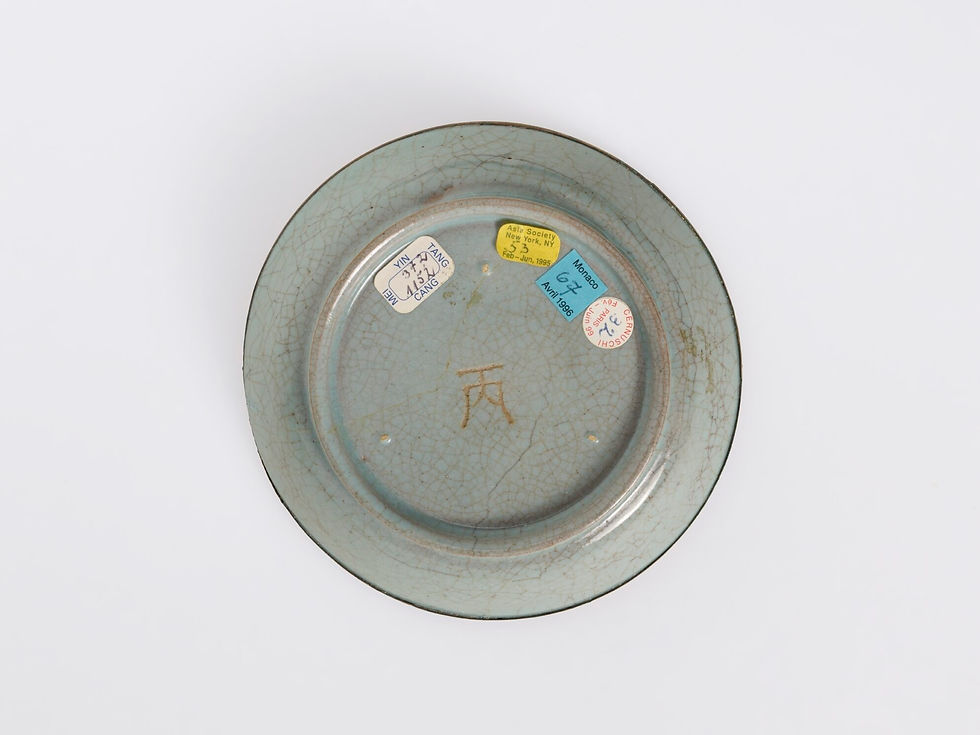
此件汝窑笔洗(Rietberg博物馆库存号 MYT 372)为一件典型北宋晚期官窑制品,直径12.8厘米,石质瓷胎,施蓝绿色裂纹釉,口沿镶金铜边(gilt-copper rim),整体器形浅圆,足部微撇,釉色清澈润泽,裂纹细密如鱼鳞或碎冰,体现了汝窑“薄胎厚釉”的经典特征。底部可见一金色“丙”字款,器底并附有多枚展览标签,记录其现代流传路径。该器物可能源于北宋宫廷,后因金兵南侵及王朝更迭而散佚民间。现代流传路径清晰:1990年于纽约Lally & Co.展览(展品号可能为相关标签所示),随后售予著名古董商Giuseppe Eskenazi(埃斯肯纳齐),最终进入瑞士Meiyintang(梅茵堂)收藏。该收藏由Zuellig兄弟(Gilbert与Stephen)于20世纪60年代起组建,专注于中国陶瓷,1994年起多次公开展览并出版多卷目录(Regina Krahl编撰)。2012年,Meiyintang基金会将包括此件在内的650余件陶瓷永久借予苏黎世Rietberg博物馆,补充其中国陶瓷部门。
底部“丙”字款的意义备受关注。该款以金色刻于釉面之下,风格简朴,可能为清代乾隆皇帝(公元1736–1795年在位)时期宫廷标记系统的一部分。乾隆嗜好古瓷,曾收藏大量汝窑(据载其藏品占传世汝窑半数以上),并在多件上刻御题诗(共183首诗于16件瓷器,其中15件为汝窑)。文献显示,乾隆在一件汝窑上题诗云:“古丙秩今最上荣”,暗示“丙”对应古时等级制度中的第三等,但于今世视为最高荣誉。该标记可能源于清宫瓷器分类(如甲、乙、丙、丁或数字1–10),用于区分品质或存放位置,与乾隆的鉴藏活动密切相关。然确切起源仍有争议:部分学者认为“丙”款可能早于乾隆,已存在于明代或更早流传中;另有观点视其为清宫独创。无论如何,此款增强了该器的历史深度,与其他传世汝窑(如台北故宫藏件)上的类似标记相呼应。
此件汝窑笔洗不仅是陶瓷工艺的巅峰代表,亦体现了中国瓷器从宫廷到国际收藏的跨时代流传,值得学者进一步通过窑址出土对比(如河南清凉寺遗址2000年发掘的中心窑区)和科学分析(如釉层微观结构)进行研究。

Ru kiln, foremost among the Five Great Kilns of the Song dynasty (Ru, Guan, Ge, Jun, Ding), is renowned for its distinctive celadon wares. Located at Qingliangsi village in Baofeng County, Henan Province (ancient Ruzhou), it primarily operated during the late Northern Song period (circa 1086–1125 CE), with production spanning only about 20–40 years, exclusively supplying imperial court wares. Ru porcelain features a fine, incense-ash gray body, thick and lustrous sky-blue glaze (often described as "the blue of the sky after rain breaking through clouds"), with intricate crackle patterns resembling fish scales or shattered ice. The glaze reportedly incorporated agate powder for its jade-like texture, and forms were simple and elegant, often emulating ancient bronzes or utilitarian vessels, reflecting the refined aesthetic of Song literati. Due to limited production and imperial exclusivity, extant Ru wares are exceedingly rare, with fewer than 90 complete pieces worldwide (Regina Krahl's 2017 tally: 87; National Palace Museum's 2015 list: 90, including fire-damaged ones), predominantly in institutions such as the National Palace Museum, Taipei (21 pieces), Palace Museum, Beijing (17), British Museum (17, including Percival David Collection), and Shanghai Museum (9). Private holdings are scarce, and provenance is crucial for authentication, given the prevalence of imitations; identification relies on body-glaze characteristics, kiln-site comparisons, and historical documentation.
This Ru kiln brush washer (Rietberg Museum inventory no. MYT 372) is a quintessential late Northern Song official ware, measuring 12.8 cm in diameter, with a stoneware body coated in bluish-green crackled glaze (celadon with black-tinted craquelure), and a gilt-copper rim mount. The form is shallow and rounded with a slightly splayed foot, the glaze clear and unctuous, with fine crackles exemplifying Ru's "thin body, thick glaze" hallmark. The base bears a gilt "bing" (丙) mark, alongside multiple exhibition labels documenting its modern transmission. Likely originating from the Northern Song imperial court, it may have dispersed during the Jurchen invasions and dynastic shifts. Its modern provenance is well-documented: exhibited at Lally & Co., New York in 1990 (possibly referenced in labels), subsequently acquired by renowned dealer Giuseppe Eskenazi, and incorporated into the Swiss Meiyintang Collection. Assembled by the Zuellig brothers (Gilbert and Stephen) from the 1960s, focusing on Chinese ceramics, the collection was exhibited internationally from 1994 and catalogued in multiple volumes by Regina Krahl. In 2012, the Meiyintang Foundation placed over 650 ceramics, including this piece, on permanent loan to Zurich's Rietberg Museum, enhancing its Chinese ceramics department. The vessel featured in key exhibitions, such as the Asia Society, New York (1995; label: 5/3, Feb-Jun 1995), Monaco (1996; label: Avril 1996), and Musée Cernuschi, Paris (1999; label: Jun-Feb T. Cernuschi). These labels corroborate literature (e.g., Eskenazi's 2012 memoir), forming the core of its ordered provenance.
The base's "bing" (丙) mark holds significant scholarly interest. Incised in gilt beneath the glaze, it likely pertains to the Qing emperor Qianlong's (r. 1736–1795) court marking system. Qianlong, an avid collector (owning over half of extant Ru wares), inscribed poems on many pieces (183 poems on 16 vessels, 15 being Ru). Documentation reveals a Qianlong poem stating: "The ancient bing rank corresponds to today's highest honors," implying "bing" aligns with a third-tier in ancient hierarchies but esteemed as supreme in modern contexts. This mark may derive from Qing palace classifications (e.g., jia, yi, bing, ding or numerals 1–10) for grading or storage. Origins remain debated: some scholars posit it predates Qianlong, existing in Ming or earlier transmissions; others view it as a Qing innovation. Nonetheless, it enhances the piece's historical profundity, echoing similar marks on other heirloom Ru wares (e.g., in Taipei's National Palace Museum).
This Ru brush washer exemplifies ceramic mastery and traces Chinese porcelain's trajectory from imperial patronage to global collecting, meriting further study via kiln-site parallels (e.g., Qingliangsi's 2000 central firing zone excavation) and scientific analysis (e.g., glaze microstructure).
汝窯洗问答 FAQ
Q1: 什么是汝窑?
A1: 汝窑是中国北宋晚期官窑,位于河南省清凉寺,以天青釉青瓷著称。烧制时间短(约20–40年),专供宫廷,胎灰白细腻,釉厚润裂纹细密,代表宋瓷巅峰。
Q2: 传世汝窑的概念是什么?
A2: 传世汝窑指未经考古发掘、通过世代流传保存至今的完整器物。全球存世不足90件,多为宫廷遗存,稀少性源于生产短暂及战乱散佚。传承有序(provenance)至关重要,包括展览、收藏记录及科学鉴定,以防伪作。
Q3: 这件汝窑笔洗(MYT 372)的流传路径如何?
A3: 产于北宋晚期,可能出自宫廷,后散佚。现代路径:1990年Lally展览售予Eskenazi,进入Meiyintang收藏,2012借予Rietberg博物馆。展览包括1985纽约亚洲协会、1996摩纳哥、1999巴黎赛努奇博物馆。
Q4: 底部“丙”字款与乾隆有何关系?
A4: “丙”款可能为乾隆时期清宫标记,用于瓷器分类(类似甲乙丙丁)。乾隆题诗提及“古丙秩今最上荣”,视其为高荣标记。该款增强历史价值,但起源或早于乾隆,与清代鉴藏密切相关。
Q5: 汝窑为何如此珍贵?
A5: 生产短暂、产量有限、宫廷专属,加上釉色独特(天青裂纹),存世稀少(不足90件)。仿制品多,需通过窑址对比(如清凉寺遗址)和微观分析(如釉泡分布)鉴定。
Q1: What is Ru kiln?
A1: Ru kiln is a Northern Song imperial kiln in Qingliangsi, Henan, famed for sky-blue celadon. Active briefly (ca. 20–40 years), it produced exclusive court wares with fine gray bodies, thick lustrous glazes, and intricate crackles, epitomizing Song ceramic excellence.
Q2: What is the concept of heirloom Ru ware?
A2: Heirloom Ru ware refers to intact pieces preserved above ground through generations, not excavated. Worldwide, fewer than 90 exist, mostly imperial relics; scarcity stems from short production and historical disruptions. Ordered provenance—exhibitions, collections, and scientific verification—is essential against fakes.
Q3: What is the transmission path of this Ru brush washer (MYT 372)?
A3: Produced in late Northern Song, likely from court; dispersed post-dynasty. Modern path: Exhibited at Lally in 1990, sold to Eskenazi, entered Meiyintang Collection, loaned to Rietberg in 2012. Exhibitions include Asia Society New York (1985), Monaco (1996), Musée Cernuschi (1999).
Q4: What is the connection between the base "bing" mark and Qianlong?
A4: The "bing" (丙) mark likely ties to Qianlong's Qing court classification system (e.g., jia, yi, bing, ding). His poem notes: "The ancient bing rank corresponds to today's highest honors," elevating it. It adds historical depth, though origins may predate Qianlong, linked to Qing connoisseurship.
Q5: Why is Ru ware so precious?
A5: Brief production, limited output, imperial exclusivity, and unique glaze (sky-blue with crackles) make it rare (under 90 pieces). Forgeries abound, requiring kiln-site comparisons (e.g., Qingliangsi) and microstructural analysis (e.g., glaze bubbles) for authentication.
器物基本資料 / Basic Information of the Object
器物名稱:汝窑筆洗
英文名稱:Ru kiln brush washer
類型:官窑(Guan ware)汝窑青瓷筆洗
時代:北宋晚期(晚11世紀至早12世紀) / Late Northern Song dynasty (late 11th – early 12th century)
產地:中國河南省寶豐縣清涼寺汝窑(Ru kilns, Qingliangsi, Baofeng County, Henan Province, China)
材質與技法:香灰胎石質瓷,施藍綠色(天青)厚釉,表面佈滿細密黑色調冰裂紋(craquelé glaze with black-tinted crackle),口沿鑲金銅邊(gilt-copper rim mount)
尺寸:直徑 12.8 cm
重量:未詳(典型汝窑筆洗輕盈)
底部標記:金色「丙」字款(gilt "丙" mark)
庫存號:MYT 372
收藏單位:蘇黎世Rietberg博物館(Museum Rietberg, Zurich)
入藏方式:2012年起由Meiyintang基金會(Meiyintang Foundation)永久借展(Dauerleihgabe Meiyintang Stiftung)
展覽與標籤記錄(部分):
1985年2月–6月:紐約亞洲協會(Asia Society, New York)
1996年4月:摩納哥(Monaco)
1999年2月–6月:巴黎賽努奇博物館(Musée Cernuschi, Paris)
其他:1990年Lally展覽,後經Giuseppe Eskenazi售予Meiyintang收藏
傳世狀況:完整,釉面裂紋自然,口沿金銅邊為後加裝(可能清代或更晚修復),整體保存極佳
參考文獻:Regina Krahl相關Meiyintang目錄;Giuseppe Eskenazi回憶錄(2012);Rietberg博物館官方記錄
Object Name:Ru kiln brush washer
Chinese Name:汝窑筆洗
Type:Imperial Ru guan ware celadon brush washer
Period:Late Northern Song dynasty (late 11th – early 12th century)
Production Site:Ru kilns, Qingliangsi, Baofeng County, Henan Province, China
Material and Technique:Porcelaneous stoneware with incense-ash grey body, thick bluish-green (sky-blue) glaze with fine black-tinted craquelure (ice-crackle pattern), gilt-copper rim mount on the mouth
Dimensions:Diameter 12.8 cm
Weight:Not specified (typical Ru brush washers are lightweight)
Base Mark:Gilt "丙" (bing) character mark
Inventory Number:MYT 372
Current Collection:Museum Rietberg, Zurich
Acquisition/Loan:Permanent loan from the Meiyintang Foundation since 2012 (Dauerleihgabe Meiyintang Stiftung)
Exhibition and Label Records (selected):
February–June 1985: Asia Society, New York
April 1996: Monaco
February–June 1999: Musée Cernuschi, Paris
Others: Exhibited at Lally & Co., New York in 1990; subsequently acquired by Giuseppe Eskenazi and entered Meiyintang Collection
Condition:Intact, with natural crackle in glaze; gilt-copper rim likely a later addition (possibly Qing dynasty or later restoration); excellent overall preservation
References:Regina Krahl's catalogues on Meiyintang Collection; Giuseppe Eskenazi memoir (2012); Museum Rietberg official records


Comments