
拍賣筆記 vol.444 蘇富比紐約2026:21760美元售出,唐三彩灑藍三足爐,壺中居 - Sotheby’s New York 2026, A Blue-Splashed Pottery Tripod Censer, Tang Dynasty, Sold for US$21,760

Updated: Sep 17

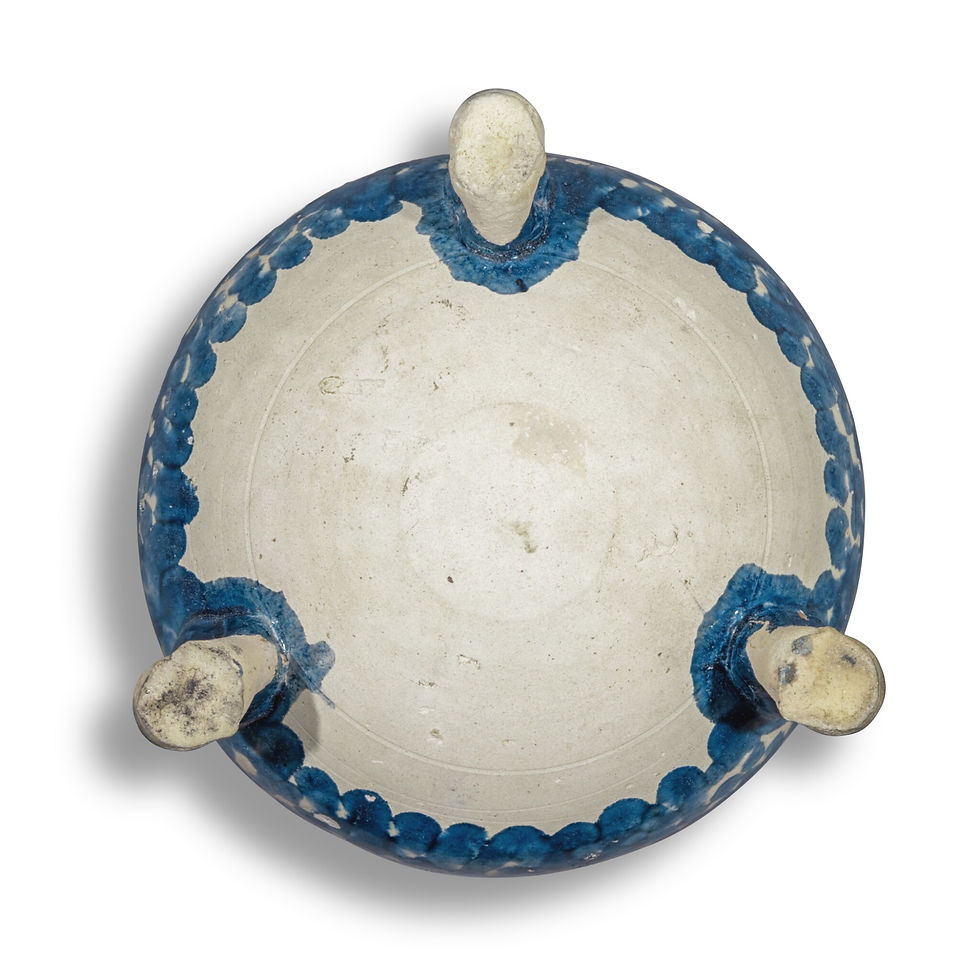
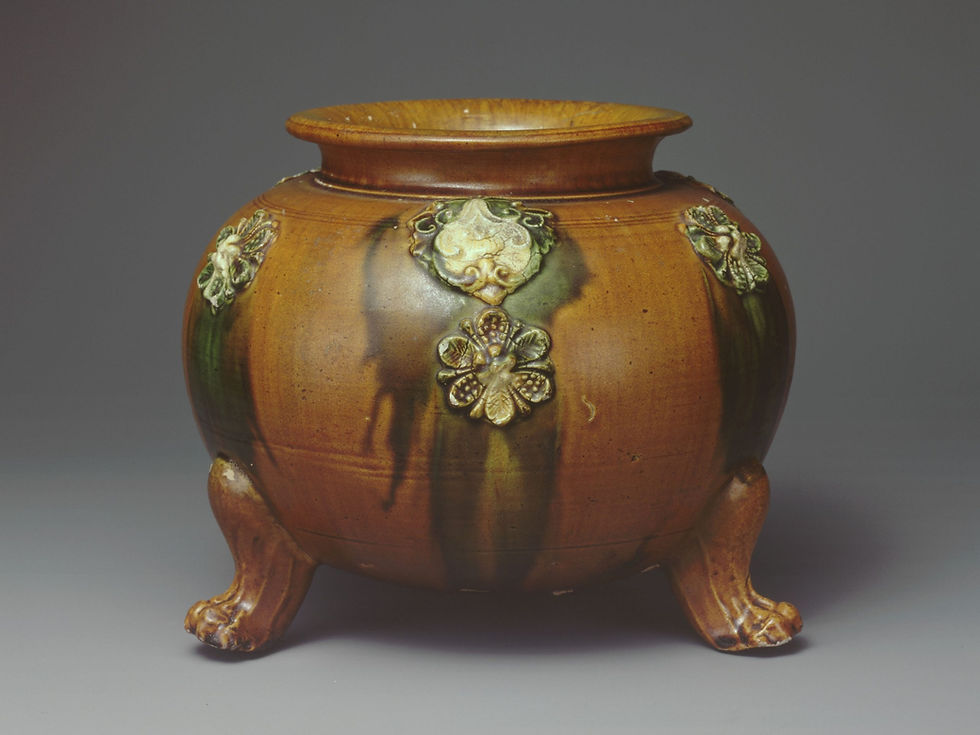
唐三彩灑藍三足爐。寬15.6公分。金屬蓋。蘇富比紐約,2026年9月16日。估價5,000–7,000美元。來源:東京壺中居;紐約懷古堂,2000年。著錄:《Kaikodo Journal》,2000年秋,編號65。牛津熱釋光 C100q85,與斷代相符。品相整體良好,散見剝釉,經小補。器作斂口、短頸、鼓腹,下承三獸足,即文獻與收藏習慣所稱三足鍑、三足爐。黃釉為地,腹壁灑鈷藍。15.6公分屬中型。蓋為後配金屬蓋,不計入唐代原器。
SACA觀察
來自壺中居,懷古堂的收藏,尺寸算中等尺寸,品相基本沒有問題。出版、牛津測試都有,也是一個加分。壺中居在蘇富比岡田博物館名氣有所提升,從之前的日本傳統古董商到進入國際市場認知。
唐代此式見於三彩、單色釉、滑石、響銅,源出金銀銅鍑。SACA《唐代筆記 vol.27》哈佛響銅三足爐、《三彩筆記 vol.16》河南博物院鞏義黃冶窯貼花三足爐,都是同一器類。藍釉是這件的級別所在。鈷料來自波斯,貴於常釉;「三彩掛藍,價值連城」。(2026.09.10)
拍賣結果:17萬港元售出仍然在非常低的價格,這件器物拍到時凌晨4點左右,相信是低價的部分原因,主要買家在亞洲的情況下,難以理解送拍美國的必要性。(2026.09.17)



參見王秋生〈唐三彩褐釉鍑:器物中的「景色」之美〉(《財新mini+》,2026年3月20日)所寫,是繭山龍泉堂舊藏、2017年東京《大唐展》第62號的袖珍褐釉三足鍑,高5公分、寬6公分。弦紋、薄胎,明顯仿金銀鍑。文中並及安思遠書案後那件同尺度豹斑石小鍑。兩件都是掌中弄器。本件15.6公分是中型實用器,不是袖珍。
可資比對者:
佳士得香港2016年10月4日 Pavilion Sale: Dexinshuwu 舊藏灑藍三彩筒式三足爐,通高16公分,曾展臺北歷史博物館1995年唐三彩特展,成交237,500港元(約30,800美元)。
同場另有一例通高22公分。佳士得倫敦2019年1月29日 Interiors:灑藍三足爐,徑18.5公分,成交3,500英鎊。
關於經手
壺中居(Kochukyo),1924年廣田松繁、西山保創於神田喜雀苑,1948年改株式會社,遷日本橋。屋號取「壺中之天」。長期經手中日韓古陶瓷,作風是日本傳統商號:前手常被抹去,只留本店。岡田專場之後,這個名字開始在蘇富比英文圖錄裡反覆出現,國際認知被抬了一層。懷古堂(Kaikodo),紐約,Howard Rogers。《Kaikodo Journal》2000年秋《In the Eye of the Beholder》編號65,是本件離開東京之後的第一份西文著錄。
唐 三彩灑藍三足爐(三足鍑)
年代:唐(618–907)
尺寸:寬15.6 cm(6⅛ in.)
配件:金屬蓋(2)
估價:5,000–7,000美元
品相:整體良好,散見剝釉,經小補
來源:壺中居,東京;懷古堂,紐約,2000年
出版:《Kaikodo Journal》,2000年秋,編號65
檢測:Oxford Authentication Ltd.,C100q85
拍賣:蘇富比紐約,2026年9月16日
FAQ
Q1:三足爐與三足鍑如何區分?
同一器類。鍑本是銅、銀食器與焚香器,陶瓷、滑石仿其形。稱爐是功能,稱鍑是器形。本件與繭山袖珍褐釉鍑、哈佛響銅鍑同型。
Q2:灑藍比滿藍差多少?
滿藍或藍地貼花,見於高等級墓與鞏義窯精品,公開價可輕鬆過三十萬港元。岡田專場之前,多被看成日本內部流通。專場之後,圖錄裡的 Kochukyo 已是可被國際盤點的來源。本件再加懷古堂2000年出版,手續完整。5,000–7,000美元仍偏低。
Q4:金屬蓋如何看?
後配,日本與紐約舊藏常見。不計入原器,亦不大幅減分。看的是器身釉與足。
A blue-splashed pottery tripod censer, Tang dynasty. Width 6⅛ in. (15.6 cm). Metal cover. Sotheby’s New York, 16 September 2026. Estimate US$5,000–7,000. Provenance: Kochukyo, Tokyo; Kaikodo, New York, 2000. Published: Kaikodo Journal, Autumn 2000, no. 65. Oxford Authentication TL no. C100q85, consistent with the dating. Condition: good overall, scattered glaze flakes with touch-ups.
The vessel has a contracted mouth, short neck and swelling body on three beast-mask feet—the form called a tripod fu or tripod censer. Straw-amber glaze on the body, cobalt splashed on the wall. At 15.6 cm it is a mid-size example. The metal cover is later and is not part of the Tang object.
SACA Observation
Provenance is the first sentence. Kochukyo, Tokyo; Kaikodo, New York, 2000, and no. 65 in the autumn Kaikodo Journal. Kochukyo was founded in Kanda in 1924 and later moved to Nihonbashi. It was a Tokyo house of the old kind. Recent Sotheby’s sales from the Okada Museum—the Jin white-rimmed tenmoku, the fifteenth-century scholars’ jar, the Spring and Autumn ding—have moved the name from domestic Japanese circulation into the fixed field of an international catalogue. This censer is not an Okada object. It carries the same invoice. The recognition has already been lifted. Kaikodo’s 2000 publication and the Oxford test are, in a day sale, an unusually complete file.
The form is a tripod fu, not merely an incense burner. The type exists in sancai, monochrome glaze, soapstone and bronze, and follows silver and bronze fu. SACA Tang Notes vol. 27, the Harvard silvered-bronze tripod, and Sancai Notes vol. 16, the Henan Museum applied-relief censer from Huangye, Gongyi, belong to the same class. Blue is what ranks this piece. Cobalt came from Persia and cost more than the common glazes. ‘Sancai with blue holds its price’ is not a slogan; it is the scarcity of blue at Huangye. This is not a full blue vessel. It is amber ground with blue splashes: a step below the applied-relief blue censers, a step above the amber-and-green tripods with no cobalt.
Wang Qiusheng, ‘唐三彩褐釉鍑:器物中的「景色」之美’ (Caixin mini+, 20 March 2026, https://mini.caixin.com/2026-03-20/102424988.html), publishes a miniature brown-glazed tripod fu from Mayuyama Ryusendo, no. 62 in the Tokyo Da Tang exhibition of 2017: 5 cm high, 6 cm wide. String-cut bands and a thin body, after metal. The same essay notes Ellsworth’s leopard-spot stone fu of the same scale, kept behind the desk. Both are objects for the hand. The present censer, at 15.6 cm, is a mid-size vessel of use, not a miniature. The comparison is of class, not of size: brown glaze is read as keiki, blue splash as cobalt. Both are tripod fu. The market still files them as small Tang sancai burners.
Christie’s Hong Kong, 4 October 2016, the Pavilion Sale: a blue-splashed sancai cylindrical tripod censer from Dexinshuwu, 16 cm overall, shown at the National Museum of History, Taipei, 1995, sold for HK$237,500 (c. US$30,800).
Condition: flakes touched in, common in a day sale. The question is whether the fills sit on the rim or on the blue. Blue painted out is more serious than loss at the lip. Fifteen centimetres is neither monumental nor a toy. Mid-size, blue-splashed, papers in order: that is the position of this lot.
On the trade
Kochukyo was founded in 1924 in Kanda by Hirota Matsushige and Nishiyama Tamotsu, re-formed as a company in 1948, and moved to Nihonbashi. The name is taken from the Hou Han shu anecdote of the world inside a jar. The house has long dealt in Chinese, Korean and Japanese ceramics, in the old Tokyo manner: earlier names are often dropped, the shop remains. After the Okada sales, Kochukyo is a name the international catalogue can count. Kaikodo, New York, Howard Rogers. Kaikodo Journal, Autumn 2000, In the Eye of the Beholder, no. 65, is the first Western publication after the piece left Tokyo.
FAQ
Q1: Censer or fu?
The same class. Fu is the bronze and silver vessel; ceramic and soapstone copy the form. ‘Censer’ is use; ‘fu’ is shape. This lot stands with the Mayuyama miniature and the Harvard bronze.
Q2: Splash versus full blue?
Full blue and blue-ground applied relief belong to high tombs and to the best of Huangye; published prices can pass HK$300,000. Amber ground with blue splash is cobalt used with restraint. It is still the blue system. An estimate written for a censer with no blue does not price the pigment.
Q3: How is Kochukyo counted now?
Before the Okada sales it was read as Japanese internal trade. After those catalogues, Kochukyo is a source the international market can list. This lot adds Kaikodo 2000. US$5,000–7,000 is still a day-sale number for an object without a name.
Q4: The metal cover?
Later, and common in Japanese and New York collections. It is not part of the Tang vessel and does not weigh heavily. The glaze and the feet do.
Title: A blue-splashed pottery tripod censer, Tang dynasty
Date: Tang dynasty (618–907)
Dimensions: Width 6⅛ in., 15.6 cm
Accessories: metal cover (2)
Estimate: US$5,000–7,000
Condition: good overall; scattered glaze flakes with touch-ups
Provenance: Kochukyo, Tokyo; Kaikodo, New York, 2000
Published: Kaikodo Journal, Autumn 2000, no. 65
TL: Oxford Authentication Ltd., C100q85
Auction: Sotheby’s New York, 16 September 2026
SACA學會相關筆記 / SACA Notes
三彩筆記 vol.16 河南省博物館:三彩貼花爐 https://www.artsaca.com/post/sancai16
唐代筆記 vol.27 哈佛大學博物館:唐代響銅三足爐(鍑) https://www.artsaca.com/post/tang27
拍賣筆記 vol.437 蘇富比香港:金代黑釉白覆輪天目,壺中居、岡田
拍賣筆記 vol.424 蘇富比香港:東周蟠虺紋鼎,壺中居、岡田 https://www.artsaca.com/post/auction424
參考文獻 / References
王秋生,〈唐三彩褐釉鍑:器物中的「景色」之美〉,《財新mini+》,2026年3月20日。繭山龍泉堂,《大唐展》,2017,編號62。高5 cm,寬6 cm。
王秋生,〈安思遠珍藏唐代豹斑石三足鍑〉,《財新mini+》。https://mini.caixin.com/2026-05-03/102440483.html
Kaikodo Journal, Autumn 2000 (In the Eye of the Beholder), no. 65.
Christie's Hong Kong, 4 October 2016. A blue-splashed sancai cylindrical tripod censer, 16 cm overall. Dexinshuwu; National Museum of History, Taipei, 1995. Sold HK$237,500. https://www.christies.com/en/stories/tang-dynasty-sancai-cc7bff939a824b86a735715b4ac2f09e
Christie’s London, 29 January 2019, lot 2. A sancai-glazed blue-splashed pottery tripod censer, 18.5 cm diam. Sold £3,500.
Sotheby’s New York, 16 December 2025, lot 22. A sancai-glazed pottery tripod censer (no blue), 22.5 cm diam. Sold US$4,826.
SACA,《三彩筆記 vol.16》。https://www.artsaca.com/post/sancai16
SACA,《唐代筆記 vol.27》。https://www.artsaca.com/post/tang27
蘇富比資料:
唐三彩灑藍三足爐
A blue-splashed pottery tripod censer, Tang dynasty
Live auction begins on:
September 16, 09:00 PM HKT
Estimate
5,000 - 7,000 USD
Description
metal cover (2)
Width 6⅛ in., 15.6 cm
Condition Report
Overall good condition, with scattered glaze flakes with touch-ups.
整體品相良好,散見剝釉,經小補。
Provenance
Kochukyo, Tokyo.
Kaikodo, New York, 2000.
Exhibited
Kaikodo Journal, Kaikodo, New York, 2000, autumn, cat. no. 65.
Catalogue Note
The dating of this lot is consistent with the results of Oxford Authentication Ltd. thermoluminescence test no. C100q85.


Comments