
拍賣筆記 vol.441 蘇富比紐約2026:南宋吉州窰黑釉剔梅花圖長頸瓶,瓊肯三世舊藏 - Sotheby’s New York 2026, A ‘Jizhou’ ‘Prunus’ Bottle Vase, Southern Song Dynasty, The Junkunc Collection
- SACA

- 2 days ago
- 9 min read

南宋吉州窰黑釉剔梅花圖長頸瓶。高18公分。蘇富比紐約,2026年9月16日。估價4,000–6,000美元。史蒂芬·瓊肯三世舊藏。器作小口、長頸、鼓腹、淺圈足。通體施黑褐釉,梅枝以剪紙漏花露胎寫出主幹,細枝剔劃,花蕊點彩。品相:圈足約三分之一缺失,缺口覆釉,底部因而略不平;器面通體見磨損,並經清潔與拋光。
SACA觀察
本件應置於南宋看梅的視覺傳統中理解。馬遠《月下賞梅圖》(大都會藝術博物館,1986.493.2)所繪並非滿樹繁花,而是一株、一月、一童子、一文人。疏影、冷香、月色,是這一時期文人觀看梅花的基本距離。吉州窰在江西吉安永和鎮,面對青原山,地處南宗禪影響所及。茶、梅與黑釉在同一地域內形成完整的器用語言。梅花於吉州窰並非點綴,而是貫穿盞、瓶、爐、壺的主體紋樣:茶碗內裝飾梅花,瓶腹為一枝梅,爐與執壺多為折枝。

王秋生《宋代梅花天目茶碗》(《財新》,2024年10月24日)對這一系統有專門討論。文中指出,盞心六瓣梅出自剪紙對折:對折最易得到放射對稱的六瓣,故其母題為梅,而非泛稱之花卉。本件長頸瓶所採用的工序與梅花天目盞相同,差異僅在紋樣由盞心轉至瓶腹。日本國寶應作為同一技術系統的參照,而非價格參照。相國寺承天閣美術館所藏南宋吉州窰玳玻散花文天目,松平不昧舊藏,後經萬野美術館,現為日本國寶。SACA《茶碗筆記 vol.05》記其於安永年間由河內屋宗海經手、以銀一百五十兩歸不昧,內箱有不昧手書。散花為玳玻釉地上的對折團花,與梅花天目紋樣不同,而剪紙與黑釉技術同源。一者進入日本茶道名物譜系,一者仍屬於中國梅花詩畫傳統。
長頸小口瓶為宋代書齋核心器形之一。南宋官窰、定窰、鈞窰、龍泉窰、磁州窰均有燒造,功能為插花,尤宜一枝梅。此器形並非某一窯口之專屬,而是南宋文人空間的基本器用。本件高18公分,尺度合於案頭。圈足缺失三分之一,故不得以完整器行情直接比附;瓊肯舊藏,亦不得以無來源民窰處理。現估4,000–6,000美元,所反映的是足傷之後紐約日場的定價,而非吉州梅花系統在陶瓷史上的位置。低估價吸引競投,確保成交率,製造市場熱度的手法是近年來拍賣行常用的手法。
可資比對的公開成交如下。佳士得紐約2023年3月23日拍品850:藍理捷舊藏吉州剪紙梅花長頸瓶一對,高20.3公分,成交25,200美元。佳士得紐約2009年3月18日拍品331:同形約18公分,成交16,250美元。蘇富比紐約2015年拍品170:兩件,估價6,000–8,000美元,口沿經修。完整且來源清楚的18至20公分之例,已脫離四千美元這一價格區間。吉州窯的最高紀錄曾拍過將近千萬港元,來自臨宇山人的舊藏,來源是千家的中興之祖千宗旦,與此類有差別。
關於藏家
史蒂芬·瓊肯三世(約1905–1978),居伊利諾伊州Oak Park。收藏主要形成於1940至1960年代,盛時逾兩千件,涵蓋瓷器、玉器、青銅、佛像與書畫,並包括兩件汝窰。其中一件汝盤1941年購自盧芹齋,1992年於紐約以160萬美元成交,創當時中國陶瓷拍賣紀錄,後歸劉鑾雄。部分藏品曾置於宅邸地下掩體。瓊肯與芝加哥藝術博物館保持長期借展關係。
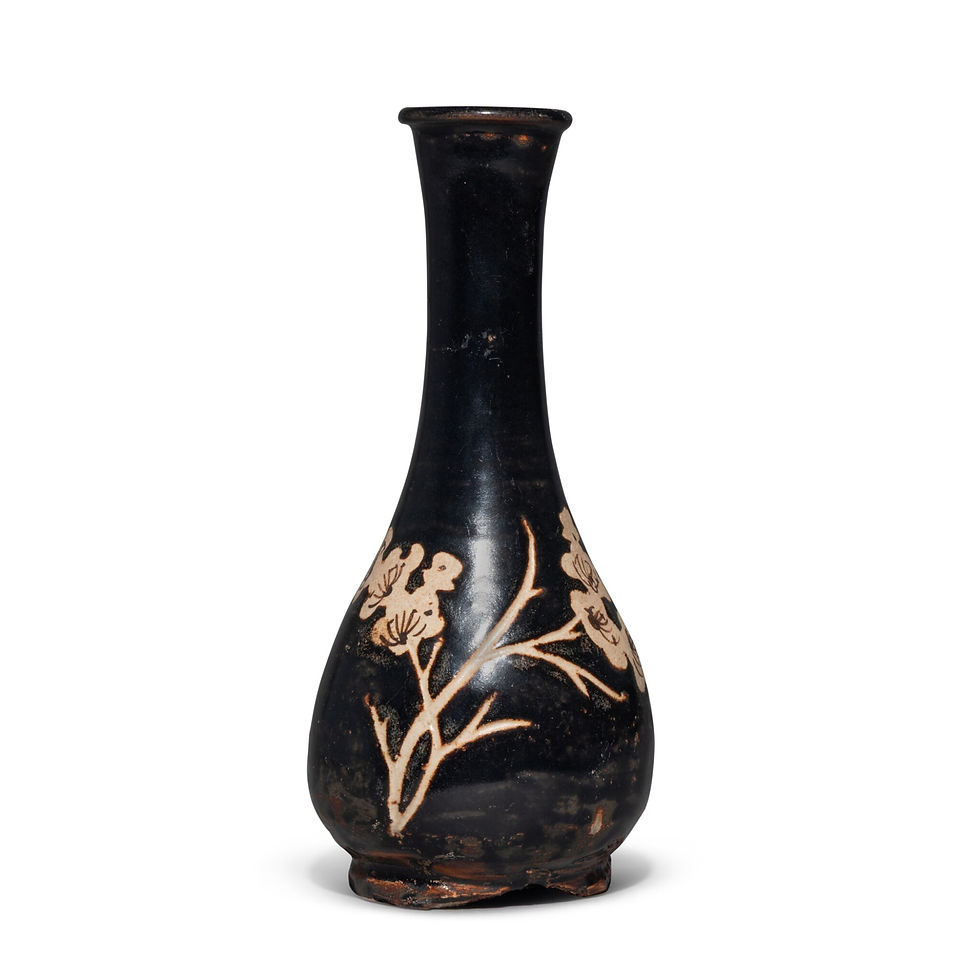


吉州窰黑釉剔梅花圖長頸瓶
年代:南宋(1127–1279)
尺寸:高18 cm(7⅛ in.)
估價:4,000–6,000美元
品相:圈足約三分之一缺失並被釉覆蓋,底略不平;表面磨損,曾經清潔拋光
來源:史蒂芬·瓊肯三世(1978年卒)收藏
拍賣:蘇富比紐約,2026年9月16日
FAQ
Q1:如何確認瓶上紋樣為梅花?
吉州盞心放射狀花瓣源於剪紙對折。本件瓶腹為一枝梅:主幹漏花、細枝剔劃、花蕊點彩,與文獻所稱「一枝梅」工序相符。不宜定為泛稱花卉。
Q2:本件與國寶散花天目應如何並置?
二者同窯、同時,並使用同一套剪紙與黑釉技術。一為茶碗,進入日本名物系統;一為長頸瓶,屬於中國梅花觀看傳統。二者不可作價格換算,但必須作為同一技術系統書寫。
Q3:長頸瓶在宋代器用中的位置如何?
長頸小口是南宋書齋的基本器形,官、定、鈞、龍泉、磁州與吉州均有製作。其功能為插花。吉州以黑地露胎表現一枝梅,是將繪畫中的觀看方式落實為可把握的器物。
Q4:圈足缺失三分之一,應如何判斷?
須核實缺口是否為舊傷、覆釉是否與胎釉一體、頸口是否另有修補。2023年完整對瓶已成交25,200美元。現估價是在為足傷計價,而不是為吉州梅花系統計價。


A ‘Jizhou’ ‘prunus’ bottle vase, Southern Song dynasty. Height 18 cm. Sotheby’s New York, 16 September 2026. Estimate US$4,000–6,000. Collection of Stephen Junkunc, III.
The vessel has a small mouth, long neck, swelling body and low foot. A dark brown-black glaze covers the exterior. The prunus is reserved in the biscuit by paper-cut resist, with incised twigs and painted stamens. The type belongs to the Jizhou ‘one-branch plum’ group, which also includes meiping, censers and ewers. Condition: approximately one third of the footring is missing and the loss is covered with glaze, leaving the base slightly uneven; the surface shows wear and has been cleaned and polished. The damage to the foot is structural and should not be treated as ordinary crackle.
SACA Observation
The vase is best read within the Southern Song practice of looking at plum. Ma Yuan’s Viewing Plum Blossoms by Moonlight (Metropolitan Museum of Art, 1986.493.2) does not present a tree in full bloom, but a single branch, a pavilion and the moon. Sparse shadow, cold scent and moonlight define the period’s distance from the subject. The Jizhou kilns at Yonghe, Ji’an, faced Qingyuan Mountain, in a region shaped by Southern Chan. Tea, plum and black glaze formed one language of use. At Jizhou, plum is not incidental ornament. It is the principal motif across bowls, bottles, censers and ewers: florets in the well, a single branch on the bottle, sprays on the censer.
Wang Qiusheng’s essay ‘宋代梅花天目茶碗’ (Caixin, 24 October 2024) remains the most direct account of this system. The six-petal floret in the tea bowl, he argued, is the form that folded paper resist produces most economically; the subject is therefore plum, not an unspecified flower. The present bottle employs the same sequence of work, transferred from the well of a bowl to the wall of a vase.
The Japanese national treasure belongs in the same technical account, not in the same price scale. The tortoiseshell-glazed ‘scattered flower’ tenmoku in the Shōkoku-ji Shōtenkaku Museum, formerly in the collection of Matsudaira Fumai and later the Manno Museum, is designated a National Treasure. SACA Tea Bowl Notes vol. 05 records its purchase in the An’ei era through Kawachiya Sōkai for 150 silver ryō; the inner box is inscribed in Fumai’s hand. The scattered florets are folded paper-cuts on a tortoiseshell ground. The pattern differs from plum tenmoku; the paper resist and dark glaze do not. One object entered the Japanese meibutsu registers; the other remains within the Chinese tradition of plum poetry and painting. To catalogue the present vase merely as a small black-glazed bottle is to omit that connection.
The long-necked bottle is a core form of the Song scholar’s table. It was produced at the Guan, Ding, Jun, Longquan and Cizhou kilns as well as at Jizhou, and was used to hold a flower, often a single plum spray. The shape is not the property of one kiln. It is a basic utensil of Southern Song interior space. Jizhou’s reserved blossom on a black ground stands closer to Ma Yuan’s single branch than carved decoration under celadon. At 18 cm the vase is a desk object. Because one third of the foot is lost, prices for complete examples cannot be applied directly; because the vase is from Junkunc, prices for unprovenanced provincial ware are equally inapplicable. The estimate of US$4,000–6,000 records a New York day-sale valuation after the damage. It does not measure the historical position of the Jizhou plum system.
Published results that correspond in form and scale are as follows. Christie’s New York, 23 March 2023, lot 850: a pair of Jizhou resist-decorated prunus bottles from J. J. Lally, 20.3 cm, sold for US$25,200. Christie’s New York, 18 March 2009, lot 331: the same form, approximately 18 cm, sold for US$16,250. Sotheby’s New York, 2015, lot 170: two bottles, estimate US$6,000–8,000, with restored rims. Complete examples of 18 to 20 cm with established provenance have already left the four-thousand-dollar range.
On the collector
Stephen Junkunc, III (c. 1905–1978) lived in Oak Park, Illinois. The collection was formed principally in the 1940s and 1960s and, at its height, numbered more than two thousand works in porcelain, jade, bronze, Buddhist sculpture and painting, including two Ru dishes. One Ru dish, acquired from C. T. Loo in 1941, sold in New York in 1992 for US$1.6 million, then a world record for Chinese ceramics, and later entered the collection of Au Bak Ling. Part of the collection was stored in a bunker on the grounds of the house. Junkunc maintained a long lending relationship with the Art Institute of Chicago. The Junkunc name constitutes accumulated provenance. It does not confer the status of imperial ware. The present vase indicates that the collection also included regional Southern Song wares that most clearly register the taste of the period.
FAQ
Q1: How is the decoration identified as plum?
The radial florets on Jizhou bowls derive from folded paper resist. The decoration on this bottle is a single branch: resist for the main stem, incision for the twigs, painted stamens. The sequence corresponds to the so-called ‘one-branch plum’. It should not be described as generic floral ornament.
Q2: How should the vase be placed beside the national-treasure bowl?
They were made in the same kilns, in the same period, with the same paper-cut and dark-glaze technique. One is a tea bowl that entered the Japanese meibutsu system; the other is a long-necked bottle that remains within the Chinese tradition of viewing plum. Their prices are not interchangeable. They belong to one technical account.
Q3: What is the place of the long-necked bottle in Song use?
It is a basic vessel of the Southern Song study, produced at Guan, Ding, Jun, Longquan, Cizhou and Jizhou, and used for flowers. Jizhou’s black ground and reserved blossom translate a pictorial convention into an object that can be held.
Q4: How should the loss of one third of the foot be judged?
It is necessary to establish whether the break is old, whether the glaze over the loss is integral, and whether the neck has further restoration. A complete pair sold for US$25,200 in 2023. The present estimate prices the damaged foot. It does not price the Jizhou plum system.
Title: A ‘Jizhou’ ‘prunus’ bottle vase, Southern Song dynasty
Date: Southern Song dynasty (1127–1279)
Dimensions: Height 7⅛ in., 18 cm
Estimate: US$4,000–6,000
Condition: approximately one third of the footring missing and glazed over; base slightly uneven; cleaned and polished
Provenance: Collection of Stephen Junkunc, III (d. 1978)
Auction: Sotheby’s New York, 16 September 2026
SACA學會相關筆記 / SACA Notes
茶碗筆記 vol.05 相國寺:國寶散花天目茶碗,南宋吉州窯、松平不昧舊藏
宋代筆記 vol.75 三井家中興名物南宋吉州窯鸞天目
拍賣筆記 vol.188 蘇富比香港:南宋吉州窰黑釉木葉天目茶盞
茶碗筆記 vol.06 大都會博物館:南宋吉州窯木葉天目茶碗
參考文獻 / References
王秋生,〈宋代梅花天目茶碗〉,《財新mini+》,2024年10月24日。https://mini.caixin.com/m/2024-10-24/102248985.html
顧力,〈就《宋代梅花天目茶碗》一文與王秋生先生商榷〉,《財新mini+》,2024年10月25日。https://mini.caixin.com/m/2024-10-25/102249274.html
王秋生,〈答顧力先生關於《宋代梅花天目茶碗》的一些疑問〉,《財新mini+》,2024年10月26日。https://mini.caixin.com/m/2024-10-26/102249661.html
Ma Yuan, Viewing Plum Blossoms by Moonlight, The Metropolitan Museum of Art, 1986.493.2. https://www.metmuseum.org/art/collection/search/44638
SACA,《茶碗筆記 vol.05》。https://www.artsaca.com/post/chawan05
Robert D. Mowry, Hare’s Fur, Tortoiseshell, and Partridge Feathers: Chinese Brown- and Black-Glazed Ceramics, 400–1400, Cambridge, 1996, no. 102.
Christie’s New York, 23 March 2023, lot 850. A pair of Jizhou resist-decorated ‘prunus’ bottle vases, each 20.3 cm. Provenance: J. J. Lally & Co. Sold US$25,200.
Christie’s New York, 18 March 2009, lot 331. A small Jizhou painted pear-shaped vase, c. 18 cm. Sold US$16,250.
Sotheby’s New York, 2015, lot 170. Two Jizhou ‘prunus’ bottle vases. Estimate US$6,000–8,000. https://www.sothebys.com/en/auctions/ecatalogue/2015/chinese-works-of-art-n09317/lot.170.html
Sotheby’s, ‘The Untold Story of Stephen Junkunc III’. https://www.sothebys.com/en/articles/the-untold-story-of-stephen-junkunc-iii-one-of-the-great-chinese-art-collectors
蘇富比資料:
PROPERTY FROM THE JUNKUNC COLLECTION
南宋 吉州窰黑釉剔梅花圖長頸瓶
現場拍賣開始:
September 16, 09:00 PM HKT
估價
4,000 - 6,000 USD
出處
史蒂芬•瓊肯三世(1978年逝)收藏
PROPERTY FROM THE JUNKUNC COLLECTION
A 'Jizhou' 'prunus' bottle vase, Southern Song dynasty
Live auction begins on:
September 16, 09:00 PM HKT
Estimate
4,000 - 6,000 USD
Description
Height 7⅛ in., 18 cm
Condition Report
The vase with visible potting and glaze flaws around the foot with 1/3 of the foot ring missing and glazed over causing the base to be slightly uneven. The surface with wear overall, cleaned and polished and with characteristic minor imperfections.
瓶足部可見製作及釉面瑕疵,包括圈足約三分之一缺失並被釉覆蓋,致使底部略微不平。表面整體見輕微磨損,經清潔及拋光處理,見正常細微瑕疵。
Provenance
Collection of Stephen Junkunc, III (d. 1978).


Comments