
拍賣筆記 vol.326 蘇富比紐約2026:810萬港元售出,普利茲克藏唐三彩黑釉飲水馬 - Sotheby’s NY 2026, A Black Bowing Horse, Tang Dynasty, Pritzker Collection, Sold for US$1.0368m

Updated: Mar 26

810萬港元(103.68萬美元)售出。傳承顯赫,來自Hyatt集團的家族Pritzker普利茲克的收藏(Jay & Cindy Pritzker),也就是Tom Pritzker的父母。非常可惜建築界自從I.M.Pei去世之後就沒有真正懂中國藝術的建築師收藏家,因此對這個普利茲克獎的傳承也沒有太多人有加分的概念,實際上,拋開Hyatt集團,Eskenazi的傳承 + 罕見程度已經足以讓其價格翻倍。
這件馬經Eskenazi售予Pritzker家族時的售價就已經高達100萬美元,而如今僅以同價格售出,實屬撿漏。正直巴塞爾香港西方當代藝術熱鬧的期間,中國古代藝術的保衛戰也在紐約打響。預估成交應該在1000-2000萬港元,但影響成交的主要原因除了缺乏有文化的收藏家之外,品像釉面較乾燥也可能是其中原因之一。考慮到存世量僅有不到10匹,並沒有可以挑剔太多的餘地,總體還是以非常低的價格購入。
2026.3.26 拍後更新。
This piece sold for HK$8.1 million (US$1.0368 million). It carries an illustrious provenance from the collection of Jay and Cindy Pritzker of the Hyatt Group family—specifically, the parents of Tom Pritzker. It is regrettable that, since the passing of I.M. Pei, the architectural world has lacked genuine collector-connoisseurs who truly understand Chinese art. As a result, few people today appreciate the added value brought by this connection to the Pritzker Prize provenance.
In reality, setting aside the Hyatt Group connection, the piece’s provenance through Eskenazi combined with its extreme rarity would have been sufficient to easily double its price.
When this horse was originally sold by Eskenazi to the Pritzker family, the price was already as high as US$1 million. Today, it has changed hands again at essentially the same price level—an absolute bargain. While the Western contemporary art scene was buzzing at Art Basel Hong Kong, a quiet but determined “defense” of Chinese ancient art was unfolding in New York.
The pre-sale estimate had been in the region of HK$10–20 million. The main factors suppressing the final result, apart from the absence of culturally attuned collectors, likely included the somewhat dry appearance of the glaze surface. Given that fewer than ten examples of this type are known to survive worldwide, there is little room for excessive criticism. Overall, this was acquired at a remarkably low price.
拍前分析:
2026年紐約亞洲藝術周,紐約拍賣最重要的一件器物無疑是這件普利茲克收藏唐三彩黑釉飲水馬,傳承來自埃斯肯納齊(Giuseppe Eskenazi),出版在其經眼錄中。黑釉低頭啃蹄、飲水狀的馬本身存世量就不多,黑色的尤其少。
這一匹三彩馬的拍賣成交價格將會影響整個唐三彩在2026以及未來幾年的走勢。懸念依然很大,西方藏家對中國藝術近年來逐漸疲態,而中國藏家生力軍們認知程度又仍有相當大的距離,交棒並不容易。
文化自信和宣傳需要人人參與,但目前此類偉大的理想主義仍然停留在理想主義狀態,大部分的華人藏家依然是以保值、增值、投資的理念,將藝術品當作一個金融產品在操盤,初心感蕩然無存,令人唏噓。中國藝術回歸世界舞台仍然路漫漫,其修遠兮。

Chinese Art
Live Sale 25 March 2026|09:30 EDT
New York
唐三彩黑釉飲水馬
Length 29½ in., 75 cm
預估:400,000 - 800,000 USD
狀況報告
Restored breaks to the four legs and the croup. Scattered touch-up throughout, including to one ear, the reins, and the mane. The tail was rebuilt. Overall with wear, minor chips, and losses to the extremities. Losses to the original pigments and some glaze flakes.
馬俑四腿及臀部見破損經修。散見小補,包括一耳、繮繩及鬃毛。馬尾經重做。整體見輕微磨損、小磕及邊緣見小缺。原始顔料見輕微缺失、釉見些許輕微剝落。
出處
埃斯卡納齊,倫敦,1993年7月12日
展出
《Early Chinese Art from Tombs and Temples》,埃斯卡納齊,倫敦,1993年,編號38
著錄
埃斯卡納齊,《中國藝術品經眼錄:埃斯卡納齊的回憶》, 倫敦,2012年,圖版208
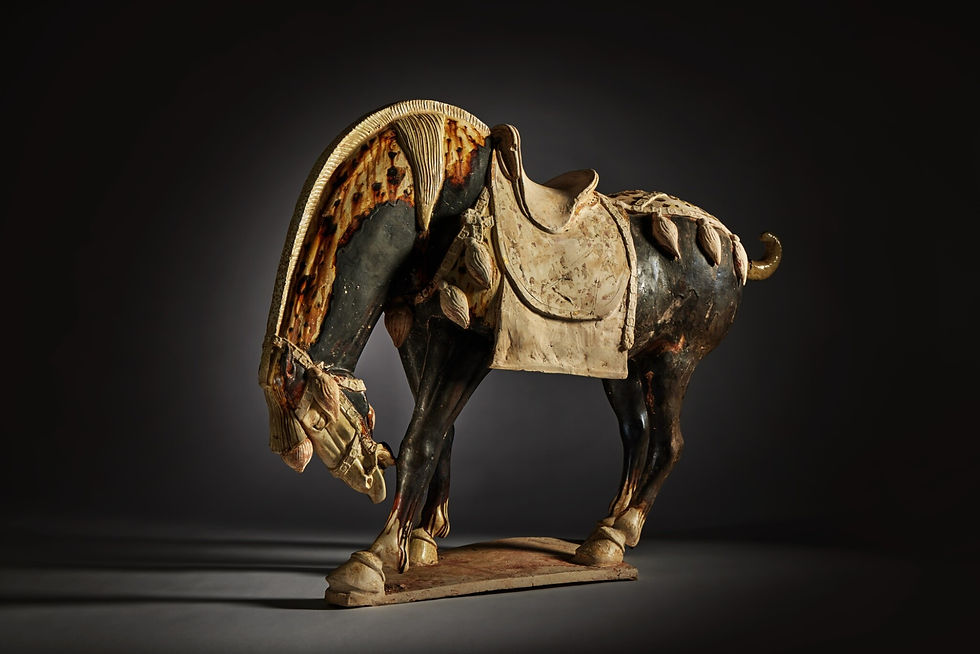
唐代陶馬,以造型精巧而著稱,足腿粗壯有力,軀幹雄健厚實,頸項修長,體態雄健,並常飾以華麗鞍韉轡具,為中國古代雕塑中最為普及、最受推崇之題材之一。此類陶馬多以精良模製技術分段燒成,原屬權貴陵墓明器。陶馬工藝於盛唐八世紀達至巔峰。唐代貴族,以陶具及其他持久物質製作日用器物,冀求將財力名位於來世延續。雖然唐墓中亦見佛像,也常見侍從、胡人、駱駝等像,然而若論影響深遠,則無出於唐馬。
馬匹,尤以傳自西域大宛名駒,於中國早期乃權力與尊榮之至高象徵之一。此類良馬循絲綢之路自中亞進入中土,以錦帛、黃金交換,至唐代已不僅為重要交通與軍事工具,更為奢華與富貴象徵。至西元667年,朝廷更限定唯貴族可蓄養馬匹,並於首都長安(今西安)郊外設立廣袤牧苑與馬廄。史籍所稱天馬或汗血寶馬,相傳最早由漢代中國朝臣發現,隨後大規模四處尋找寶馬。其形象正如本例所示,多作前肢筆直、胸肌雄健之姿,象徵力量、權力與速度巔峰,其象徵意義適合用作帝王陵墓明器。
唐代陶馬,固多以雕塑精妙見長,然如本品寫實逼真者,實屬鳳毛麟角。本馬毛色斑駁,簡約而寫實,有別於常見之白釉、黃釉,或近乎超自然效果之綠、藍三彩。釉層以常見之黃色為底,復施含鐵量高之釉料,於蹄足與頸項間尚可見底層釉色,使整體呈現濃厚而近乎虹彩之黑色效果,如此效果,尤其罕見於此類尺寸龐大之例。頸部則點染黃斑彩,彷彿異彩流動,馬鬃於微風中飄動,效果栩栩如生。
如此釉色處理,大膽寫實而節制簡約,與原本顏料及鎏金華麗裝飾相輔相成,此中痕跡,歷經十三世紀仍清晰可辨。鞍褥與流蘇施粉紅、黑及紅色花卉紋,轡具與馬鞍則點染鮮綠,尤為奪目者,乃韁繩與配件上之金箔。此等金彩與彩繪組合,使本馬成為目前現身市場當中,裝飾最具視覺衝擊力和最奢華作例之一,瑰麗輝煌而又具自然寫實風格。
唐代陶馬,多數不帶個別特質,本品則形象極富個性,神情溫馴而生動,極可能依據名駒塑造,為馬定製造像,相信僅限於達官顯貴。唐玄宗(712–756年在位)愛馬,曾命宮廷畫師韓幹(約706–783年)為其御馬作畫。唐代張彥遠《歷代名畫記》(847年)記載,玄宗「好大馬,令幹寫其最駿者」,其所飼四十餘萬匹馬中,尤以六匹以拳毛騧、什伐赤、白蹄烏、特勒驃、青騅、颯露紫等色名區分。可比較畫例,其中最著名者為《照夜白》,現藏紐約大都會藝術博物館、傳為韓幹所繪。另一畫例,清高宗乾隆斷定乃韓幹繪,畫中馬黑腹,白鼻,白蹄,馬鬃顏色斑駁,曾屬大阪藤田美術館藏, 2017年3月15日售於紐約佳士得,編號509。此外,亦可參照昭陵六駿石刻,原為唐太宗(在位627–649年)昭陵所立,紀念其最喜愛之六匹戰馬。其中兩像現藏賓夕法尼亞大學考古與人類學博物館(館藏編號 C395 及 C396),其餘四件藏於西安碑林。
除釉彩裝飾外,本馬姿態亦殊為罕見。其低首弓頸、前肢微屈,既似致禮之鞠躬,亦若搔蹄之瞬間,兼顯尊貴與溫柔。此類姿態之彩釉陶馬例,傳世所知僅有五件。其造型淵源,可上溯至北魏時期之灰陶馬,東京永青文庫收藏一例(見小山富士夫《中國陶磁》卷一,東京,1970年,圖17;又如西安獨孤思貞夫婦墓(紀年709年)出土一對灰陶馬,其中一匹亦作俯首狀,載於《China.Dawn of a Golden Age, 200–750 AD》,紐約大都會藝術博物館,2002年,圖錄編號199。另有1966年陝西西安十號坑出土之紅陶馬成組四匹,馬鞍可拆卸,為同一馬之四態,其中亦包含俯首姿與本品相近,載於《Imperial China.The Art of the Horse in Chinese History》,肯塔基州,2000年,圖錄編號139。
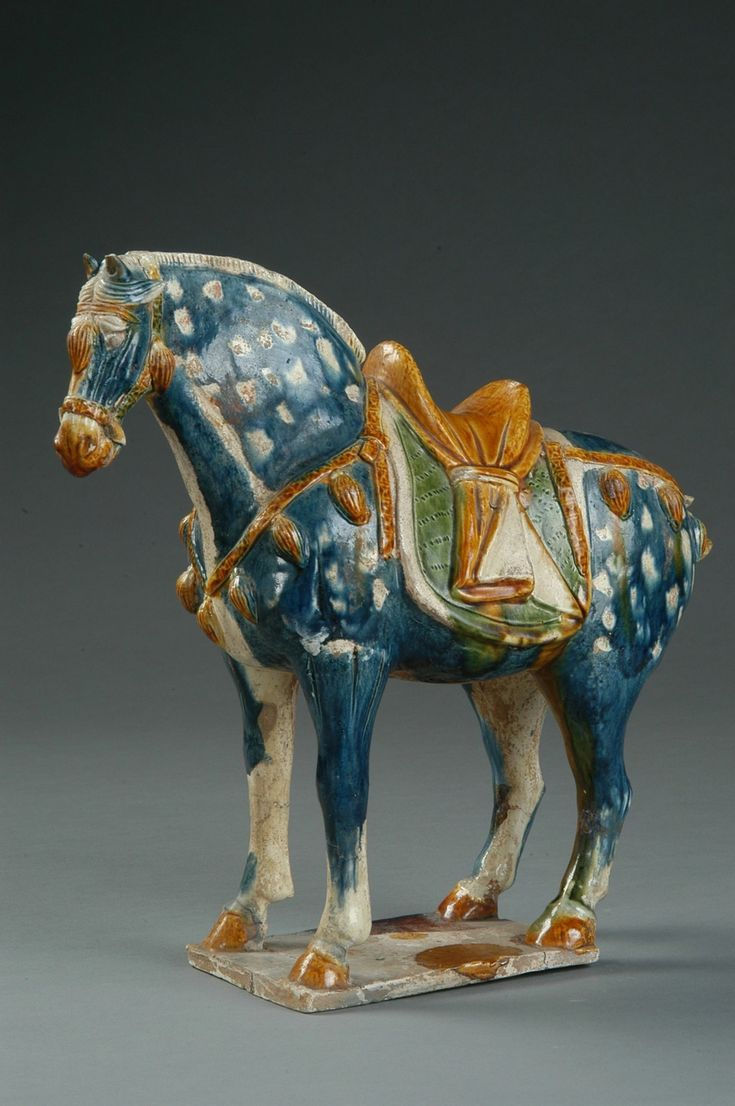
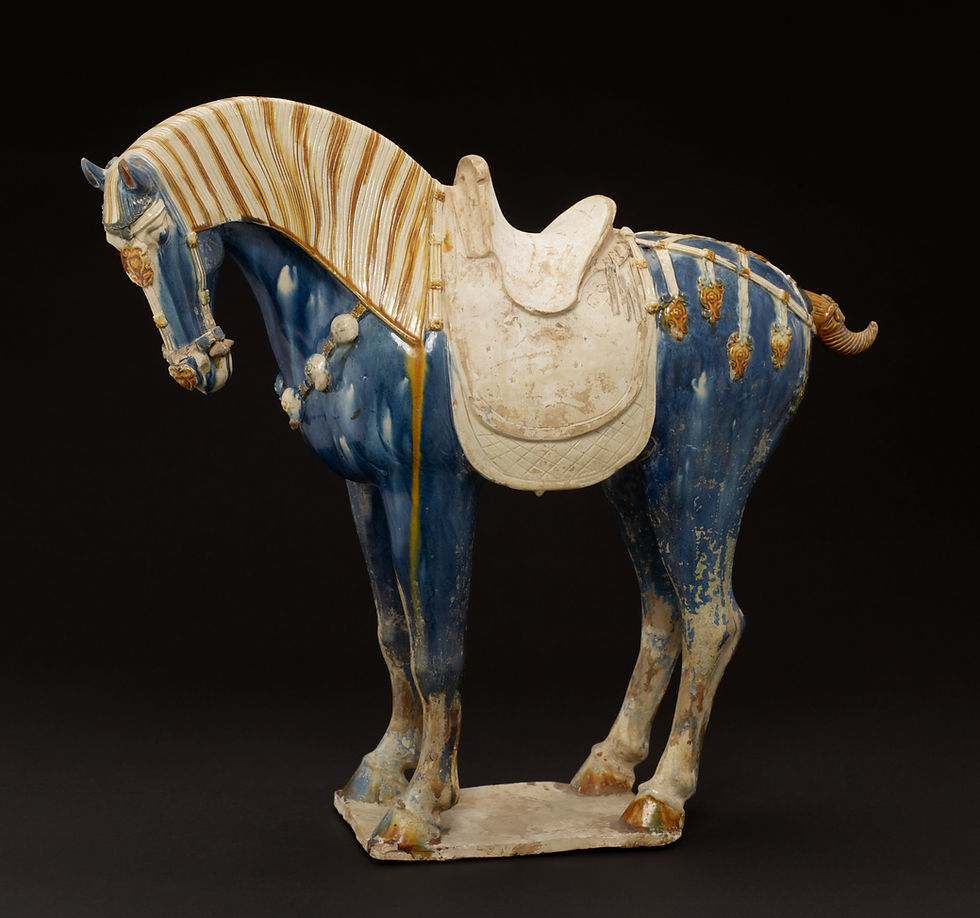
於已知五件施釉相近作例當中,未見他例同時具備本作之花斑毛色與鎏金彩繪裝具。可比三例,以白釉為主,施三彩鞍具:其一藏於波士頓美術館(藏品編號27.2),載於《Unearthing China’s Past》,1973年,圖錄編號88;其二售於紐約蘇富比1975年3月13日,編號208,售出後入藏東京松岡美術館,並收錄於該館1975年《開館記念:松岡美術館名品図録》 ,頁5,編號3(圖一);第三例圖載1997-1998年《Oriental Art》封面,卷XLIII,第4期,並於1998年9月16日紐約佳士得上拍,編號309。第四例為一件黃釉、配以綠釉鞍具之俯首馬,並與一件同色系之立姿陶馬同存於捷克布拉格國家美術館,館藏編號 Vp 4128,載於該館官方網站(圖二)。第五例則施以與本器相近之黑釉,頸項飾斑點,現藏於東京千代田區靜嘉堂文庫美術館,錄於《中國陶磁展》,靜嘉堂文庫美術館,東京,1992年,編號16號(圖三)。此外尚可比對一件施黑釉兼黃釉之陶馬,現藏於芝加哥藝術博物館,館藏編號1943.1136。該馬頭部與頸項經修復,亦呈俯首姿態,著錄於《Masterpieces of Chinese Arts from the Art Institute of Chicago》一書,曾於大阪市立東洋陶大阪市立東洋陶瓷美術館美術館、熱海 MOA 美術館及東京出光美術館巡迴展出,1989年出版,圖錄編號48 (圖四)。
本拍品經牛津熱釋光檢測編號666m83,結果與其斷代相符。
The most significant lot in the New York Asia Week auctions of 2026 is undoubtedly this Tang sancai black-glazed drinking horse from the Pritzker collection, previously handled by Giuseppe Eskenazi and published in his memoir A Dealer’s Hand: The Chinese Art World Through the Eyes of Giuseppe Eskenazi.
Surviving examples of sancai horses in a lowered-head, hoof-nibbling, drinking posture are already rare; those with predominantly black glaze are especially scarce. The auction result for this exceptional piece will likely set the tone for the entire Tang sancai market in 2026 and beyond.
The suspense remains clear: Western collectors have shown increasing fatigue toward Chinese art in recent years, while the new generation of Chinese buyers still lacks sufficient depth of connoisseurship and appreciation. The generational handover is proving far from straightforward.
True cultural confidence and dedicated effort require participation from everyone, yet at present, such lofty idealism remains confined to the realm of ideals. The majority of Chinese collectors continue to approach artworks primarily through the lens of preservation of value, appreciation, and investment—treating them essentially as financial instruments to be traded. The original spirit of passion and pure collecting impulse is almost entirely absent, which is truly lamentable.
THE CINDY AND JAY PRITZKER COLLECTION
A magnificent and extremely rare gilt-decorated and sancai-glazed pottery figure of a bowing horse, Tang dynasty, first half of 8th century
Estimate
400,000 - 800,000 USD
Lot Details
Description
Length 29½ in., 75 cm
Condition Report
Restored breaks to the four legs and the croup. Scattered touch-up throughout, including to one ear, the reins, and the mane. The tail was rebuilt. Overall with wear, minor chips, and losses to the extremities. Losses to the original pigments and some glaze flakes.
Provenance
Eskenazi Ltd, London, 12th July 1993.
Exhibited
Early Chinese Art from Tombs and Temples, Eskenazi, London, 1993, cat. no. 38.
Literature
Giuseppe Eskenazi in collaboration with Hajni Elias, A Dealer’s Hand. The Chinese Art World Through the Eyes of Giuseppe Eskenazi, London, 2012, pl. 208.
Catalogue Note
Skillfully molded with stocky legs, broad torsos, graceful necks, and often intricate trappings, Tang horses are among the most ubiquitous and celebrated forms of Chinese sculpture ever produced. These powerful beasts, assembled from complex molded sections, originally formed part of larger collections of ‘spirit objects’ (mingqi) in elite funerary contexts and reached their zenith around the eighth century, at the height of the Tang dynasty (618–907). Through their mingqi, Tang elite sought to recreate real-world possessions in clay and other enduring materials, and bring their wealth and status with them into the next world. However, while other sculptural forms, including Buddhist guardians, attendants and camels, are also frequently attested in Tang burial contexts, no other subject has had the lasting and profound impact of the Tang horse.
Horses, particularly those bred from the fabled stock of the Ferghana Valley, were among the most important symbols of power and prestige in early China. Imported along the Silk Road from Central Asia in exchange for precious textiles and gold, by the Tang dynasty, horses had gained a reputation not just as an important means of transportation and warfare, but as true symbols of wealth and luxury. By 667 CE, the ownership of horses had been restricted by law to the aristocracy alone, who grazed their stock in extensive stables and parks on the outskirts of the Tang capital in Chang’an (modern-day Xi’an). Known as ‘celestial’ or ‘blood-sweating’ horses, the horses of Ferghana were said to have been first discovered by Chinese officials in the Han dynasty who launched extensive campaigns to recover them. Portrayed like the present example with rigid fore-legs and stocky barrel-shaped chests, these horses represented the very peak of strength, power and speed and, as such, made fitting accompaniments to a royal tomb.
While many Tang horses display a level of sophistication in their sculpting, it is exceedingly rare to find such a degree of naturalism on a figure of this type. Unlike more commonly attested figures glazed predominantly in white, amber, or almost supernaturally in the greens and blues of the sancai (‘three color’) palette, the present horse features a striking yet simple piebald coat. With a second iron-rich layer of glaze draped over the more standard amber, still visible around the ankles and neck, the horse is robed in a remarkably opaque, almost iridescent, black coat rarely so successfully achieved at scale. Combined with the selective application of amber splashes around the neck, the figure appears as if alive, its mottled fur flowing in the breeze.
This bold naturalism and simplicity in glazing is, in turn, accentuated by more florid additions in pigment and gold, still preserved in traces after thirteen centuries. With floral designs in pink, black and red to the saddle cloth and tassels, bright green pigments around the halter and saddle, and – most strikingly – gold leaf across the straps and trappings, this decorative scheme represents one of the most visually imposing and sumptuous examples ever to come to market, exuding both splendor and naturalism in its dramatic glazing and vibrant pigmentation.
Indeed, while many Tang horses tend to lack a distinct personality, the present model appears to be unique in design, replete with characterful tenderness, and very possibly sculpted and colored after a living model— a level of customization likely limited only to the very highest echelons of society. Emperor Xuanzong (r. 712–756), for example, was notorious for his love of horses and commissioned court artist Han Gan (c. 706–783) to paint portraits of his herd. As scholar Zhang Yanyuan notes in his Lidai minghua ji (‘Record of famous painters of all periods’; 847), Emperor Xuanzong ‘loved large horses and ordered Han [Gan] to paint the most noble of his more than 400,000 steeds,’ six of which are described by their respective colors: red, purple, scarlet, yellow, clove, and ‘peach-flower’. Compare the most famous of these paintings, entitled ‘Night-shining White’ (Zhaoyebai), attributed to the artist and preserved in the Metropolitan Museum of Art, New York (accession no. 1977.78), and another, attributed to Han Gan by the Qianlong Emperor (r. 1735–1795), depicting a similar horse of black torso, dappled mane and white snout and hooves, sold from the collection of the Fujita Museum, Osaka, at Christie’s New York, 15th March 2017, lot 509. Also compare six life-size stone stelae produced for the burial grounds of Emperor Taizong (r. 627-649) in Zhaoling, said to depict his six favorite battle chargers, two of which are now preserved in the University of Pennsylvania Museum of Archaeology and Anthropology, Pennsylvania (accession. nos C395 and C396), and the other four in the Beilin Museum, Xi’an.
Beyond its shimmering decoration, the present horse is also remarkable in its posture. At once a regal bow and tender scratch of the leg, the horse’s stance with arched neck and lowered head is exceedingly rare with only five other glazed examples apparently published. For the origins of this design, compare a related unglazed gray pottery example of this form preserved in the Eisei Bunko Museum, Tokyo, dated to the Northern Wei period in Koyama Fujio, Chūgoku tōji [Chinese ceramics], vol. I, Tokyo, 1970, fig. 17; a pair of gray horses uncovered from the tomb of Court Official Dugu Sijing and his wife (dated 709), included in China. Dawn of a Golden Age, 200–750 AD, Metropolitan Museum of Art, New York, 2002, cat. no. 199, including one in a bow; and a set of four red-painted pottery horses with removable saddles, excavated in 1966 from Pit No. 10, Xi’an, Shaanxi province, included in Imperial China. The Art of the Horse in Chinese History, Kentucky Horse Park, Kentucky, 2000, cat. no. 139, apparently representing the same horse in four different poses, including the present bow.
Of the five other known glazed examples, no other bowing horse appears to share the present piebald coloration or gilt-polychrome trappings. Compare three, each predominantly glazed in white with sancai trappings: the first preserved in the Museum of Fine Arts, Boston (accession no. 27.2), included in Unearthing China’s Past, Museum of Fine Arts, Boston, 1973, cat. no. 88; the second sold in these rooms, 13th March 1975, lot 208, to the Matsuoka Museum of Art, Tokyo, and included in its Inaugural Exhibition, Selected Masterpieces of the Matsuoka Museum of Art, Tokyo, 1975, p. 5, cat. no. 3 (Fig. 1); and the third illustrated on the cover of Oriental Art, 1997–1998, vol. XLIII, no. 4, and offered at Christie’s New York, 16th September 1998, lot 309. The fourth known example, an amber-glazed bowing horse with green trappings, is preserved alongside an upright horse of similar coloration, in the National Gallery, Prague (accession no. Vp 4128), illustrated on the Museum's website (Fig. 2); and the fifth, decorated with a similar black glaze and dappled neck, is in the Seikado Bunko Art Museum, Chiyoda, included in Chūgoku tōji ten [An exhibition of Chinese ceramics], Seikado Bunko Art Museum, Tokyo, 1992, cat. no. 16 (Fig. 3). Finally, also compare a black- and amber-glazed horse from the Art Institute of Chicago (accession no. 1943.1136) with its restored head and neck arranged in a bow, included in Masterpieces of Chinese Arts from the Art Institute of Chicago, Museum of Oriental Ceramics, Osaka, MOA Museum of Art, Atami and Idemitsu Museum of Arts, Tokyo, 1989, cat. no. 48 (Fig. 4).
The dating of this lot is consistent with the results of Oxford Authentication Ltd. thermoluminescence test no. 666m83.
本拍品經牛津熱釋光檢測編號666m83,結果與其斷代相符。

Comments