
拍賣筆記 vol.250 邦瀚斯香港:玉神面飾,石家河文化之後 - An Important And Extremely Rare Jade 'Deity Mask’, Late Neolithic Period, Post-Shijiahe Culture


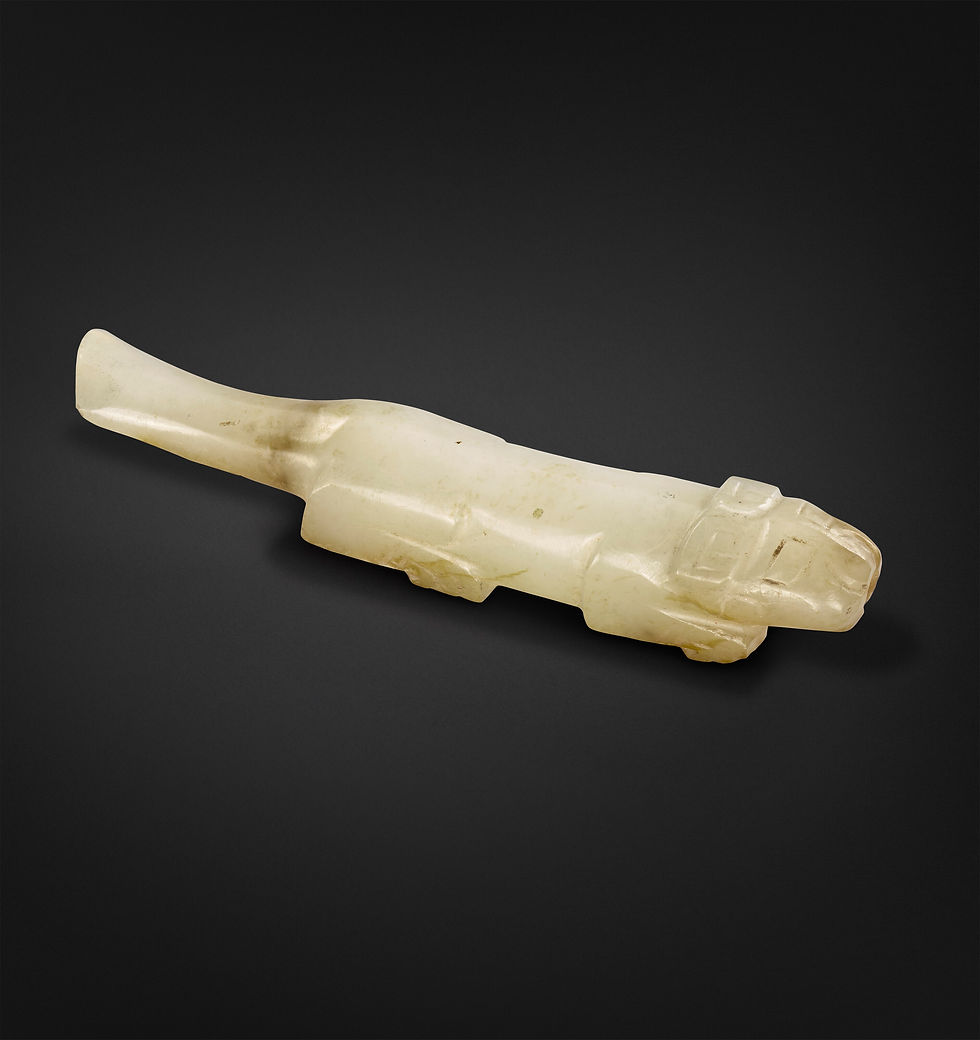
以淡青色玉雕成,呈三角形斷面,一側弧面陰刻並浮雕出具象化的神祇面貌。雙目細長如杏,神采強烈;鼻梁高挺;嘴角橫張,露出尖利獠牙,神情威猛。兩側配有大耳飾,上方飾以冠冕,並以外伸的凸棱構成框飾。細部線條或陰刻或起棱,勾勒極為精緻,展現出晚期新石器玉雕的高度造型感與象徵性。
拍品305
玉神面飾
新石器時代晚期
石家河文化之後 約公元前2100–1900年
估價:HK$1,500,000 – 2,500,000(約合 US$190,000 – 320,000)
2025年10月29日 下午2時30分
香港 太古廣場《精美中國瓷器及工藝品專場》
附盒。寬3.6公分,高4.3公分。
來源:
Compagnie commerciale de la Chine et du Japon(中日貿易公司),巴黎,二十世紀初展覽
著錄:Adolphe Worch,《Objets d'art Chine(中國藝術品)》﹐巴黎,1909年,頁1,編號2

此玉面首,頭戴冠帽華麗,雙眼如杏炯炯,寬鼻下,咧嘴露齒,長曲獠牙懾人。華冠向兩側延展,出戟處彷若獸鳥之首,下戴大圓耳環。已然如此小巧,卻又精緻入微。冠上、眼下、齒旁、領口,均有隱起陽線,細膩之處,他例難出其右。如此雅緻罕例,可謂後石家河文化時期的代表作。
長江中游地區的石家河文化,論規模之盛、歷時之久,相較其他新石器時代文明,如東面的良渚與北方的龍山,絕不遜色。至公元前約二千年前後,位處今河北省天門一帶沃土的這個農業社會,已發展出複雜的城市群,中央古城有護城壕溝,四周有住宅、祭祀、作坊等區域。除了早期陶器外,出現不少精緻入微的玉雕,透露這個時期當地的物質生活、信仰與文化內涵。
石家河出土及傳世玉雕雖是數以百計,但如此品作人面者如鳳毛麟角,應乃當時社會文化中極其重要之物。學者把此類玉雕分成兩組:神人者,頭戴華冠、口長獠牙,此品正為一例;凡人者,多不露齒,頭飾設計較形簡單。
肖家屋脊遺址出土一玉神人罕例(W6:32),尺寸、造形與此接近,切面同呈三角,中間也有隧孔,與本品關聯密切。肖家屋脊例受學界高度重視,在《中國出土玉器全集》湖北湖南卷石家河文化部分居首(北京,2005年,卷10,頁2;圖1)。石家河譚家嶺古城遺址發現另一近例(W9:7),但神人面首比例略較此寬,收入《石家河遺珍:譚家嶺出土玉器精粹》一書,也列為群玉之首(北京,2019年,頁1-4;圖2)。其他例子則可見於重要博物館收藏:倫敦大英博物館玉神人例,刊於羅森,《Chinese jade: from the Neolithic to the Qing》,倫敦,1995年,頁37,圖21,藏品編號1947.7-12.515。另可對比長期借展美國華盛頓史密森國家亞洲藝術博物館的玉神人,上戴高冠, 藏品編號LTS1985.1.276.1。

拍賣市場上所見石家河文化玉神人,屈指可數,如養德堂舊藏例,較扁平呈牌狀,以隱起陽線交代臉部輪廓,2017年11月29日在香港佳士得成交,拍品編號2722。藍田山房與雲中居遞藏也有一石家河文化例,呈管珠狀,卻是凡人之屬,華冠、尖牙欠奉,香港佳士得2019年11月27日,拍品編號2752。
就此類玉神人的功用,學術研討多時,卻尚未有定論。杜金鵬據玉件的穿孔,推測昔日玉神人首像或乃以細繩繫在冠帽前方(杜金鵬,〈石家河文化玉雕神像淺說〉,《江漢考古》,1993年第3期,頁56)。
學者相信,石家河雖有本地作坊與巧手藝匠,但當地缺乏原材,玉料均需由外地進口。可能正因此故,石家河文化玉器尺寸普遍稍小,多為袖珍精巧之品。因材之限,石家河藝匠或曾取用其他文化中已經雕琢成器,加工改製。肖家屋脊出土例、大英博物館藏品與本品同呈三角之狀,形與源自良渚文化的玉琮邊角極為相似,讓人思忖後石家河文化藝匠以琮改製玉神人的可能性。更多有關史前古玉改製的討論,見羅森,前述出處,頁22-25;及 Keith J. Wilson,〈Thinking Green: Chinese Jades Reworked in the Second Millennium BCE〉,《東方陶瓷學會會刊》,卷77,2012-2013年,頁39-56。
雖然具體文化互動的方式未明,但石家河與周邊新石器時代文明有一定程度的交流,特別是山東的龍山文化(圖3),兩者對神人的刻劃有不少相通之處(杜金鵬,前述出處,頁57)。石家河玉神人突出的輪廓,或影響後來的三星堆文化,造就青銅巨像的炯炯巨目(圖4)。
此玉神人面首,早在1909年收入 Adolphe Worch(1843-1915)的圖錄中。他生於德國卡瑟爾,1888年在巴黎藍路9號創立骨董店「中日貿易公司」。其侄 Edgar Worch(1880-1972)及後加入,協助打理古董生意,並在1906-1914間每年到中國採購器物,對拓展公司的中國藝術部門,功不可沒。1914年,公司在紐約開設分店,奈何出師未捷,第一次世界大戰的爆發致使草草結業。戰亂期間,法國政府更沒收 Adolphe 的財產。Edgar 則被逼返德,至戰後才在柏林續營中國古董生意,更成立個人字號,在藝壇叱咤一時,經手眾多珍貴中國藝術品,不少現已納入重要博物館典藏。

LOT 305
AN IMPORTANT AND EXTREMELY RARE JADE 'DEITY MASK'
Late Neolithic period, Post-Shijiahe Culture, c. 2100-1900 BC
29 October 2025, 14:30 HKT
HK$1,500,000 - HK$2,500,000
US$190,000 - US$320,000
Late Neolithic period, Post-Shijiahe Culture, c. 2100-1900 BC
Masterfully carved, the pale celadon stone of triangular section with a curved side modelled with an anthropomorphic face, detailed with powerful almond-shaped eyes, prominent nose, and widespread mouth revealing sharp, ferocious fangs, all flanked by a pair of large earrings and surmounted by a headdress framed by protruding flanges, the finest details subtly outlined with incised and raised lines, box.
3.6 cm wide, 4.3 cm tall (2).
Provenance:Compagnie commerciale de la Chine et du Japon, Paris, early 20th centuryExhibited, Published and Illustrated:Adolphe Worch, Objets d'art Chine, Paris, 1909, p. 1, no. 2This extremely rare, masterfully carved jade mask is a quintessential example of the final phase of the Shijiahe culture. It was one of the largest Neolithic civilisations that flourished in the middle Yangtze valley, parallel to other major ancient cultures such as Liangzhu to its east and Longshan in the north. By around the 2nd millennium BC, on the fertile land of modern-day Tianmen city, Hubei, an agricultural civilisation was well established, marked by a complex city with a moat-protected citadel, surrounded by residential areas, ceremonial altars and workshops. A quantity of finely worked jade carvings appeared alongside early pottery wares, suggesting the material wealth, spiritual belief and cultural sophistication of the civilisation. Among the hundreds of excavated and passed-down jade carvings attributable to the culture, there are only a small number of jade masks, suggesting their societal and cultural importance. Scholars categorise this rare group of intricately carved jade masks into two subtypes: deities with two pairs of fangs and elaborate headdresses – such as the current example – and humanoids typically shown without teeth, and their headdresses are of simpler designs.A closely related deity mask of this size and design, also of triangular section and perforated vertically, was unearthed from Xiaojiawuji (W6:32) and selected as the foremost example of the Shijiahe culture in The Complete Collection of Jades Unearthed in China, Beijing, 2005, vol. 10, p. 2 (fig. 1). Another deity mask of a broader proportion was excavated from the citadel Tanjialing (W9:7) and illustrated as the opening piece in Shijiahe yizhen: Tanjialing chutu yuqi jingcui (Treasures of Shijiahe: Selected jade unearthed in Tanjialing), Beijing, 2019, pp. 1-4 (fig. 2). Further examples are in major museum collections: see one in the British Museum, London, illustrated in Jessica Rawson, Chinese jade: from the Neolithic to the Qing, London, 1995, p. 37, fig. 21, accession no. 1947.7-12.515; and another with an elaborate tophat, on long-term loan to the Smithsonian National Museum of Asian Art, accession no. LTS1985.1.276.1. A handful of related flat jade deity mask plaques with outlined facial features have appeared at auction, including one sold at Christie's Hong Kong, 29 November 2017, lot 2722, from the Yangdetang Collection. Compare also a Shijiahe jade bead in the form of a humanoid head, without any fancy headdress, nor ferocious fangs, formerly in the collections of Lantien Shanfang and Chang Wei-hwa, sold at Christie's Hong Kong, 27 November 2019, lot 2752. The function of such jade deity masks has sparked considerable academic debate, yet no consensus has been reached. Du Jinpeng suggested, based on his observation of the perforations on these pieces, that they were likely to have been attached in front of headdresses and secured with strings (Du Jinpeng, 'A brief introduction to jade carvings of deities from the Shijiahe culture', Jianghan Archaeology, 1993, no. 03, p. 56). Scholars believe that despite having local jade workshops and skilled artisans, Shijiahe did not have immediate access to nephrite and had to rely on raw material imported from nearby areas. Such limitations possibly contributed to the characteristically small sizes of their carvings. Shijiahe artisans may have also reworked and repurposed jade items from nearby cultures. The triangular sections of the Xiaojiawuji example, the British Museum mask and the present lot are reminiscent of a jade cong, a form first devised in the Liangzhu culture, suggesting possible alterations in antiquity. For further discussions on this topic, see Jessica Rawson, op. cit., pp. 22-25; and Keith J. Wilson, 'Thinking Green: Chinese Jades Reworked in the Second Millennium BCE', Transactions of the Oriental Ceramic Society, vol. 77, 2012-2013, pp. 39-56.Although the exact methods of interaction remain a mystery, there was cultural exchange between the Shijiahe culture and other Neolithic civilisations, particularly with Longshan culture in Shandong (fig. 3). The deity masks from Shijiahe exhibit visual elements reminiscent of the demonic faces found in northern styles (Du Jinpeng, op. cit., p. 57). Shijiahe figurines, characterised by prominent facial features, may have also influenced the Sanxingdui culture, which is renowned for producing monumental bronze figures with captivating eyes (fig. 4). This jade mask was first published in 1909 by Adolphe Worch (1843-1915). Born in Kassel, Germany, Worch founded Compagnie commerciale de la Chine et du Japon on 9 rue Bleue of Paris in 1888. Adolphe worked closely with his nephew Edgar Worch (1880-1972), who travelled to China annually to acquire works of art between 1906 and 1914, resulting in the expansion of the company's Chinese art department. A New York branch was established in 1914, but its operation was short-lived due to the outbreak of World War I. The French government confiscated Adolphe's property during the war, and Edgar Worch was forced to return to Germany. After the war, Edgar resumed his Chinese art trade and eventually opened his own gallery, selling numerous important artworks through his brand, many of which are now preserved in major museums.


Comments