
北朝筆記 vol.39 關於中國南北朝時代佛教美術中的鳥,論證藤田美術館北朝鳥乘菩薩 - On Birds in the Buddhist Art of China’s Northern and Southern Dynasties Period


關於中國南北朝時代佛教美術中的鳥
研究者:沖繩縣立藝術大學美術工藝學部教授 下野玲子
全文發表在《鹿島美術研究》年報第42號別冊(2025)
引言
佛教自印度主要經中亞傳入中國,在被中國接受的過程中深受中國固有文化影響,從而產生了獨特的美術。本研究旨在闡明此類佛教美術中國化的若干問題之一端,聚焦於中國佛教興盛的北魏時代(439–534年)佛教美術中出現的鳥的圖像,考察其形態與意義。作為出發點,曾以北魏鳥乘菩薩像為題,為追溯其源流,本稿主要報告對北魏以前作品與文獻的考察結果。
關於藤田美術館的此尊菩薩,參見:《北朝筆記 vol.38 藤田美術館:北魏銅鎏金騎鳥彌勒菩薩交腳坐像 - Fujita Museum, Gilt-Bronze Seated Maitreya Bodhisattva with Bird Ride, Northern Wei Dynasty》


1. 鳥乘菩薩像
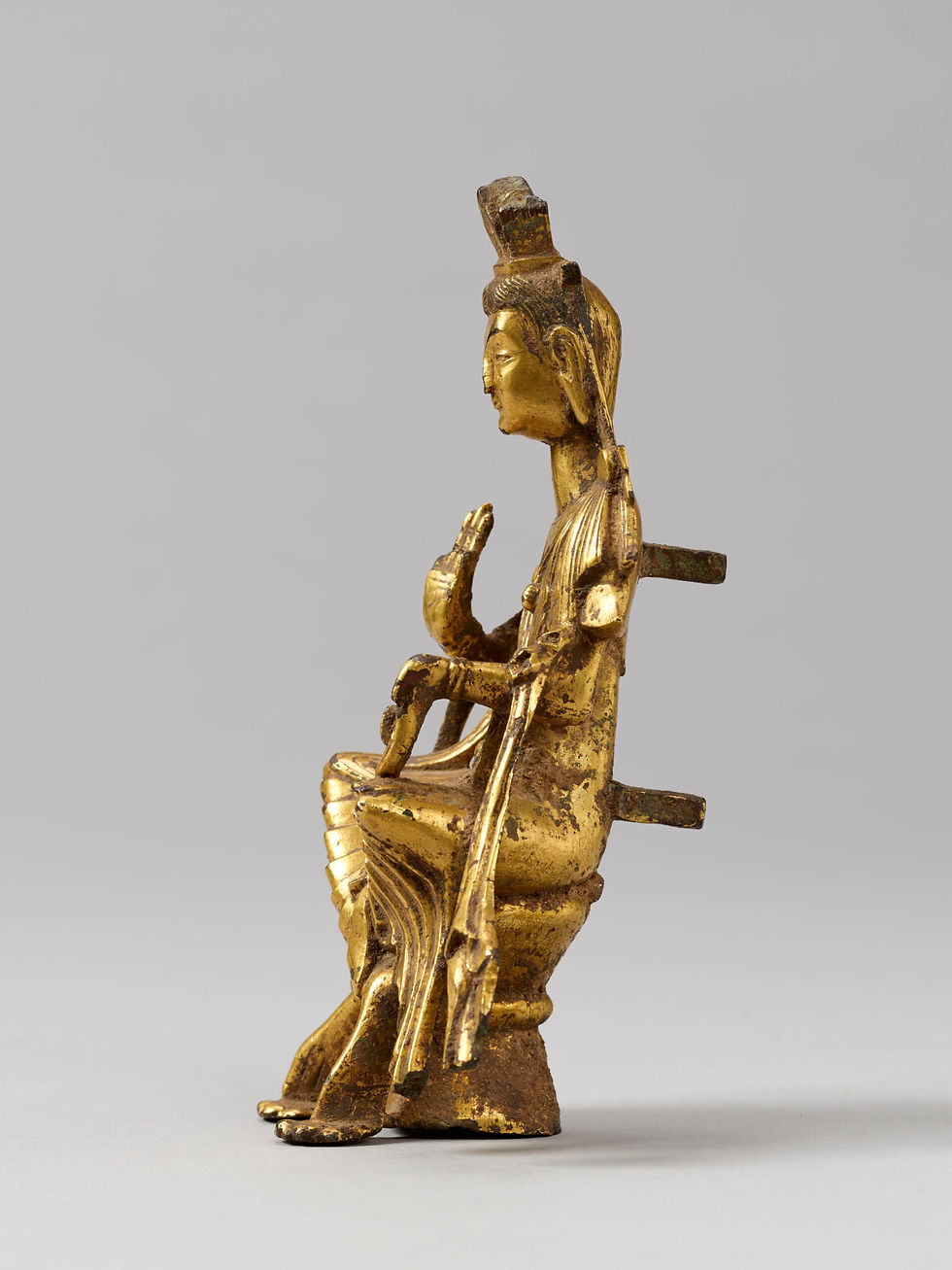
大阪府藤田美術館藏有一尊北魏金銅交腳彌勒菩薩像〔圖1、2〕。本像因交腳姿態而被視為彌勒菩薩,細長頭部與身體等造型充分體現北魏後期特徵。台座銘文有神龜元年(518年)製作年與尊名,菩薩坐於鳥背一事別無類例,但菩薩像與鳥的組合並不協調,台座是否原本配套亦存疑(注1)。然而,其上曾承載某像的可能性很高,這一特徵尤為值得關注。鳥足粗壯,單足而立。足部極度誇大,應是為了以一足支撐鳥身及其上所載之物。鳥頭相對身體偏大,鉤狀彎曲的巨大鳥喙與帶多角形棱的大眼令人聯想到猛禽。雙翼折疊於身體兩側,尾羽向後方略彎,呈棕櫚葉狀延伸,但並不甚長,故與鳳凰有別。面部刻有細密毛雕線,身體刻鱗狀羽毛。
此像作為北魏後期有銘佛像,先行研究屢有提及,但對「乘鳥」一事幾乎未作說明(注2)。近來中國張之涵氏關注本像之鳥,舉出佛教金翅鳥(迦樓羅)、中國古文獻中的一足鳥「畢方」與「商羊」,討論其與佛教的關係(注3)。
2. 一足鳥及其圖像(1)畢方
中國古代文獻中較知名的一足鳥有畢方與商羊,故先確認二者的文獻記述及北魏以前的作例。
畢方最早見於戰國至前漢整理的神話文獻《山海經》(注4)。《西山經》記曰:
有鳥焉,其狀如鶴,一足,赤文青質而白喙,名曰畢方,其鳴自叫也,見則其邑有譌火。
(郭璞注:譌亦妖字。)(注5)
畢方狀如鶴而一足,青體赤文、白喙,為火災前兆,屬災異。同書《海外南經》記述稍異:
畢方鳥在其東,青水西。其為鳥人面一腳。一曰在二八神東。
此處畢方為人面,但一足之特徵共通。前漢劉向《淮南子·氾論訓》高誘(後漢)注亦有說明:
木生畢方。(注:木之精也。狀如鳥,青色赤腳,一足,不食五穀。)
「赤腳」與《山海經·西山經》不同,但一足仍是最大特徵。唐代總章元年(668年)道世所編《法苑珠林》卷45記:
《白澤圖》曰……又火之精名曰必方,狀如鳥,一足。以其名呼之則去。……又上有山林下有川泉,地理之間生精,名曰必方,狀如鳥,長尾。此陰陽變化之所生。(《大正藏》53,633c)
必(與畢同音)方仍為一足,稱火之精,可與《山海經》火災前兆的畢方等同視之,但「長尾」與鶴之特徵不符。《法苑珠林》為佛教文獻,張之涵氏以此作為佛教徒接受畢方的一證。《白澤圖》是記述驅除各種鬼神方法的奇書,約成立於2–4世紀初(注6)。
此「必方」因呼名可退,屬不祥之鳥。但唐666年薩守真撰《天地瑞祥志》卷14物精條幾乎收錄同文(注7),至遲初唐已被納入祥瑞範疇。
畢方作例見於後漢山東嘉祥武氏祠畫像石中構成祠堂天井的「祥瑞圖殘石」〔圖3〕。圖左上刻文名稱部分殘缺,但「有鳥如鶴……白喙名……其鳴自……有動」等文句與前述《山海經·西山經》一致,且確為一足,是中世以前畢方可靠圖像的珍貴遺品(注8)。頭雖長但粗,足亦不甚長,與鶴不甚相似。此圖下方有可比「比目魚」「比肩獸」的祥瑞圖像,再下有「諸」字《山海經》所載凶兆人面獸,吉凶並存,頗可玩味(注9)。即便為凶兆,其靈妙之力或被期待辟邪除魔,或作為天降兆示之一類與祥瑞一併表現。
3. 一足鳥及其圖像(2)商羊
商羊最早記述見於前漢劉向《說苑·辨物》:
其後齊有飛鳥一足來下,止於殿前,舒翅而跳。齊大怪之,又使聘問孔子。孔子曰:此名商羊,急告民趣治溝渠,天將大雨。於是如之,天果大雨,諸國皆水,齊獨以安。
商羊為一足鳥,止於齊國殿前跳躍,為天將大雨之兆。後漢王充《論衡·變動》記:
天氣變於上,人物應於下。故天且雨,商羊起舞,使天雨也。商羊者,知雨之物也,天且雨,屈其一足起舞矣。
此處未明確商羊為一足或二足,但言將雨時屈一足起舞。
三國魏王肅注《孔子家語》卷3《辯政》有與《說苑》類似記述,明言「齊有一足之鳥」(注10)。北朝《太平御覽》卷928羽族部15「眾鳥」引三國吳沈瑩《臨海異物志》逸文:
《臨海異物志》曰:東垂有一足鳥,俗名曰獨足,疑是商羊。文身赤口,惟食蟲豸,不害稻粱。鳴如人嘯聲,將雨轉鳴。或曰山噪鳥,晝伏夜翔,或時晝出,則群鳥噪之。
此謂東方邊陲有一足鳥,俗稱獨足,疑即商羊。文身赤口,唯食蟲類,不害穀物。漢至三國以降,整體形態與色彩雖不一定,但商羊為一足鳥且預示雨之點共通。雨或大雨前兆可吉可凶,但前述《天地瑞祥志》卷18「總載」在鳳凰等瑞鳥中立「商羊」項,引《家語》。故商羊逐漸被當作祥瑞對待。
有商羊題記的作品見於甘肅敦煌魏晉時期推定的佛爺廟灣1號畫像磚墓彩色畫像磚。墓室入口照壁嵌有各種祥瑞鳥獸畫像磚,多有墨書題記,是3–4世紀初珍貴作例(注11)。題記中有文獻未見之獸,商羊寫作「尚陽」(發音同商羊)的一足鳥,夾在「麒麟」「鳳」畫像磚左右各一(注12)。可見尚陽被當作與麒麟、鳳凰同類的瑞物。〔圖4〕為右側一例,左向,頭大,上有大冠羽,翼折疊,尾羽長而緩弧上揚,墨線繪一孔雀眼斑。全身白色,頭至尾羽上部沿背脊着紅色,喉至腹有紅色點狀蛇腹表現,顯示非常鳥。
4. 其他一足鳥圖像
後漢畫像石中雖無題記,亦可見其他一足鳥圖像。〔圖5、6〕為山西離石馬茂莊後漢畫像石2號墓前室西壁左側(南側)圖像,縱長畫面有四鳥。報告說明自上而下為朱雀、銜圭紅鳥、三足鳥、雙頭鳥(注13)。最上部為長冠羽、尾向上長反的鳳凰形鳥。其下為銜吊掛玉狀物的一足鳥,翼折疊,尾無或極短,圓臀特徵明顯。圭為上部尖的五角形玉,本圖形制不同,菅野惠美氏質疑稱圭,但據紅鳥銜玉特徵,解釋為《墨子》所記「赤鳥」瑞,是傳達天命的受命祥瑞(注14)。其下為三足鳥(烏鴉),雙頭鳥可視為比翼鳥,皆為瑞鳥(注15)。報告與菅野氏未指出,但銜玉鳥與上下鳥比較,應判斷為一足。
類似圖像可舉〔圖7〕。此為220年卒的三國魏曹操高陵(河南安陽)出土畫像石局部,下部殘缺足數不明,為銜帶圓臀鳥,有「陽遂」題(注16)。左右有「舍利也」「辟邪离也」題記的獸,故「陽遂鳥」很可能為瑞鳥。若作「陽遂」,408年高句麗德興里古墳天井有題記之鳥,亦被視為祥瑞,但該鳥為二足雞形頭,尾雖簡略有延伸線,與〔圖6、7〕圖像差距較大〔圖8〕(注17)。故〔圖6〕一足是否可釋為「陽遂」尚需進一步探討,容另稿論述。
5. 金翅鳥與彌勒菩薩
北魏佛教美術中,常出現頭頂冠羽、尾羽裝飾性長的鳳凰形鳥。太和十八年(494年)遷都洛陽前的都城平城(今山西大同)近郊,約460年開始營造的雲岡石窟是北魏前期代表佛教美術。雲岡營造分三期,遷都前為第一期(第16–20窟)與第二期(第7–13、1·2、5·6窟)。第一期幾乎不見鳥圖像,第二期窟龕楣兩端或屋形龕上可見鳳凰形鳥〔圖9〕(注18)。遷都後不久營造的洛陽郊外龍門石窟古陽洞屋形龕上中央亦有鳥棲圖像。這些因在佛教美術中,多被解釋為印度傳來的金翅鳥(迦樓羅),近來李靜傑氏亦在金翅鳥變遷中論及(注19)。
藤田美術館交腳彌勒菩薩所乘之鳥,從鉤狀大喙與尾羽形狀看,難與雲岡、龍門鳳凰形鳥視為同種。與前述「畢方」「商羊」圖像除一足外亦少共通點。但佛教金翅鳥常以龍為食的猛禽,喙形等可作為金翅鳥解釋的要素。
目前正規佛典中無法指出彌勒菩薩與金翅鳥的直接聯繫,但中國撰述的疑經《普賢菩薩說證明經》(敦煌本P.2186)中有稍相關記述:
釋迦涅槃後七百年,天地大震動,天呼地呼。一月三怪苦困百姓。療除穢惡,分簡五種。專行疫病,平治罪人。有法盡生,無法盡滅。……卻後數日,我遣阿修羅王,手把七日,劫燒終盡。日出之時,閻浮履地,草木燋燃,山石剝裂,山峪堤塝,地平融盡。我爾時天上遣金翅鳥,下召取有緣。此鳥身長二十里,縱廣三十里,口銜七千人,背負八萬人,得上兜率天。彌勒俱時下。(《大正藏》85,1366a–1367c)
釋迦滅後七百年,天地大震,怪異疫病苦民,阿修羅王持七日燒盡地上世界。天上遣巨大金翅鳥,銜載有緣之人救至兜率天,同時彌勒下生。據菊地章太氏,本經成立於6世紀中葉至後半,晚於藤田像神龜元年(518年)(注20)。經中亦未言彌勒乘金翅鳥,故非本像直接圖像學依據。但彌勒相關疑經大量產生,將本應在釋迦滅後56億7千萬年後下生的彌勒說成即將出現等,遭佛教排斥而多佚。本經成立前,或已有二者共同救度眾生的疑經或民間信仰流傳。
最後介紹北齊天保年(550年)銘石雕殘片(非北魏)。方形台座上僅殘三爪鉤狀足尖,可能為一足立鳥之足〔圖10〕。台座正面刻銘「敬造思惟菩薩像一區」,圖錄解釋為思惟菩薩殘片(注21)。若然,則更可能為釋迦太子思惟像,所乘非彌勒。但菩薩像乘一足鳥的可能性仍存,故作為類例介紹。
結語
本稿為探北魏菩薩像所乘一足鳥之源流,抽取一足鳥相關文獻與美術作品加以考察。文獻中原本難言具祥瑞義的「畢方」與「商羊(尚陽)」,至初唐間逐漸被當作祥瑞或準祥瑞,收入《天地瑞祥志》等祥瑞類書。一足鳥作例方面,後漢武氏畫像石以「畢方」、魏晉彩色畫像磚以「尚陽」作為祥瑞表現,後漢畫像石中亦見名稱難定的其他一足瑞鳥。然而,這些一足鳥成為佛教尊像坐騎的原因,現階段尚難給出合理說明,今後仍需繼續探討。


注
(1)奈良國立博物館編《國寶的殿堂 藤田美術館展:曜變天目茶碗與佛教美術的光輝》(奈良國立博物館・朝日新聞社・NHK奈良放送局・NHKプラネット近畿,2019年)233頁,岩井共二氏的解說。
(2)松原三郎《中國佛教彫刻史論》(本文編,吉川弘文館,1995年,262頁)、石松日奈子〈中國交腳菩薩像考〉(《佛教藝術》178,1988年5月)等。據前者,全高45cm,像高16.5cm。
(3)張之涵〈北魏神龜元年交腳彌勒菩薩像的造型考證〉,《文物鑑定與鑑賞》196,2021年第1期。張氏亦關注本像的台座意匠,正面中央有鏤空錢與龜的表現,亦從祥瑞意義加以理解。
(4)《山海經》的成立年代,參見松浦史子《漢魏六朝時期〈山海經〉的受容及其展開》(汲古書院,2012年)緒論5頁。
(5)前野直彬《山海經・列仙傳》(全漢文大系33,集英社,1975年)140頁參照。
(6)佐佐木聰《復元白澤圖:古代中國的妖怪與辟邪文化》(白澤社,2017年)12頁、17~18頁參照。
(7)佐佐木聰前揭注(6)書56~57頁;佐野誠子・佐佐木聰〈京都大學人文科學研究所所藏《天地瑞祥志》第十四翻刻・校注〉(《名古屋大學中國語學文學論集》29,2015年12月)160頁參照。《天地瑞祥志》是僅存於日本的以天文為中心的祥瑞類書,唐麟德三年(666)四月成立,但因麟德四年正月改元等原因,亦有新羅成立說。高柯立編《稀見唐代天文史料三種》下(北京・國家圖書館出版社,2011年)有京都大學人文科學研究所近代寫本的影印本刊行。
(8)題記釋文參見林巳奈夫〈漢代鬼神的世界〉(《東方學報》46,1974年3月)。
(9)拓本見於關野貞《支那山東省的漢代墳墓表》(東京帝國大學,1916年)附圖62第99圖等,但Chavannes, La sculpture sur pierre en Chine au temps des deux dynasties Han, 1893, PL.7較為清晰。國立情報學研究所數位絲綢之路專案《東洋文庫所藏》貴重書數位典藏以下URL公開:http://dsr.nii.ac.jp/toyobunko/viewer/index.html?pages=III-11-C-9/V-1&pos=164&lang=ja
(10)齊有一足之鳥,飛習於公朝,下止於殿前,舒翅而跳。齊侯大怪之,使使聘魯問孔子。孔子曰:「此鳥名曰商羊,水祥也。昔童有屈其一腳,振訊兩眉而跳且謠曰:『天將大雨,商羊鼓舞。』今齊有之,其至矣。急告民趨治溝渠、脩隄防,將有大水為災。」頃之,大霖雨,水溢泛諸國,傷害民人,唯齊有備不敗。景公曰:「聖人之言,信而有徵矣。」(《孔子家語》卷3〈辯政〉)
(11)殷光明(北村永譯)①〈敦煌西晉墓出土墨書題記畫像磚的考察〉(《佛教藝術》285,2006年3月);殷光明②〈敦煌西晉墨書題記畫像磚墓及相關問題考論〉(《考古與文物》2008年第2期)。
(12)殷光明前揭注(11)①論文53~55頁。
(13)山西省考古研究所・呂梁地區文物工作室・離石縣文物管理所〈山西離石馬茂莊東漢畫像石墓〉(《文物》1992年第4期)。
(14)菅野惠美〈墓葬裝飾中祥瑞圖的展開〉(《東洋文化研究》10,2008年;後收入同氏《中國漢代墓葬裝飾的地域研究》,勉誠出版,2012年)。
(15)三足鳥與比翼鳥為瑞的詳細論述,參見菅野惠美前揭(14)論文。
(16)河南省文物考古研究院編著《曹操高陵》(中國社會科學出版社,2016年)233頁圖152。
(17)朝鮮畫報社出版部編《高句麗古墳壁畫》(朝鮮畫報社,1985年)圖73等,有「陽之鳥/履火而行」墨書題記。
(18)八木春生《雲岡石窟文樣論》(法藏館,2000年)169頁亦有指摘。
(19)李靜傑〈金翅鳥圖像分析〉(《敦煌研究》2022年第4期)。
(20)菊地章太〈弘與彌勒——天師道的改革與中國佛教救世主信仰的成立〉(《道教的歷史與文化》,雄山閣出版,1998年)、同《彌勒信仰的亞洲》(大修館書店,2003年)等參照。
(21)趙超・只強華《永遠的北朝:深圳博物館北朝石刻藝術展》(文物出版社,2016年)圖51。據該書,石灰岩製,進深22.5cm、寬15.5cm、高16cm。實物未見。


On Birds in the Buddhist Art of China’s Northern and Southern Dynasties Period
Researcher: Professor Shimono Akiko (Reiko), Faculty of Arts and Crafts, Okinawa Prefectural University of Arts
Introduction
Buddhism was transmitted from India to China mainly via Central Asia. In the process of its reception in China, it was strongly influenced by indigenous Chinese culture and gave rise to a distinctive form of art. This study aims to clarify one aspect of the various problems related to the Sinicization of Buddhist art, focusing on the imagery of birds that appear in Buddhist art during the Northern Wei period (439–534), when Buddhism flourished in China, and examining their forms and significance. Taking as a starting point the Northern Wei image of a bodhisattva riding a bird, this paper reports the results of an examination of works and textual sources primarily from before the Northern Wei in order to trace its origins.
1. Bodhisattva Images Riding Birds
The Fujita Museum in Osaka Prefecture holds a Northern Wei gilt-bronze cross-legged Maitreya bodhisattva statue (Figs. 1, 2). Because it is a cross-legged bodhisattva, it is regarded as Maitreya. The slender head and body and other modeling features well represent the characteristics of the late Northern Wei period. The pedestal inscription includes the production year of the first year of Shengui (518) and the name of the deity. Sitting on the back of a bird is without parallel, but the combination of the bodhisattva image and the bird does not harmonize well, and it is doubtful whether the pedestal originally formed a set with the image (Note 1). Nevertheless, the possibility that some image was once carried on it is high, and this is a noteworthy feature. The bird’s legs are thick and it stands on a single leg. The extreme size of the foot is probably in order to support both the bird itself and whatever is placed upon it with that one leg. The bird’s head is large relative to its body; the large, hook-shaped curved beak and the large eyes with polygonal ridges evoke a bird of prey. Both wings are folded against the sides of the body, and the tail feathers extend somewhat curved backward in a palmette-like form, but they are not particularly long, so it differs from a phoenix. Fine engraved hair lines are carved on the face, and scale-like feathers on the body.
Although this image has frequently been taken up in previous research as an inscribed Buddhist statue of the late Northern Wei, almost no explanation has been given concerning its riding a bird (Note 2). Recently, however, the Chinese scholar Zhang Zhihan has focused on the bird of this image, citing the Buddhist Golden-winged Bird (Garuda), as well as the one-legged birds “Bifang” and “Shangyang” that appear in ancient Chinese literature, and discussing their relationship with Buddhism (Note 3).
2. One-legged Birds and Their Imagery (1) Bifang
Among the one-legged birds described in ancient Chinese literature, Bifang and Shangyang are relatively well known; therefore, the textual descriptions of these two and examples from before the Northern Wei will first be confirmed.
The oldest description of Bifang appears in the mythological text Shanhaijing (Classic of Mountains and Seas), which is thought to have been compiled from the Warring States to the Former Han periods (Note 4). The “Xishan jing” (Classic of the Western Mountains) records as follows:
There is a bird there. Its form is like a crane, with one leg, red patterns on a blue substance and a white beak. Its name is Bifang. Its cry is a self-call. When it appears, there will be anomalous fire in that settlement.
(Guo Pu’s commentary: “anomalous” is also a variant of “demonic.”) (Note 5)
Bifang is a one-legged bird resembling a crane, with a blue body bearing red patterns and a white beak; it is an omen of suspicious fires and thus belongs to the category of anomalies. The same Shanhaijing, in the “Haiwai nanjing” (Classic of the Regions Beyond the Seas, South), has a somewhat different explanation:
The Bifang bird is to its east, west of the Qingshui. As a bird it has a human face and one foot. One account says it is east of the Erba gods.
Here Bifang is given a human face, but the characteristic of being one-legged is shared. The commentary by Gao You (Later Han) on Liu Xiang’s Huainanzi, “Fanlun xun,” of the Former Han also explains the form of Bifang:
Wood produces Bifang. (Commentary: It is the essence of wood. Its form is like a bird, blue in color with red legs, one-legged. It does not eat the five grains.)
“Red legs” differs from the description in the “Xishan jing” of the Shanhaijing, but the one-legged nature remains the major characteristic. Continuing, Fayuan zhulin, fascicle 45, compiled by the Buddhist monk Daoshi in the first year of Zongzhang of the Tang (668), contains the following passage:
The Baize tu says: … Furthermore, the essence of fire is named Bifang. Its form is like a bird, one-legged. If one calls it by its name, it will depart. … Furthermore, where there are mountains and forests above and rivers and springs below, between the geographical features essences are produced. They are named Bifang. Their form is like a bird with a long tail. These are produced by the transformations of yin and yang. (Taishō 53, 633c)
Bifang (homophonous with Bi) is again one-legged and is said to be the essence of fire, so it may be identified with the Bifang that is an omen of suspicious fires in the Shanhaijing; however, the “long tail” does not accord with the characteristics of a crane. Because Fayuan zhulin is a Buddhist text, Zhang Zhihan treats it as one piece of evidence for the reception of Bifang by Buddhists. The Baize tu is a curious book that explains methods of driving away various ghosts and spirits, thought to have been compiled in the early 2nd to early 4th centuries (Note 6).
This “Bifang” is an inauspicious bird, since it can be driven away by calling its name. However, the Tiandi ruixiang zhi, fascicle 14, “Wu jing” section, compiled by Sa Shouzhen in 666 of the Tang, records almost the same text (Note 7), and by the early Tang at the latest it was being treated within the category of auspicious omens.
An example of such a Bifang is found on the so-called “Auspicious Omens Picture Fragment Stone,” which formed part of the ceiling of the shrine hall among the Later Han pictorial stones of the Wu family shrines in Jiaxiang County, Shandong Province (Fig. 3). The explanatory text carved in the upper left of the picture has the name portion missing, but the wording “there is a bird like a crane … white beak named … its cry self-… has movement” coincides with the “Xishan jing” of the Shanhaijing cited earlier, and it is indeed one-legged; thus it is a precious surviving example of a reliable pre-medieval image of Bifang (Note 8). However, the head is long but thick, and the legs are not particularly long, so it does not greatly resemble a crane. Below this picture are images of auspicious creatures comparable to the “bi-mu fish” and “bi-jian beast,” and further below appears a human-faced beast that is an inauspicious omen recorded in the Shanhaijing with the character “zhu.” The depiction of both auspicious and inauspicious is interesting (Note 9). Even if it was an inauspicious omen, its marvelous power may have been expected to function for warding off evil and expelling demons, or it may have been expressed as one type of omen sent down by Heaven, grouped together with auspicious omens.
3. One-legged Birds and Their Imagery (2) Shangyang
The oldest description of Shangyang appears in Liu Xiang’s Shuoyuan, “Bianwu,” of the Former Han:
Thereafter in Qi there was a flying bird with one leg that came down and stopped in front of the hall, spreading its wings and hopping. Qi thought it greatly strange and again sent an envoy to inquire of Confucius. Confucius said: “This is named Shangyang. Urgently tell the people to hurry and repair the ditches and canals; Heaven is about to send a great rain.” Thereupon they did so, and Heaven indeed sent a great rain; all the other states were flooded, and only Qi was secure by this means.
Shangyang is a one-legged bird; its flying down and hopping in front of the hall of the state of Qi was an omen that Heaven would send a great rain. Wang Chong’s Lunheng, “Biandong,” of the Later Han records as follows:
When the qi of Heaven changes above, humans and creatures respond below. Therefore when Heaven is about to rain, Shangyang rises and dances, causing Heaven to rain. Shangyang is a creature that knows rain; when Heaven is about to rain, it bends one of its legs and rises to dance.
Here it is not clearly recorded whether Shangyang has one leg or two, but it is said that when rain is about to fall it bends one leg and rises to dance.
In addition, the Kongzi jiayu, fascicle 3, “Bianzheng,” traditionally annotated by Wang Su of the Wei of the Three Kingdoms, has a description similar to that in the Shuoyuan “Bianwu,” recording that “in Qi there was a one-legged bird” (Note 10). Furthermore, an excerpt from the Linhai yiwu zhi (compiled by Shen Ying of the Wu of the Three Kingdoms) cited in the Taiping yulan, fascicle 928, “Yuzu bu” 15 “Zhong niao,” of the Northern Dynasties period, contains the following:
The Linhai yiwu zhi says: At the eastern extremity there is a one-legged bird; the common name is Duzu (lone-footed). It is suspected to be Shangyang. It has patterned body and red mouth, eats only insects and reptiles, and does not harm rice and grain. Its cry is like a human whistle; when rain is about to fall it cries repeatedly. Some call it the mountain-noise bird; it hides by day and flies by night; sometimes it appears by day, and then flocks of birds noisily cry at it.
Here it is said that “at the eastern extremity there is a one-legged bird; the common name is Duzu; it is probably Shangyang. It has a patterned body and red mouth, eats only insects, and does not harm grain.” From the Han through the Three Kingdoms and later, the overall form and coloration are not consistent, but the points that Shangyang is a one-legged bird and that it announces rain are shared. The nature of being an omen of rain or great rain can be classified as either auspicious or inauspicious, but in the aforementioned Tiandi ruixiang zhi, fascicle 18 “Zongzai,” an entry for “Shangyang” is established among the auspicious birds such as the phoenix, citing the Jiayu. Therefore it may be inferred that Shangyang gradually came to be treated as an auspicious omen.
Works bearing the title of Shangyang are found among the painted pictorial bricks of Tomb No. 1 at Foyemiaowan in Dunhuang City, Gansu Province, estimated to be of the Wei-Jin period. On the screen wall at the entrance to the tomb chamber are set pictorial bricks depicting various auspicious birds and beasts, many of which have ink-written titles; these are precious examples from around the early 3rd to early 4th centuries (Note 11). The titles include beasts not found in the literature, but Shangyang is a one-legged bird written in ink as “Shangyang” (the pronunciation is the same as Shangyang). One each is arranged to the left and right, sandwiching the pictorial bricks of “Qilin” and “Feng” (Note 12). Here it can be seen that Shangyang is treated as an auspicious creature of the same class as the qilin and phoenix. Figure 4 is the one on the right side; it is depicted facing left, with a large head and a large crest feather on top of it; the wings are folded. The tail feathers are long, gently arcing and turning upward, with one peacock eye-spot drawn in ink line. The entire body is white; from the head to the upper part of the tail feathers a red color is applied along the spine, and from the throat to the abdomen there is a dotted red coloration representing a snake-like belly, indicating that it is not an ordinary bird.
4. Other One-legged Bird Images
On Later Han pictorial stones, even without titles, other one-legged bird images can be found. Figures 5 and 6 are the pictorial image on the left side (south side) of the west wall of the front chamber of Tomb No. 2 of the Later Han pictorial stones at Mamaozhuang in Lishi, Shanxi Province. Four birds are represented in a vertically elongated composition. According to the report’s explanation, from top to bottom they are a vermilion bird (zhuque), a red bird holding a gui tablet, a three-legged bird, and a double-headed bird (Note 13). The uppermost is a phoenix-form bird with long crest feathers and a long, upwardly recurved tail. Below it is a one-legged bird holding a jade-like object suspended from its beak; the wings are folded, the tail is absent or extremely short, and the rounded buttocks are a distinctive feature. A gui is a pentagonal jade pointed at the top, but the form in this picture differs, so Kanno Emi questions calling it a gui; however, from the characteristics of being a red bird holding jade, she interprets it as the auspicious “red bird” recorded in the Mozi, an omen of receiving the Mandate of Heaven that transmits Heaven’s command (Note 14). Below it is a three-legged bird (crow), and the double-headed bird may be considered a biyi bird; both are thus auspicious birds (Note 15). Although neither the report nor Kanno points it out, the bird holding the jade, when compared with the birds above and below it, should be judged to be one-legged.
As a similar bird image, the picture in Figure 7 may be cited. This is part of a pictorial stone excavated from the Gaoling of Cao Cao of the Wei of the Three Kingdoms, who died in 220 (Anyang City, Henan Province). The lower part is missing so the number of legs is unclear, but it is a bird with rounded buttocks holding a sash, and it has the title “Yangsui” (Note 16). To its left and right are beast-like creatures with titles such as “Sheli ye” and “Bixie li ye,” so the “Yangsui bird” is also highly likely to be an auspicious bird. If it is “Yangsui,” a bird with an ink-written title appears on the ceiling of the Tokhung-ri Tomb of Koguryo in 408 and is likewise considered auspicious, but that one is a two-legged bird with a chicken-form head, and although the tail is simplified the drawn lines extend, so the iconographic distance from Figures 6 and 7 is large (Fig. 8) (Note 17). Therefore, whether the one-legged bird in Figure 6 may be interpreted as “Yangsui” requires further examination and will be discussed in a separate paper.
5. The Golden-winged Bird and Maitreya Bodhisattva
In the Buddhist art of the Northern Wei period, examples of phoenix-form birds with crest feathers on the crown of the head and long, decorative tail feathers frequently appear. In the suburbs of Pingcheng (present-day Datong City, Shanxi Province), the capital before the transfer of the capital to Luoyang in the 18th year of Taihe (494), the Yungang Caves, whose construction began around 460, represent the Buddhist art of the early Northern Wei. The construction of the Yungang Caves has been classified into three periods by previous research; the construction before the transfer of the capital belongs to Period I (Caves 16–20) and Period II (Caves 7–13, 1·2, 5·6). In Period I almost no bird imagery is seen, but in the caves of Period II phoenix-form birds can be confirmed at both ends of niche lintels or above house-shaped niches (Fig. 9) (Note 18). Also, in the Guyang Cave of the Longmen Caves in the suburbs of Luoyang, constructed not long after the transfer of the capital, an image of a bird perched in the center above a house-shaped niche can be seen. Because these exist within Buddhist art, they are often explained as the Golden-winged Bird (also called Garuda) of Indian origin, and recently Li Jingjie has also taken them up and discussed them within the development of the Golden-winged Bird (Note 19).
The bird ridden by the cross-legged Maitreya bodhisattva of the Fujita Museum, from the large hook-shaped beak and the form of the tail feathers, is difficult to regard as the same type as the phoenix-form birds of Yungang and Longmen. On the other hand, apart from being one-legged, it also shows little in common with the images of “Bifang” and “Shangyang” examined in the previous sections. However, because the Buddhist Golden-winged Bird is a bird of prey that regularly feeds on dragons, the shape of the beak and so on are elements that can be interpreted as the Golden-winged Bird.
At present it is not possible to point to any connection between Maitreya bodhisattva and the Golden-winged Bird from orthodox Buddhist scriptures, but in the apocryphal scripture Puxian pusa shuo zhengming jing (Dunhuang manuscript P.2186) compiled in China, a somewhat related passage can be found:
Seven hundred years after Śākyamuni’s nirvāṇa, Heaven and Earth greatly shake, Heaven cries and Earth cries. Three times in one month anomalies afflict the common people. Filth and evil are cured and eliminated, and the five kinds are sorted. Epidemics are exclusively carried out and sinners are governed. Those with the Dharma all live; those without the Dharma all perish. … After several more days, I send the Asura King, who holds the seven suns in his hand and burns everything to the end. At the time of the sun’s rising, treading the Jambudvīpa earth, grasses and trees are scorched and burned, mountain rocks peel and crack, mountain valleys and embankments, the level ground melts completely. At that time I send from Heaven the Golden-winged Bird to descend and summon those with affinity. This bird’s body is twenty li long, thirty li in breadth; in its mouth it holds seven thousand people, on its back it carries eighty thousand people, and they are able to ascend to Tuṣita Heaven. Maitreya descends at the same time. (Taishō 85, 1366a–1367c)
Seven hundred years after Śākyamuni’s extinction, Heaven and Earth greatly shake, anomalies and epidemics arise that afflict people, and the Asura King holds seven suns and burns the terrestrial world completely. Then a huge Golden-winged Bird is sent from Heaven, which holds or carries people with affinity and saves them, ascending to Tuṣita Heaven at the same time that Maitreya descends to the earth. According to Kikuchi Shōta, the composition of this scripture is from the mid to late 6th century, later than the production year of the Fujita Museum image, the first year of Shengui (518) (Note 20). Moreover, it is not written that Maitreya rides the Golden-winged Bird, so it does not constitute direct iconographic grounds for this image. However, numerous apocryphal scriptures related to Maitreya were produced, and the teaching that Maitreya, who originally descends 5,670,000,000 years after Śākyamuni’s extinction, would appear imminently, became a reason for rejection from the Buddhist side, and almost none survive. Prior to the composition of this scripture, apocryphal scriptures or folk teachings that spoke of the two together saving sentient beings may already have been circulating.
Finally, although it is a work of the Northern Qi with a Tianbao year (550) inscription rather than Northern Wei, a stone carving fragment is introduced. Only a square pedestal and the tips of three hooked claws of feet remaining on it survive; it is probably the foot of a bird standing on one leg (Fig. 10). The carved inscription on the front of the pedestal reads “Respectfully made one zone of a Contemplative Bodhisattva image,” so the catalogue in which this image is published interprets it as a fragment of a Contemplative Bodhisattva image (Note 21). If so, it is highly likely to be an image of Prince Siddhārtha in contemplation, and the image carried is not Maitreya. However, the possibility that a bodhisattva image was in the form of riding a one-legged bird can be considered, so it is introduced here as a comparable example.
Conclusion
In this paper, in order to explore the origins of the one-legged bird ridden by the Northern Wei bodhisattva image, literature and art works related to one-legged birds have been extracted and examined. In the literature, “Bifang” and “Shangyang (Shangyang),” which originally are difficult to consider as having auspicious significance, came to be treated as auspicious or quasi-auspicious by the early Tang period and were included in auspicious-omen encyclopedias such as the Tiandi ruixiang zhi. As for examples of one-legged birds, the Later Han Wu family pictorial stones represent “Bifang” and the Wei-Jin painted pictorial bricks represent “Shangyang” respectively as auspicious, and on Later Han pictorial stones other one-legged auspicious birds whose names are difficult to determine are also found. However, concerning the reason why these one-legged birds became the vehicles of Buddhist deities, a rational explanation is difficult at the present stage, and further examination will continue to be pursued in the future.


Comments