
北朝筆記 vol.38 藤田美術館:北魏銅鎏金騎鳥彌勒菩薩交腳坐像 - Fujita Museum, Gilt-Bronze Seated Maitreya Bodhisattva with Bird Ride, Northern Wei Dynasty


此尊金銅造彌勒菩薩交腳坐像,現藏日本大阪藤田美術館。菩薩面相略帶微笑(所謂阿爾凱克式微笑),雙腿交疊坐於一隻單足鳥背上,造型極為罕見。通高約44.5厘米,像本身高16.7厘米。台座背面銘文記「大魏神龜元年三月……曲陽……造交腳彌勒坐像……」,知為北魏神龜元年(518)河北曲陽地區所造。
單足鳥作為佛教造像坐騎,在現存漢傳佛教藝術中幾乎絕無僅有。雲岡石窟第六窟中心塔柱南面下層東西兩側拱端所見展翅鳥形,學者多稱為金翅鳥(Garuda),或可與漢代獨立鳳鳥(如藍理捷2011年展覽一例,以及SACA學會近期筆記所論)遙相呼應,然其形態與功能仍有本質差異。參見:漢代筆記 vol.32 藍理捷:西漢鎏金銅鳳凰,2011年展覽 - J.J.Lally, A Gilt Bronze Figure Of A Phoenix, Ancient Chinese Bronzes Exhibition 2011
多數學者(包括日本與台灣研究者)認為,從接合狀態來看,鳥與像本體原非一體,鳥為後配;台座雖有明確紀年銘文,亦未必原配。由此引申出兩個關鍵問題:
台座上龜形與類似方孔圓錢母題極為罕見。若台座非原配,則銘文是否真實?其神龜元年(518)紀年是否可信?
所騎單足鳥究竟為何鳥?屬何時代?是否即《山海經》所載單足異鳥?抑或漢化過程中工匠對金翅鳥或鳳鳥的誤讀與再創造,抑或純屬臆造?
這些問題至今仍待解決。


此像因菩薩坐於一足鳥背而極為獨特,早期研究(如松原三郎、石松日奈子等)多只關注其交腳造型與北魏後期風格,幾乎不討論乘鳥問題。
近年張之涵首度聚焦此鳥,嘗試聯繫佛教金翅鳥(迦樓羅)以及中國傳統一足鳥「畢方」「商羊」。下野玲子進一步追溯北魏以前文獻與圖像(武氏祠畢方、敦煌佛爺廟灣「尚陽」、其他漢代畫像石一足瑞鳥等),指出此鳥與雲岡、龍門常見鳳凰形金翅鳥,以及畢方、商羊圖像皆不甚吻合,僅共有「一足」特徵。正規佛典亦無彌勒乘金翅鳥的直接依據,僅疑經《普賢菩薩說證明經》有金翅鳥救度眾生至兜率天、與彌勒同時下生的記述,但年代偏晚,且未言乘鳥。
關鍵進展在於北齊天保年(550)銘石雕殘件:方形台座上僅存三爪鉤狀足尖,銘文為「敬造思惟菩薩像一區」。此殘件雖非彌勒,卻顯示菩薩像乘一足鳥的形式在北朝確實可能存在,使藤田美術館這件孤立作品不再完全無類可尋,乘鳥造型的合理性因此大幅提高。目前整體研究仍處於源流探索階段,一足鳥成為佛教尊像坐騎的確切原因尚未圓滿解釋。


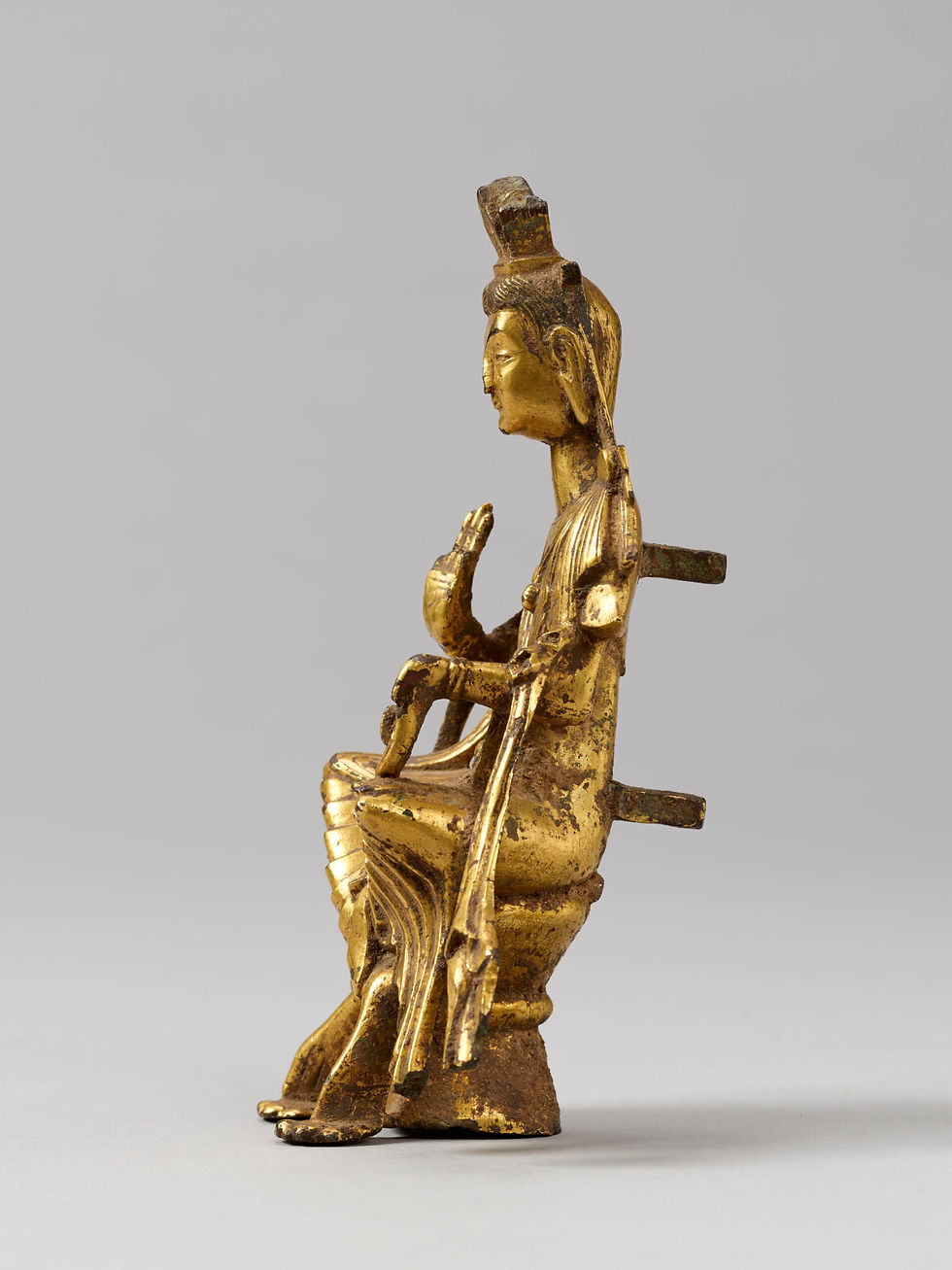
This gilt-bronze cross-legged seated Maitreya Bodhisattva is in the collection of the Fujita Museum, Osaka. The figure, with a slight archaic smile, sits with legs crossed atop a rare one-legged bird. Total height is approximately 44.5 cm; the figure alone measures 16.7 cm. An inscription on the reverse of the pedestal records that it was commissioned in the third month of the first year of the Shengui era (518) of the Northern Wei, in Quyang (present-day Hebei).
A one-legged bird serving as a mount for a Buddhist image is virtually unknown in surviving Chinese Buddhist art. The two winged bird forms at the ends of the arches on the lower level of the south face of the central pillar in Cave 6 at Yungang, identified by scholars as Garuda, may remotely echo independent Han-dynasty phoenix figures (such as the example shown in J. J. Lally’s 2011 exhibition, and discussed in recent SACA notes). Yet their form and function remain fundamentally different.
Most scholars, including those in Japan and Taiwan, consider that the condition of the joints indicates the bird and the figure were originally separate, with the bird a later addition. Although the pedestal bears a clear dated inscription, it too may not be original to the image. This raises two key questions:
The turtle and coin-like motifs on the pedestal are extremely rare. If the pedestal is not original, is the inscription genuine? Can the Shengui first-year (518) date be trusted?
What exactly is the one-legged bird? From which period does it date? Is it the one-legged bird mentioned in the Shanhaijing? Or does it represent a craftsman’s misreading and creative reinterpretation of the Garuda or phoenix during the process of sinicization—or is it simply a fabrication?
This statue is highly distinctive for the bodhisattva seated on the back of a one-legged bird. Early studies (e.g., Matsubara Saburō, Ishimatsu Hinako) focused mainly on its cross-legged posture and late Northern Wei style, almost never addressing the bird-riding motif.
Recently, Zhang Zhihan first focused on the bird, linking it to the Buddhist Golden-winged Bird (Garuda) and the traditional Chinese one-legged birds Bifang and Shangyang. Shimono Akiko further traced pre-Northern Wei texts and images (Bifang on the Wu Family Shrines stones, “Shangyang” on the Foyemiaowan bricks at Dunhuang, and other one-legged auspicious birds on Han pictorial stones). She notes that the bird does not closely match the phoenix-style birds commonly interpreted as Garuda at Yungang and Longmen, nor the images of Bifang and Shangyang, sharing only the single-leg feature. Orthodox Buddhist scriptures provide no direct basis for Maitreya riding a Garuda; only the apocryphal Puxian pusa shuo zhengming jing describes a Garuda rescuing beings to Tuṣita Heaven at the same time Maitreya descends, but this text is later than the statue and does not mention riding.
The key advance is a Northern Qi Tianbao-year (550) stone fragment: only the tips of three hooked claws remain on a square pedestal, with an inscription reading “Respectfully made one image of a Contemplative Bodhisattva.” Although not Maitreya, this fragment demonstrates that the form of a bodhisattva riding a one-legged bird was indeed possible in the Northern Dynasties, making the previously isolated Fujita example no longer entirely without parallels and significantly increasing the plausibility of the bird-riding motif. Overall research remains at the stage of exploring origins; the precise reason why one-legged birds became vehicles for Buddhist deities has not yet been fully explained.

雲岡石窟第六窟中心塔柱南面下層西內部拱端鳥形

雲岡石窟第六窟中心塔柱南面下層東內部拱端鳥形

A GILT BRONZE FIGURE OF A PHOENIX, Western Han Dynasty (206 B.C. – A.D. 8)
J.J.Lally, Ancient Chinese Bronzes March 19 - April 9, 2011, no.20
金銅造弥勒菩薩交脚坐像
こんどうぞうみろくぼさつこうきゃくざぞう
Gilt-Bronze Seated Maitreya Bodhisattva
中国・北魏時代 6世紀
表情は乏しいながらも口角をやや上げ微笑をたたえる、いわゆるアルカイクスマイルの金銅仏です。一本足の鳥の上に乗るめずらしい表現ですが、接合部分の状態から本来は仏と鳥は別であったと考えられます。台脚背面の銘文には、中国・北魏の神亀元年(518)に現在の河北省曲陽の地域で作られたとあります。この台脚と像もセットではなかった可能性がありますが、線的な衣文(えもん)の表現や体のプロポーションなどから、銘文にある年と近い時期の制作と考えられます。


Comments