
春秋戰國 vol.16 秦國:鷙鳥鴟梟形金飾片,甘肅省禮縣大堡子山遺址 - Qin, Gold Plate in Bird Form

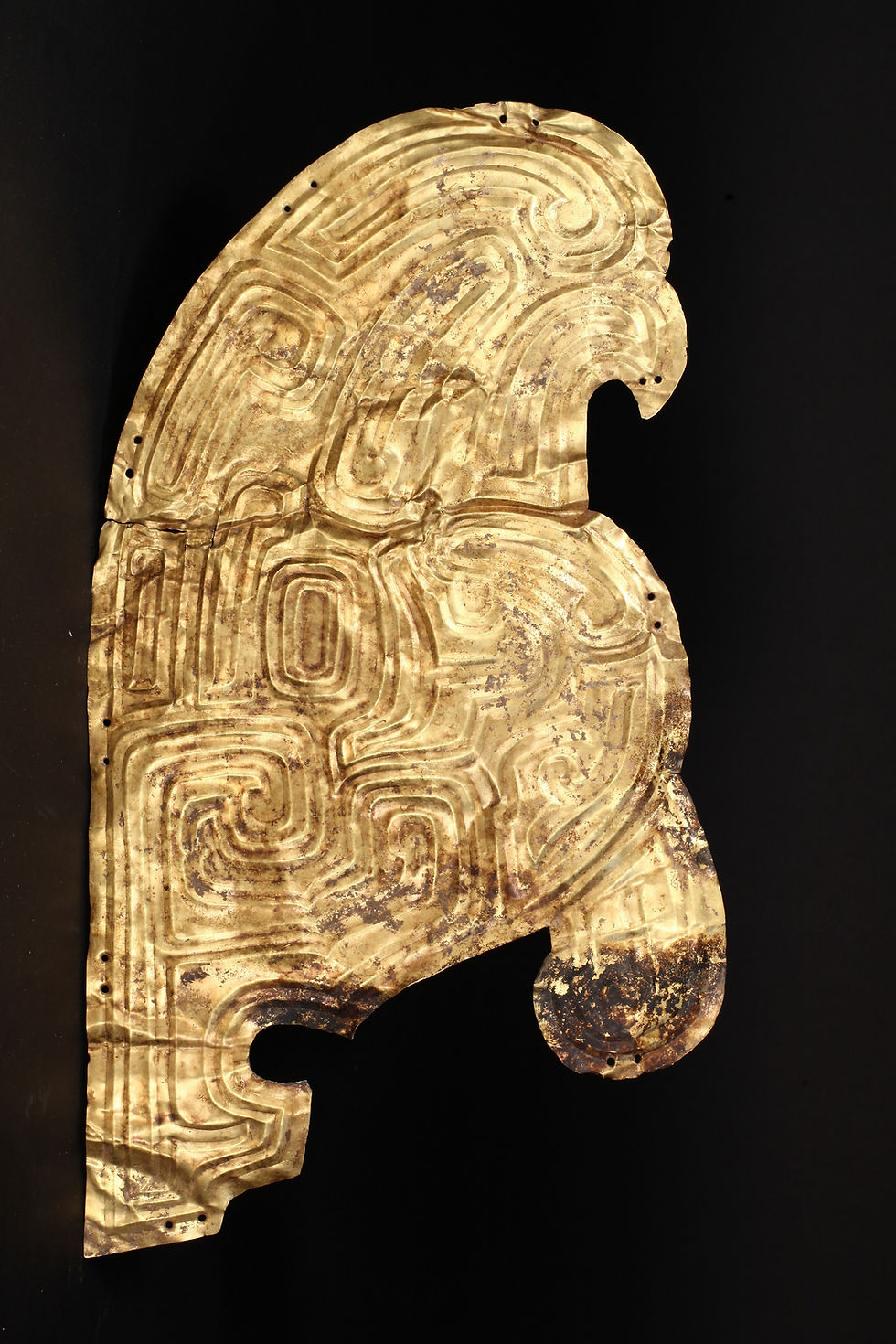
鷙鳥鴟梟形金飾片
春秋早期(公元前七七〇年—前七世紀上半葉)
長四二・七釐米,寬三四・六釐米
甘肅省禮縣大堡子山遺址出土
甘肅省博物館藏
這是一對(或一組)以金箔錘揲而成的鷙鳥側面立像。勾喙環目,突胸曲爪,尾羽卷曲下垂,通體飾以不規則的凹凸勾曲紋,象徵翎毛的層次與動勢。邊緣均勻分布成對釘孔,顯示它曾被固定於棺椁之上。金箔極薄(約〇・一至〇・二毫米),正面打磨光潔,背面較為樸素,部分鏤空處或曾鑲嵌其他材料。如此大幅面的金飾,在早期秦文化中極為罕見,也是目前所見秦公陵園金器中體量最為可觀的作品之一。
大堡子山位於禮縣永興鎮、永坪鎮境內,西漢水與漾水河環抱,被公認為文獻所載的「西犬丘」「西垂」——秦人早期都邑與公陵所在。上世紀九十年代初,陵園慘遭瘋狂盜掘,大量青銅器與金飾片流失海外。這批金飾片(包括鷙鳥形、圭形、竊曲形、鱗形等八十餘件)於一九九〇年代中期在法國私人收藏中被學者韓偉辨識,其後經中國政府長期外交與法律努力,於二〇一五年分批回歸,全部劃歸甘肅省博物館收藏。這是中國首次成功主動追索並實現大規模回歸的早期秦文物事件,具有標誌性意義。
鷙鳥,即凶猛之鳥。秦人始祖少昊名「鷙」,少昊部族以鳥為圖騰。秦公大墓以成對大金鷙裝飾棺椁,既是對祖先族神的崇敬,也寄託護佑亡靈升天的願望。金飾片的造型融合了中原紋樣傳統與西戎文化的雄健氣質,顯示早期秦人在西垂邊陲既堅守東方祖先信仰,又積極吸收周邊族群的審美與工藝。它與同出的其他金飾片共同構成棺飾系統,再現了春秋早期秦公葬禮的奢華與象徵體系。
在SACA學會的文章矩陣中,這件鷙鳥形金飾片與前兩篇形成清晰的縱深對話:
《vol.14 「秦人」卜甲》以西周王室占卜文字,將「秦人」首次寫入歷史記錄;
《vol.15 蟠龍紋銅車形器》以春秋中期西垂貴族的精緻弄器,展現秦人在故地的物質創造與審美個性;
而這件春秋早期的大金鷙,則直接出自秦公陵園,以黃金與圖騰的語言,表達最高等級的祖先崇拜與身份宣示。
三者共同勾勒出一條從「被命名」到「自我塑造」、從文字到器物、從周原核心到西垂故都的完整軌跡。SACA一貫強調:早期秦文化的研究,必須將文字材料、青銅禮器、金玉飾件與遺址空間置於同一網絡中考察。唯有如此,方能看見秦人如何在邊陲環境中,逐步建構屬於自己的禮制、信仰與藝術語言。
這對金鷙不僅是工藝傑作,更是秦人精神世界的物化象徵——它讓我們在黃金的光芒中,看見一個族群對自身起源的記憶,以及在西垂大地上建立起的最初榮耀。


尋蹤|大堡子山鷙鳥形金飾片的流失與回歸
SACA Society for Ancient Chinese Art
上世紀九十年代初,甘肅禮縣大堡子山秦公陵園遭遇大規模盜掘。西垂故地的公墓被挖得千瘡百孔,大量青銅器與金飾片被走私出境。這批金飾片中,最引人注目的是成對的大型鷙鳥形金飾片——勾喙環目、突胸曲爪,通體錘揲勾曲紋,體量可達四十餘釐米,原本應釘附於秦公棺椁之上,象徵祖先圖騰與護佑。
一九九三年前後,法國古董商、學者克里斯蒂安·戴克成(Christian Deydier,中文名戴克成/戴克誠)從香港一位台灣古董商手中購得一批金飾片。一九九四年春,時任陝西省考古研究所所長的韓偉應戴克成邀請赴法,在其巴黎寓所見到這批器物。韓偉當即震驚:形制奇特、數量眾多、製作精美,前所未聞,並初步認定它們出自大堡子山被盜秦公墓。戴克成後來在圖錄《秦族黃金》中以繁體中文書寫:「一個難得的天賜良機,讓我獲得了如此罕見的珍寶。」
約二零零零年,戴克成又從原賣家遺孀處購得兩對大型鷙鳥形金飾片。他將它們出示給好友、時任法國總統希拉克。希拉克極為欣賞,認為如此珍品應入博物館。經希拉克牽線,法國收藏家、奢侈品集團掌門人弗朗索瓦·皮諾(François Pinault)以約一百萬歐元從戴克成手中購得這兩對鷙鳥,並連同戴克成本人捐出的二十八件金飾片,一併捐贈給法國國立吉美亞洲藝術博物館。
中國方面從未放棄追索。國家文物局組織考古、科技與法律團隊,建立完整證據鏈:金飾片殘留的朱砂與土壤成分與大堡子山出土物高度一致;器形、工藝與後來科學發掘材料吻合;地方公安、法院卷宗中盜掘者的描述亦相互印證。二零一四年中法建交五十週年之際,雙方聯合專家組赴禮縣實地調查,最終確認吉美博物館所藏三十二件金飾片正是大堡子山流失之物。
當時法國《遺產法典》嚴格規定公立博物館館藏屬於「不可讓渡」(inaliénable)的公共財產。一旦金飾片捐入吉美,即進入國家公共領域,無法直接轉讓。唯一可行的路徑,是原捐贈人撤銷對吉美的捐贈,使文物退出公共領域、重回私人所有,再由原捐贈人直接交還中國。二零一五年四月十三日,皮諾透過中國駐法大使館,將四件大型鷙鳥形金飾片移交中方。五月十三日,戴克成親自攜帶二十八件金飾片抵達北京,交予國家文物局。七月二十日,三十二件文物在甘肅省博物館舉行正式移交儀式,「秦韻——大堡子山流失文物回歸特展」同步開幕。九月二十一日,戴克成再返還其收藏的另外二十四件不同形制金飾片,直接移交甘肅省博物館。
國家文物局決定,全部回歸金飾片劃撥甘肅省博物館永久收藏。這是中國首次成功主動追索並實現大規模回歸的早期秦文物事件。戴克成作為重要收藏者與返還者,在整個過程中扮演了關鍵角色——從最初的收購與展示,到最終主動撤銷捐贈並親自交還。
時至今日,大堡子山流失文物的追索仍未結束。日本美秀博物館(MIHO Museum)至今仍收藏有一對鴟梟形金飾片與一對金虎,兩者均被標為西周時期中國作品,造型與工藝與已回歸的鷙鳥形金飾片高度相近。二零二六年春季,該館更在特別展《古代黄金の物語》中公開展出這兩對金器。
值得注意的是,法國的法律環境已發生重要變化。二零二六年五月九日,馬克龍總統頒布《關於歸還因非法佔有而喪失的文物的法律》(Loi n° 2026-351)。新法打破了過去「一物一法」的困境,允許政府在符合條件時,以行政法令將特定文物從公共領域移出,無需再為每件文物單獨立法。其適用範圍為一八一五年十一月二十日至一九七二年四月二十三日之間,以盜竊、掠奪或脅迫方式取得的外國文物。雖然主要針對殖民時期掠奪,但法律文字採「非法佔有」概念,理論上可涵蓋同期其他地區的案例。
然而,大堡子山金飾片的盜掘與走私發生於一九九〇年代初,屬於一九七二年之後的行為,並不在新法時間範圍之內。這類現代盜掘走私案件,仍需依賴一九七〇年UNESCO公約框架、雙邊外交協商,或私人藏家的自願返還。新法對圓明園等一八六〇年掠奪文物更具潛在意義,但對大堡子山這類近期案件,法律路徑與二零一五年時並無本質改變。金鳥雖已部分歸巢,西垂故地的完整圖景,仍有待更多文物的歸來,以及持續的法律與外交努力,方能真正拼合。
Tracing the Trail|The Looting and Repatriation of the Dabuzishan Raptor Gold Plaques
SACA Society for Ancient Chinese Art
In the early 1990s the Qin ducal cemetery at Dabuzishan in Li County, Gansu, suffered catastrophic looting. The tombs of the western homeland were riddled with pits; large numbers of bronzes and gold ornaments were smuggled abroad. Among the most striking were the paired large raptor-shaped gold plaques—hooked beak, round staring eyes, protruding breast, curved talons, covered in hammered curvilinear patterns suggesting feathers, some reaching over forty centimetres in length. They had originally been nailed to the coffins of Qin lords, embodying the ancestral bird totem and its protective power.
Around 1993 the French antique dealer and scholar Christian Deydier (Chinese name 戴克成 / 戴克誠) acquired a substantial group of these gold plaques from a Taiwanese dealer in Hong Kong. In the spring of 1994, Han Wei, then director of the Shaanxi Provincial Institute of Archaeology, was invited by Deydier to Paris. At Deydier’s residence Han saw the pieces and was immediately struck by their unusual form, quantity and exquisite workmanship—unlike anything previously known—and provisionally identified them as coming from the looted Qin tombs at Dabuzishan. Deydier later wrote in the catalogue Qin Gold, in traditional Chinese characters: “A rare heaven-sent opportunity allowed me to obtain such extraordinary treasures.”
Around 2000 Deydier acquired two further pairs of the large raptor plaques from the widow of the original Taiwanese dealer. He showed them to his friend, then French President Jacques Chirac, a noted admirer of Chinese culture. Chirac felt such pieces belonged in a museum. Through Chirac’s introduction, the French collector and luxury-group magnate François Pinault purchased the two pairs from Deydier for approximately one million euros and, together with the twenty-eight additional plaques donated by Deydier himself, presented them to the Musée Guimet in Paris.
China never abandoned the pursuit. The State Administration of Cultural Heritage assembled archaeological, scientific and legal teams to construct a complete chain of evidence: residual cinnabar and soil on the plaques matched material from Dabuzishan; form and technique corresponded with later scientifically excavated finds; and local police and court records of the looting cases corroborated the descriptions. In 2014, the fiftieth anniversary of Sino-French diplomatic relations, a joint expert group conducted fieldwork in Li County and confirmed that the thirty-two plaques in the Guimet were indeed the looted Dabuzishan pieces.
At that time French law strictly defined public museum collections as inalienable state property. Once the gold plaques had been donated to the Guimet they entered the public domain and could not be transferred directly. The only viable path was for the original donors to revoke their gifts, returning the objects to private ownership, after which the donors themselves could hand them back to China. On 13 April 2015 Pinault delivered the four large raptor plaques through the Chinese Embassy in France. On 13 May Deydier personally brought twenty-eight plaques to Beijing and presented them to the State Administration of Cultural Heritage. On 20 July the formal handover of the thirty-two pieces took place at the Gansu Provincial Museum, accompanied by the opening of the exhibition “Qin Resonance—Repatriated Cultural Relics from Dabuzishan.” On 21 September Deydier returned a further twenty-four plaques of various forms from his remaining collection, handed over directly in Gansu.
The State Administration of Cultural Heritage decided that all the returned gold ornaments should be permanently allocated to the Gansu Provincial Museum. This was China’s first successful large-scale active repatriation of early Qin cultural relics. Deydier, as both major collector and key participant in the return, played a central role—from the initial acquisition and scholarly presentation to the final voluntary revocation of the donation and personal delivery.
To this day the recovery of cultural relics from Dabuzishan remains incomplete. The Miho Museum in Japan still holds a pair of owl-raptor-shaped gold plaques (chīxiāo-form) and a pair of gold tigers, both attributed to the Western Zhou period of China. Their form and craftsmanship closely correspond to the repatriated raptor-shaped gold plaques. In spring 2026 these pieces were publicly exhibited in the museum’s special exhibition Tales of Ancient Gold.
Notably, the legal landscape in France has undergone an important change. On 9 May 2026 President Macron promulgated the Law on the Restitution of Cultural Property that has been the Subject of Unlawful Appropriation (Loi n° 2026-351). The new law breaks the previous “one object, one statute” bottleneck by allowing the government, under defined conditions, to remove specific items from the public domain by administrative decree without the need for special legislation in each case. It applies to foreign cultural property illicitly appropriated—through theft, pillage, or transfer under coercion—between 20 November 1815 and 23 April 1972. Although primarily directed at colonial-era appropriations, the language of “illicit appropriation” is broader and could theoretically encompass cases from other regions within the same period.
However, the looting and smuggling of the Dabuzishan gold plaques occurred in the early 1990s, after 1972, and therefore fall outside the temporal scope of the new law. Cases of modern illicit excavation and trafficking continue to rely on the 1970 UNESCO Convention framework, bilateral diplomacy, or voluntary returns by private collectors. The new legislation holds greater potential significance for objects taken during the 1860 sack of the Yuanmingyuan, yet for recent cases such as Dabuzishan the legal pathway remains essentially unchanged from 2015. While some of the golden birds have returned to the nest, the full picture of the western homeland still awaits the return of further pieces, sustained legal effort, and continued diplomatic will before it can be completely restored.


Gold Plaque in the Form of a Raptor (Zhi-bird)
Early Spring and Autumn period (770 BCE – first half of the 7th century BCE)
Length 42.7 cm, width 34.6 cm
Excavated from the Dabuzishan site, Li County, Gansu Province
Collection of the Gansu Provincial Museum
This is a large gold-foil plaque (or pair) hammered into the profile of a fierce raptor. It shows a hooked beak, round staring eyes, protruding breast, curved talons and a curling tail. The entire surface is covered with irregular raised and recessed curvilinear patterns that evoke layers of feathers. Pairs of nail holes along the edges indicate that it was originally fixed to a coffin. The foil is extremely thin (approximately 0.1–0.2 mm); the front is carefully polished while the reverse is left relatively plain. Some openwork areas may once have held inlays. Such a large-format gold ornament is rare in early Qin culture and ranks among the most impressive gold pieces recovered from the Qin ducal cemetery.
Dabuzishan, located in Yongxing and Yongping townships of Li County and embraced by the Western Han and Yangshui rivers, is widely identified as the historical “Xiquanqiu” or “Xichui”—the early Qin capital and ducal burial ground. In the early 1990s the cemetery suffered catastrophic looting; large numbers of bronzes and gold ornaments were smuggled abroad. These gold plaques (over eighty pieces in various forms, including raptors, gui-shaped, qiequ-patterned and scale-shaped) were identified in a French private collection in the mid-1990s by the archaeologist Han Wei. After prolonged diplomatic and legal efforts by the Chinese government, they were returned in batches in 2015 and allocated to the Gansu Provincial Museum. This recovery is regarded as China’s first successful large-scale active repatriation of early Qin cultural relics.
The zhi-bird is a fierce raptor. The Qin ancestral figure Shaohao bore the name “Zhi,” and the Shaohao tribe took the bird as its totem. The placement of large paired gold raptors on the coffins of Qin lords expressed both reverence for the ancestral deity and the hope that the totem would protect and guide the deceased. The plaques combine Central Plains decorative traditions with the vigorous aesthetic of the western Rong cultural sphere, illustrating how early Qin people in the Xichui frontier maintained their eastern ancestral beliefs while absorbing neighbouring artistic and technical influences. Together with the other gold ornaments from the same tombs, they formed a coherent coffin-decoration system and reveal the splendour and symbolic order of early Spring and Autumn Qin ducal funerals.
Within SACA’s article matrix this piece enters into dialogue with the two preceding entries.
Vol. 14 “Qinren” Oracle Bone records the name “Qin people” for the first time in a Western Zhou royal divinatory context;
Vol. 15 Coiled-Dragon Miniature Bronze Cart presents the refined nongqi craftsmanship of mid-Spring and Autumn Qin aristocrats still residing in the western homeland;
the present early Spring and Autumn gold raptor, excavated from the Qin ducal cemetery itself, speaks in the language of gold and totem the highest level of ancestral veneration and status display.
Together the three objects trace a continuous trajectory—from being named, to self-fashioning, from text to object, from the Zhouyuan core to the Xichui capital. SACA has consistently argued that the study of early Qin culture requires placing textual evidence, ritual bronzes, gold and jade ornaments, and settlement space within a single analytical network. Only then can one see how the Qin people, living on the western frontier, gradually constructed their own ritual system, belief structure and artistic language.
These gold raptors are not merely technical masterpieces; they are the material embodiment of the Qin spiritual world—allowing us, in the gleam of gold, to perceive a people’s memory of its own origins and the first glory it established on the land of Xichui.
FAQ:鷙鳥形金飾片
SACA Society for Ancient Chinese Art
一、這件金飾片的具體形制與工藝特點是什麼?
以極薄金箔錘揲而成,呈鷙鳥側面立姿。勾喙、環目、突胸、曲爪、卷尾,通體飾凹凸勾曲紋以象徵翎毛。邊緣有成對釘孔,用於固定於棺椁。部分鏤空處或曾鑲嵌。體量達四二・七釐米長,在早期秦金器中極為突出。
What are the form and technical characteristics of this gold plaque?
It is hammered from extremely thin gold foil into the profile of a standing raptor, with hooked beak, round eyes, protruding breast, curved talons and curling tail. The surface is covered with raised and recessed curvilinear patterns representing feathers. Paired nail holes along the edges allowed it to be fixed to a coffin. Some openwork areas may once have held inlays. At 42.7 cm in length it is exceptionally large among early Qin gold ornaments.
二、它為什麼被認為與秦人祖先崇拜有關?
秦人始祖少昊名「鷙」,少昊部族以鳥為圖騰。秦公大墓以成對大金鷙裝飾棺椁,既表達對族神的崇敬,也寄託護佑亡靈的願望。這是目前所見最直接的早期秦人鳥圖騰物質證據之一。
Why is it linked to Qin ancestral worship?
The Qin ancestral figure Shaohao was named “Zhi,” and the Shaohao tribe took the bird as its totem. The placement of large paired gold raptors on Qin lords’ coffins expressed reverence for the ancestral deity and the hope of protection for the deceased. This is among the most direct material evidence of early Qin bird-totem belief.
三、這批金飾片的流失與回歸有何重要意義?
上世紀九十年代初大堡子山遭嚴重盜掘,金飾片流失海外。經中國政府長期努力,於二〇一五年分批回歸,劃歸甘肅省博物館。這是中國首次成功主動追索並實現大規模回歸的早期秦文物事件,具有標誌性意義。
What is the significance of the looting and repatriation of these gold ornaments?
The Dabuzishan cemetery suffered catastrophic looting in the early 1990s; the gold plaques were smuggled abroad. After prolonged efforts by the Chinese government they were returned in batches in 2015 and allocated to the Gansu Provincial Museum. This is regarded as China’s first successful large-scale active repatriation of early Qin cultural relics.
四、它在SACA「春秋戰國」系列文章矩陣中的位置是什麼?
與《vol.14 「秦人」卜甲》(文字命名)、《vol.15 蟠龍紋銅車形器》(西垂貴族弄器)形成縱深對話,共同呈現從被記錄到自我表達、從周原到西垂的完整軌跡,體現SACA以網絡化思維考察早期秦文化的方法。
How does it fit within SACA’s “Spring and Autumn–Warring States” series matrix?
It forms a deep dialogue with Vol. 14 “Qinren” Oracle Bone (textual naming) and Vol. 15 Coiled-Dragon Miniature Bronze Cart (aristocratic nongqi of the western homeland), together tracing the trajectory from being recorded to self-expression, from Zhouyuan to Xichui, and exemplifying SACA’s networked approach to early Qin culture.
五、這件器物反映了早期秦文化的哪些特質?
它同時展現對東方祖先信仰的堅守與對西戎文化的吸收,以及在邊陲環境中發展出的高度金工技術與等級象徵系統,是理解秦人如何在西垂建構自身文化認同的關鍵實物。
What characteristics of early Qin culture does this object reveal?
It simultaneously demonstrates the maintenance of eastern ancestral beliefs, the absorption of western Rong cultural elements, and the development of sophisticated gold-working techniques and hierarchical symbolism on the frontier—making it a key artefact for understanding how the Qin constructed their cultural identity in Xichui.
六、目前研究還有哪些需要注意的問題?
部分金飾片的精確組合方式、是否成對使用、鏤空處原有鑲嵌物的性質,以及與棺椁其他裝飾的完整關係,仍需結合考古殘留痕跡與比較材料進一步研究。SACA主張以多重證據謹慎詮釋,避免單一圖騰論的過度推論。
What open questions remain?
The precise original arrangement of the plaques, whether they were used in pairs, the nature of any original inlays, and their complete relationship with other coffin decorations still require further study combining archaeological residues and comparative material. SACA advocates cautious interpretation based on multiple lines of evidence, avoiding over-extension of a single totemic reading.


Comments