
青銅筆記 vol.50 藍理捷:西周早期芮公青銅方座簋,銘文「芮公為旂宮寶簋」 - J.J.Lally, An Archaic Bronze Ritual Food Vessel (Gui), Inscribed Rui Gong, Early Western Zhou Dynasty


此件西周早期芮公方座簋,銘文「芮公為旂宮寶簋」,出自傳奇古董商藍理捷(J.J. Lally)2011年春季特展。方座簋級別較高,國際流通市場上價格不菲,參見一件埃斯肯納齊經手的「伯矩簋」:青銅筆記 vol.33 埃斯肯納齊:西周早期青銅伯矩簋 - Eskenazi, Archaic Bronze Vessel of Bo Ju Gui, Early Western Zhou Dynasty
芮公為姬姓芮國之君。芮國乃周初畿內重要邦國,國君世代入朝為卿士。《尚書·顧命》載成王臨終,「乃同召太保奭、芮伯、彤伯、畢公、衛侯、毛公」,芮伯位居次席,可見其在王室中的崇高地位。此器銘中「芮公」與文獻中的「芮伯」相互印證,正是西周早期芮國國君為宗廟所作之禮器。尤為難得的是,此簋皮殼保存極佳,通體呈溫潤的金黃色,間有零星翠綠色鏽斑點綴,正是青銅器鑄成之初的本色,歷三千年而光澤猶存,殊為可貴。
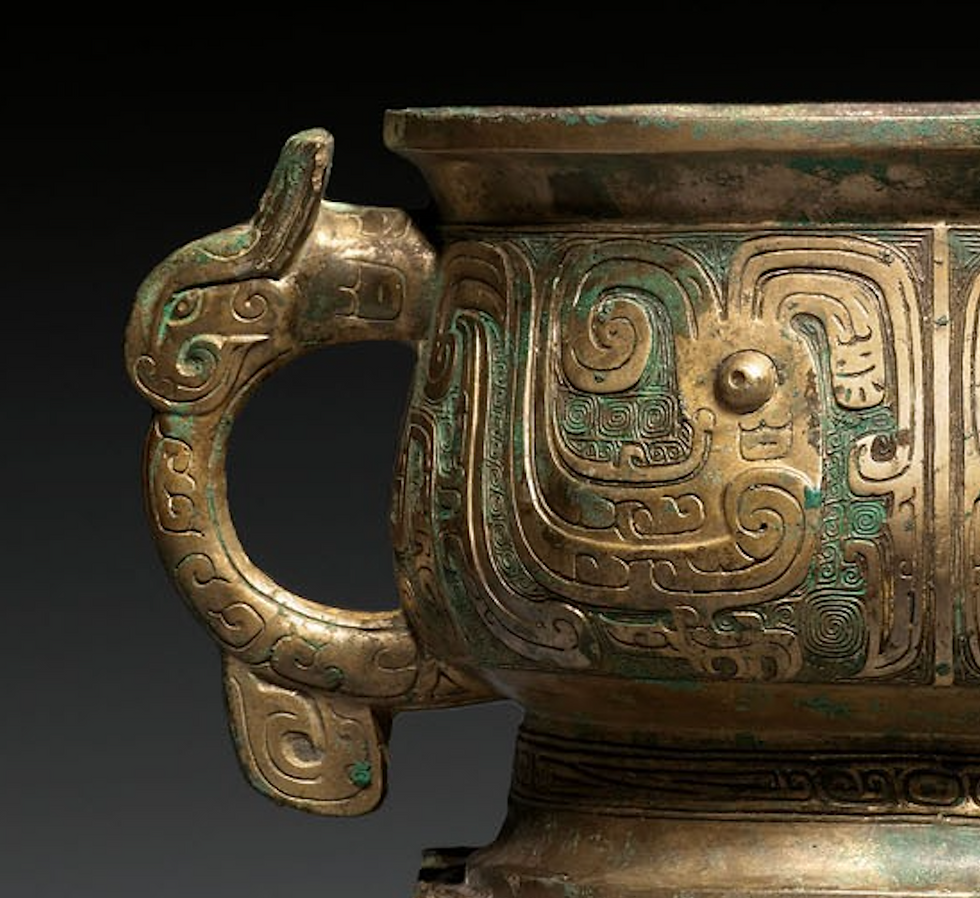

西周早期芮公青銅方座簋
展覽著錄: 藍理捷(J.J. Lally & Co.),《中國古代青銅器》(Ancient Chinese Bronzes),2011年3月19日至4月9日,編號3。
銘文:「芮公為旂宮寶簋」
尺寸: 寬 28 厘米(含雙耳)
此件銅簋圓腹深闊,造型飽滿。器身以浮雕工藝精鑄兩對相背的鳳鳥紋(大鳥紋),鳥首迴顧,圓目炯然,巨喙如鉤並捲曲成精緻的渦狀;寬大的尾羽向外舒展,填滿兩側空間。神鳥紋表面以陰線細膩刻畫卷雲紋,並點綴勾羽紋,底襯細密繁複的雷紋地,層次分明。
器身束腰圈足處,飾以一圈狹長的經典雲雷紋帶。下承高挺的方形底座(方座),四面亦飾有四對與器身相呼應的相背鳳鳥紋。方座頂部四角的邊隅處,則精巧地填飾兩兩相對的無身夔龍紋。
簋口微侈,折沿無紋。器腹兩側置有粗壯的獸首半環耳,下帶垂珥,獸首高聳鬈角,威猛莊嚴。整器保存極佳,淡金褐色的溫潤銅胎上,零星散佈著明艷的孔雀綠鏽斑,古意盎然,展現出極高的金石審美價值。

【銘文考釋】
簋內底中心鑄有七字銘文: 「芮公為旂宮寶簋」
意為:芮公為「旂宮」(可能為宗廟或宮殿名)鑄造了此件珍貴的青銅簋。
【學術參閱與同類器比較】
此類帶有銘文的西周方座簋是周代高等級禮器的典型代表。在各大博物館與重要私人收藏中,可找到數件與本器高度相關的珍貴青銅器:
范季融「首陽吉金」舊藏 參考一件器形與紋飾極為相似的西周青銅方座簋(帶蓋),銘文為「芮伯作旂宮日寶簋」。該器著錄於2008年上海出版的《首陽吉金:范季融、胡盈瑩藏中國珍貴青銅器》展覽圖錄,頁100-103,編號34。
山東黃縣莊頭村出土 另一件紋飾相近的西周帶蓋銅簋,銘文為「芮公叔作旂宮寶簋」,1980年出土於山東黃縣(今龍口市)莊頭村西周墓。據學者考證該墓葬年代為西周早期,詳見《文物》1986年第8期,頁70-72。
陝西長安張家坡窖藏出土 亦可比較1961年陝西長安張家坡西周窖藏出土、現藏於陝西歷史博物館的一件方座銅簋。見1996年北京出版《中國青銅器全集:西周(一)》第5卷,頁57,編號60。該器銘文提及的歷史人物與事件表明,其年代應定於西周穆王時期(約公元前1001-947年)。
進階學術閱讀:關於周代這一重要禮器形制的綜合論述,可參閱張懋鎔教授撰寫的〈西周方座簋研究〉,載於《考古》1999年第12期,頁69-76。
Ancient Chinese Bronzes
March 19 - April 9, 2011
3. AN ARCHAIC BRONZE RITUAL FOOD VESSEL (GUI)
Early Western Zhou Dynasty, late 11th – 10th Century B.C.
with deep rounded sides finely cast in varied relief with two pairs of addorsed exotic birds shown in silhouette with heads turned over their backs, each with prominent round eye and large hooked beak ending in a tight volute, and with wide flaring tail-feathers filling the frame on either side, all embellished on the surface with intaglio linear scroll motifs detailed with hooks and spurs throughout and reserved on leiwen grounds, the waisted foot of the bowl cast with a narrow running band of ‘classic scroll’ motif, the tall quadrangular pedestal base decorated with four more matching pairs of addorsed birds, the spandrels on the corners of the upper base filled with confronted pairs of bodiless kui dragons, the wide flaring mouth with galleried rim left undecorated above a pair of tabbed loop handles issuing from monster heads with high curled horns, the surface very well preserved with lightly encrusted areas of bright malachite green corrosion widely scattered over the pale golden-tan lustrous metal, with an inscription of seven characters cast in the center of the interior of the bowl.
Width over handles 11 inches (28 cm)
The inscription may be read as: Ruigong wei qi gong bao gui (芮公為旂宮寶簋) and may be translated as “Ruigong made this precious gui vessel for the Qi palace.”
A Western Zhou bronze gui and cover of very similar form and decoration, inscribed Ruibo zuo qi gong ri bao gui, is illustrated in the exhibition catalogue Ancient Chinese Bronzes from the Shouyang Studio: The Katherine and George Fan Collection, Shanghai, 2008, pp. 100-103, no. 34.
Another very similarly decorated bronze gui and cover, inscribed Ruigongshu zuo qi gong bao gui, unearthed in 1980 from a Western Zhou tomb at Zhuangtou village, Huang county, Shandong province, is illustrated in the excavation report in Wenwu, 1986, No. 8, pp. 70-72, where the scholars attributed the tomb to early Western Zhou dynasty.
Compare also the bronze gui excavated in 1961 from a Western Zhou hoard at Zhangjiapo, Chang’an, Shaanxi province, and now in the Shaanxi History Museum, illustrated in Zhongguo qingtongqi quanji: Xi Zhou, I (Compendium of Chinese Bronzes: Western Zhou, I), Vol. 5, Beijing, 1996, p. 57, no. 60, with description and further details on p. 18 and with a rubbing of the long inscription inside the bowl on p. 64. The inscription mentions historical figures and events which indicate that the gui should be dated to the reign of the early Western Zhou King Mu (r. 1001-947 B.C.).
For a comprehensive discussion of this important Zhou dynasty ritual vessel form, see “A Study of the Western Zhou Bronze Gui with a Square Pedestal” by Zhang, Kaogu, 1999, No. 12, pp. 69-76.
西周早期 芮公銅簋寬 28 厘米


Comments