
拍賣筆記 vol.522 邦瀚斯巴黎2026:吉賽爾專場,秦公鎛,銘文「秦公作鑄鎛龢鐘」 - Bonhams Paris 2026, Gisele Croes Sale, A Large Archaic Bronze Bell, Bo, Spring and Autumn Period


本件42 cm體量、南方系大型鉤形透雕蟠龍扉棱、內壁短銘「秦公作鑄鎛龢鐘」,在私人收藏與拍賣市場中極為罕見,與太公廟出土組(現藏寶雞)及美秀、上博藏品形成最核心的比對群。其學術價值與市場稀缺性突出。(SACA觀察,2026.11.23)
秦公鎛
銘文「秦公作鑄鎛龢鐘」
春秋時期,公元前七世紀早期
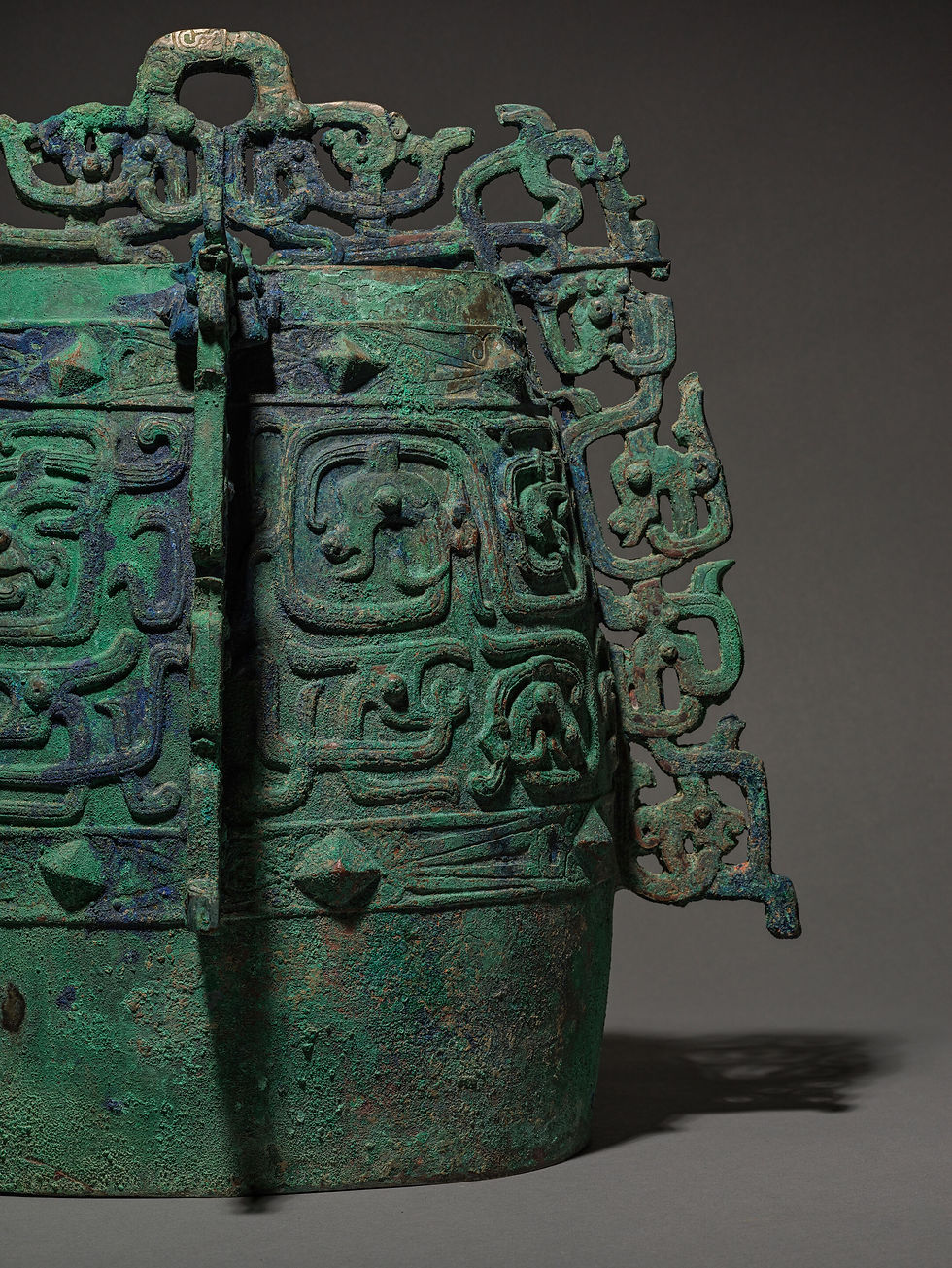
器呈橢圓截面,口沿平齊,兩側鼓起後向上收斂至平頂。器表以四條鉤形透雕扉棱分隔為四區,扉棱飾交錯蟠龍。器身飾寬帶紋,內含兩列交錯蜿蜒蟠龍,龍目凸出、龍吻張開並呈鉤狀,其間為菱形乳突與蟬紋相間的飾帶。頂部有倒U形紐。內壁鑄七字銘文:「秦公作鑄鎛龢鐘」(意為「秦公作此鎛,以與鐘龢協」)。
估價:
€80,000–€120,000(約HK$690,000–HK$1,000,000)
拍賣:
2026年12月10日,巴黎 Avenue Hoche
來源:
清翫雅集(台灣),2000年前;
Gisèle Croës Arts d’Extrême Orient(布魯塞爾),2017年
著錄:
鴻禧藝術文教基金會《千禧年清翫雅集收藏展》,台北,2000年,第214頁,編號118;
Gisèle Croës《Collecting Chinese Art, Bronze–Gold–Silver, Part 1》,紐約,2018年
尺寸:高42 cm × 寬41 cm × 深36 cm


此鎛鑄造精工,蟠龍交錯繁複,為春秋早期(約前770–前476年)東周青銅器技術傑作。鎛為早期中國第二類重要編鐘形制,與鐃(nao)明顯不同:鐃口呈尖橢圓且口沿內凹,鎛口為圓潤橢圓且口沿完全平齊。頂部倒U形紐表明其垂直懸掛於大型框架,口向下。無舌,以木槌敲擊口沿上方中央發聲。圓形截面與平口使其不能如鐃般產生雙音,或用於強調節奏、配合雙音鐃演奏旋律。體量較大,在打擊樂器組合中地位特殊。迄今未見超過三件成組出土的鎛,本件可能原屬三件一組。
紋飾以寬帶內兩列疏朗的大型交錯蜿蜒蟠龍為主,龍身交纏,上下以大型尖菱形乳突帶為界。大型透雕扉棱將器表分為四區,並與頂紐相連。風格獨特,與北方及中原出土鎛明顯有別,更接近南方晚西周至早東周帶大型鉤形扉棱的鎛(參Jessica Rawson, Western Zhou Ritual Bronzes in the Sackler Collections, Washington, D.C., pp. 753–757, no. 129)。
內壁銘文「秦公作鑄鎛龢鐘」,譯為「秦公作此鎛,以與鐘龢協」。此銘將本件與1978年陝西寶雞太公廟村出土的三件巨型秦公鎛(Jessica Rawson, ibid., p. 758, fig. 129.8)相聯繫。該組秦公鎛器身下部有長篇銘文,記秦公(在位前697–前677年)下令鑄造。春秋時期秦國崛起為五霸之一,本件或與太公廟秦公鎛同鑄於同一作坊、同一時期。
本件極為罕見。除太公廟三件秦公鎛外,形制、紋飾及特徵相近者僅知兩件:一件為日本加賀美秀美術館藏(The Miho Museum. South Wing, Kaga, 1997, pp. 176–177, no. 81);另一件為上海博物館藏(陳燮君編,《上海博物館》,香港,2007年,第41頁,編號37)。

同款/相近博物館藏品
此類春秋早期大型南方系鎛(橢圓截面、平口、大型鉤形透雕蟠龍扉棱、交錯蟠龍主紋、倒U形紐、短銘文)極為稀少。最重要比對如下:
藏處 | 尺寸/說明 | 連結 |
寶雞青銅器博物院(太公廟秦公鎛,一套三件) | 1978年陝西寶雞陳倉區太公廟村窖藏出土。最大通高75.1 cm、鎛身高53 cm、重62.5 kg。形制、紋飾、銘文基本相同,器身有135字長銘,記秦武公祭祀先祖,提及襄公「賞宅受國」及文公、靜公、憲公業績。國家一級文物,鎮館之寶。 | |
美秀美術館(Miho Museum,日本) | 東周早期(前7世紀),高67.3 cm。橢圓截面、平口、大型透雕蟠龍扉棱、交錯蟠龍紋,與本件最為接近。 | |
上海博物館 | 春秋早期秦公鎛,高約38.5 cm。形制相近,鼓部有銘文「秦公作鑄□□鐘」(字畫較淺)。Bonhams注釋明確比對此件(陳燮君編《上海博物館》,2007,p. 41, no. 37)。 | 上海博物館官網(青銅器館/相關展覽) |
天津博物館(克鎛,參考) | 西周晚期克氏器。扉棱與形制有可比性,但年代更早、銘文與風格不同。美秀目錄提及為少數帶複雜透雕扉棱的例子之一。 | 天津博物館相關藏品說明(克氏青銅器) |
補充:甘肅禮縣大堡子山出土的秦公/秦子鎛亦屬秦系早期樂器,但形制與銘文系統與太公廟組有別,多見於近年展覽。
同款/相近拍賣例(詳細,附連結)
真正形制、扉棱、主紋及短銘文與本件高度一致的春秋早期大型鎛,公開拍賣紀錄極少。以下為形制相近的鎛類(多為稍晚或風格有異的春秋鎛),供參考:
拍賣/來源 | 尺寸/說明 | 連結 |
Sotheby’s New York, 2021 | 東周春秋青銅蟠螭紋鎛,高27.2 cm。橢圓截面、多層乳突、蟠龍紐,估價USD 50,000–70,000。 | |
Christie’s New York, 2012 | 春秋早期5世紀青銅鎛,高約33 cm。成交約USD 122,500。橢圓截面、乳突與蟠龍帶。 | |
Christie’s New York, 2018前後 | 春秋晚期至戰國早期大型鎛,高約37.8–43.7 cm。C.T. Loo舊藏系統,紐為對龍/虎形。 | |
Sotheby’s / 其他 | 多件高25–40 cm的春秋鎛,常見成排乳突+獸面或蟠螭紋,紐為對獸形。成交多在數萬至十餘萬美元區間。 | 搜尋「archaic bronze bell bo Spring and Autumn」可查相關紀錄 |
資料來源:Bonhams Paris Lot 35頁面、Jessica Rawson著作、寶雞青銅器博物院、美秀美術館、上海博物館相關出版與公開資訊。
MAGNIFIQUE ET TRÈS RARE CLOCHE RITUELLE EN BRONZE, BO
Période des Printemps et Automnes, début du VIIe siècle av. J.-C.
10 December 2026, 10:30 CET
€80,000 - €120,000
HK$690,000 - HK$1,000,000
A MAGNIFICENT AND VERY RARE LARGE ARCHAIC BRONZE BELL, BO
Spring and Autumn period, early 7th century BC
Of elliptical section, with a level rim and swelling sides narrowing to a flat top, the surface divided into four sections by hooked openwork flanges depicting interlacing snake-dragons, the sides cast with a band enclosing two rows of interlaced sinuous dragons, with large bulging eyes and open, hooked snouts, between a band of diamond-shaped bosses alternating with cicadas, surmounted at the top by an inverted U-shaped loop, the interior cast with a seven-character inscription reading Qin gong zuo zhu bo he zhong ('the Duke of Qin had this bell (bo) cast to accompany the bells (zhong) harmoniously').
42 cm (16 1/2 in.) high x 41 cm (16 1/8 in.) wide x 36 cm (14 1/8 in.) deep
Provenance:
Ching Wan Society, Taiwan, by 2000
Gisèle Croës Arts d'Extrême Orient, Brussels, 2017
Published, Illustrated and Exhibited:
The Chang Foundation, Ching Wan Society Millennium Exhibition, Taipei, 2000, p. 214, no. 118 (Published)
Gisèle Croës Arts d'Extrême Orient, Collecting Chinese Art, Bronze – Gold – Silver, Part 1, New York, 2018
This magnificent bell with its exquisitely cast design of intricately interlaced sinuous snake-dragons is a technical masterpiece, and a superb example of the bronzes made during the early Spring and Autumn period (ca. 770-476 BC) of the Eastern Zhou dynasty. It represents the second important category of bells popular in early dynastic China known as bo. Visually, its shape and design are very different from bells of the nao type. Like the nao, it is of elliptical cross-section but where the nao is pointed, the bo has a rounded shape, and where the nao has a concave mouth, the bo has an entirely flat mouth. The inverted U-shaped suspension loop cast at the top of this bell indicates that it was suspended vertically from a large, solid frame with the mouth facing down. Like the nao bell, there is no indication that it had a clapper but was sounded by striking it with a mallet at a central spot above the mouth. The rounded shape and flat mouth did not permit the bo to produce two tones like the nao, and it has been suggested that bo bells such as this example may have served to accent the tempo or underlying rhythm for melodies produced by the musical two-toned nao bells. The large size of this bo bell and related examples suggests that they may have occupied a special status and function within a percussion assemblage. Never has a set of more than three bo bells been discovered and it is possible that this example was originally part of a set of three.
The surface decoration on this bell is arranged in a wide band enclosing a double register of generously spaced large interlacing sinuous snake-dragons, their bodies entwined and bordered by a band of large pointed diamond-shaped bosses. Large openwork flanges divide the surface into four segments and are joined by the loop at the flat top of the bell. The style of this bell is distinctive and very different from other bo excavated from sites in northern and central China. With predecessors in the Shang dynasty similarly cast with flanges, the features of this bo are much closer related to bells of this type made in the South during the late Western Zhou and early Eastern Zhou period, distinguished by their large, hooked flanges, see Jessica Rawson, Western Zhou Ritual Bronzes in the Sackler Collections, Washington, D.C., pp. 753-757, no. 129.
The present bo is inscribed on the inside, the inscription reading Qin gong zuo zhu bo he zhong and may be translated as 'the Duke of Qin had this bell (bo) cast to accompany the bells (zhong) harmoniously'. The inscription records that this magnificent bell was cast by order of the Duke of Qin, establishing a link to a famous set of three massive, almost identical bronze bo bells excavated 1978 in Taigongmiao village, Baoji, Shaanxi province, illustrated in Jessica Rawson, ibid., p. 758, fig. 129.8. Known as the 'Qin Gong' bells, each bell is inscribed with a lengthy inscription on the lower part of the body documenting that these bells were cast on the order of a Duke of Qin (r. 697-677 BC). During the Spring and Autumn period the state of Qin emerged as one of the major powers and one of the five hegemons competing for supremacy. It may be assumed that the present bo bell may have been cast in the same workshop and at the same time as the set of Qin Gong bo bells from Baoji.
This present bo is a rare example and, apart from the set of three 'Qin Gong' bo bells, only two other bells of this shape and design and distinctive features are known. The first is a closely related bronze bo bells of similarly large proportions and design is in the collection of the Miho Museum, Kaga, Japan, illustrated in The Miho Museum. South Wing, Kaga, 1997, pp. 176-177, no. 81, the second in the collection of the Shanghai Museum, published in Chen Xiejun (ed.), Shanghai Museum, Hong Kong, 2007, p. 41, no 37.


Comments