
拍賣筆記 vol.503 蘇富比香港2026:賽克勒、戴潤齋,商晚期青銅弄器提梁卣,萬古之幽專場 - Sotheby’s HK 2026, A Miniature Bronze Royal Ritual Wine Vessel And Cover, You, Late Shang Dynasty


弄器概念,SACA學會過去多有提及。這件器物傳承上來自戴潤齋(J. T. Tai),再經過賽克勒的收藏,這個組合在早期重要青銅器上多有出現。著錄上有著名的貝格立(Robert Bagley)背書。此卣2019年佳士得紐約拍出,388萬港元售出。(SACA觀察,2026.10.25)
弄器」(nongqi)概念簡述
「弄器」指商周青銅器中體量明顯較小、鑄造精良、細節繁複的一類器物。傳統觀點(唐蘭、黃銘崇等)多認為其供貴族近距離賞玩、把玩,而非大型宗廟祭祀用器;字源上「弄」含雙手持玉之意,強調可把玩、珍愛。另有學者(如李零、部分古文字學者)指出自銘「弄」者尺寸不一,或與「奉/獻」相關,功能仍有爭議。自銘「弄」的實例約十餘件,多見於高等級(尤其女性)墓葬或私密場合。
SACA學會多次以學術筆記方式討論此概念,強調其尺寸小巧、工藝複雜、藝術性高,常出於高等級女性墓葬,可能盛液體、化妝品或作微型儀式/案頭清玩,模糊禮器與生活器用界線。
以下按博物館藏/考古出土、拍賣/市場、SACA學會提及分類整理。
一、博物館藏/考古出土弄器
1. 弗利爾美術館(Freer Gallery of Art)藏「子乍弄鳥」尊(或「子之弄鳥」)
春秋晚期,高約26.5厘米。鴞鳥形酒尊,錯金銘「子乍弄鳥」,鳥喙可開合,工藝極精。公認弄器代表,傳山西太原一帶出土,與趙卿墓鳥尊有聯繫。山西青銅博物館有複製件。
連結:Smithsonian Learning Lab 或弗利爾相關頁面。
2. 故宮博物院藏「君子之弄鬲」
戰國,通高14厘米、口徑15厘米、重1.76公斤。圓體三足鬲,帶蓋三環鈕,飾方塊綯紋,口沿銘「君子之弄鬲」。故宮認為體現戰國禮器功能轉為賞玩。
連結:故宮博物院藏品頁。
3. 韓城梁帶村芮國遺址(M26,芮國第一夫人墓)六件弄器組
西周晚期至春秋,包括鏤空龍紋方盒、雙層龍紋方鼎(高約10.3厘米)、竊曲紋圈足匜、龍紋小鍑(高約7厘米)、垂鱗紋罐、素面單把罐。器小工精,置於棺椁間靠近頭部,與大型禮器分區,發掘者定為弄器。現藏梁帶村芮國遺址博物館。
4. 安陽出土自銘弄器
1975年小屯微型方鼎蓋,銘「王作女瓦弄」。鄭振香《1975年安陽殷墟的新發現》,《考古》1976年第4期。
1987年郭家莊東南殷墓小簋,自銘弄彝,口徑約14 cm。中國社會科學院考古研究所藏,見《中國青銅器全集》卷2,圖版97。
王作弄卣(高約20.2 cm,Arnold Knapp舊藏,曾借展哈佛福格)見劉雨、汪濤《流散歐美殷周有銘青銅器集錄》圖版133,及1974年倫敦蘇富比。
5. 多倫多皇家安大略博物館(ROM)微型鼎等
商晚期微型鼎(高6.8厘米、6厘米等),見於1977年紐約華美協進社《Early Chinese Miniatures》展。黃銘崇統計商晚期微型青銅僅十餘件,此為其中。
ROM中國青銅藏品總入口:Royal Ontario Museum – Chinese Art / Bronzes
圖像見下文
6. 山西青銅博物館其他小型器
如春秋竊曲紋醽、四輪方盒等,館方以弄器類展出。
7. 禮縣圓頂山蟠龍紋銅車形器(禮縣博物館)
春秋中期,高8.8厘米、長15厘米。四輪銅車形盒,蟠龍紋,輪可轉,結構精巧,SACA視為秦國弄器典型。
二、拍賣/市場弄器
1. 蘇富比香港「Possessing the Past」商晚期微型青銅提梁卣(本拍品)
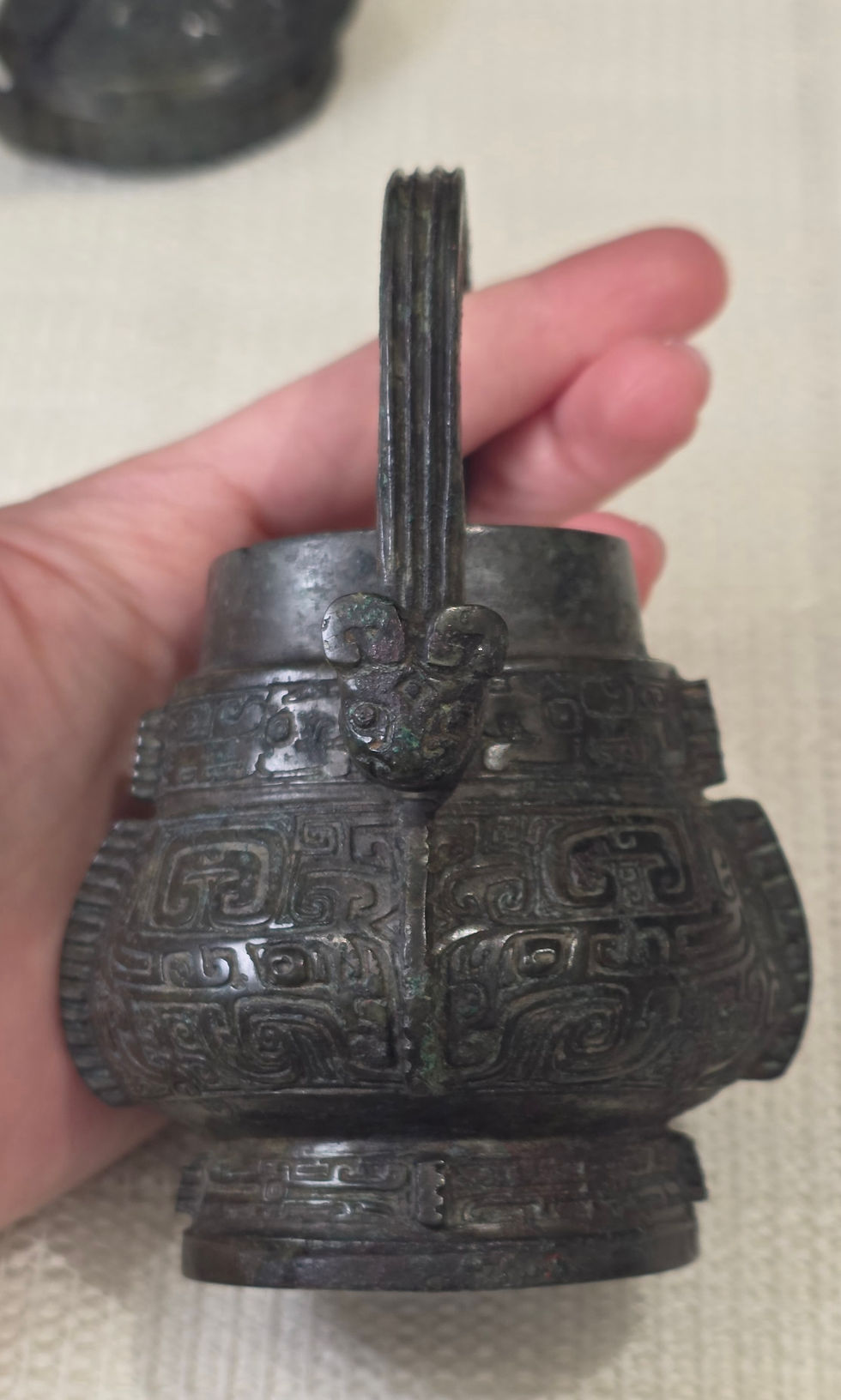
高11.5厘米(提梁直立)。典型商晚期紋飾(獸面、夔龍、扉棱),屬弄器範疇。來源:1972年倫敦蘇富比→J.T. Tai→Arthur M. Sackler舊藏→Else/Elizabeth Sackler→2019年佳士得。
2. 蘇富比香港2026岡田博物館專場:商末夔蟬紋小鼎
高16.9厘米。SACA明確標為弄器,鳳鳥+蟬紋,估價80–160萬港元,最終約120–153萬港元落槌。來源壺中居。
SACA筆記:拍賣筆記 vol.404
3. 佳士得紐約2026:商晚期弄器青銅觶(首陽齋舊藏)
高約10.6厘米,帶銘,人面傾向獸面,SACA視為袖珍弄器。
SACA筆記:拍賣筆記 vol.334
4. 其他相關
藍理捷(J.J. Lally)2003年展戰國至西漢袖珍錯金方壺(高約6厘米),SACA標為弄器,比較奈良國立博物館坂本五郎舊藏。
樂山堂商代袖珍「史」銘青銅鐃(高12.1厘米),SACA提及。
歷史上Arnold Knapp舊藏王作弄卣(1974年倫敦蘇富比)。
5.佳士得紐約 2019年9月13日 編號806 連結
A VERY RARE MINIATURE BRONZE RITUAL WINE VESSEL AND COVER, YOULate Shang Dynasty, 12th–11th century BC高 11.5 cm(含提梁)
基本資料
來源:1972年倫敦蘇富比 lot 10 → J.T. Tai → Arthur M. Sackler → Else Sackler → Elizabeth A. Sackler
文獻:Delbanco 1983, no.17;Bagley, Shang Ritual Bronzes in the Arthur M. Sackler Collections, 1987, no.65
展覽:The Metropolitan Museum of Art, The Arts of Ancient China, 1973–1977
估價:USD 200,000–300,000
成交價:USD 495,000(含佣金)約388萬港元
此即後來於蘇富比香港「Possessing the Past」以弄器概念再上拍的同一件微型提梁卣。佳士得頁面保留完整描述與圖像,可直接對照。
三、SACA學會提及的弄器
SACA在多篇青銅/商周/春秋戰國筆記中系統討論,核心觀點一致:尺寸小、工藝精、高等級女性墓常見,功能多樣(賞玩、盛物、微型儀式)。
商周筆記 vol.03(哈佛溫斯洛普舊藏商代四足龍首觥,高16.4厘米):討論弄器概念,引用弗利爾「子之弄鳥」、故宮「君子之弄鬲」、山西例子。連結:artsaca.com/post/shangzhou03
青銅筆記 vol.18(樂山堂西周鳥形蓋盒):再次引用弗利爾鳥尊與弄器定義討論。青銅筆記 vol.18 樂山堂:西周青銅鳥形蓋盒
青銅筆記 vol.44(藍理捷袖珍錯金方壺):明確標為弄器,並比較博物館藏品。連結:artsaca.com/post/bronze44
春秋戰國 vol.15(禮縣圓頂山蟠龍紋銅車):完整介紹秦國弄器實例,並回溯SACA過往討論。連結:artsaca.com/post/latezhou15
核心專論
黃銘崇〈殷代與東周之「弄器」及其意義〉《古今論衡》第6期(2001),頁66–88。中央研究院歷史語言研究所書目頁:中研院史語所《古今論衡》第6期條目(英文題:The ‘Nong vessel’ of the Shang and Western Zhou and its significance)
此文梳理自銘「弄」器、微型青銅器,並討論其與大型禮器的關係,是後續研究最常引用的基礎文獻。
開放全文或詳細摘錄
蘇榮譽〈傳承、中斷、變革與創新:春秋中期前特殊青銅盤研究〉《饒宗頤國學院院刊》第9期(2022)。全文PDF(含「早期青銅弄器與玩好性青銅器」專節,約頁186–193):HKBU Jao Tsung-I Academy PDF
文中引黃銘崇、張亞初、李零、巫鴻等觀點,並列舉商代方鼎蓋「王乍弄」、春秋「君子之弄鬲」「子之弄鳥」等實例,討論玩好性與禮器邊界。
綜合整理唐蘭、黃銘崇、李零、王人聰等觀點,並系統列出自銘「弄」的十餘件器物(含梁帶村組器、安陽小簋、弗利爾鳥尊、故宮君子之弄鬲等),對「賞玩說」與「奉器說」有清楚對比。
相關重要文獻
李零〈說匵——中國早期的婦女用品:首飾盒、化妝盒和香盒〉,《故宮博物院院刊》2009年第3期。
文中梳理自銘帶「弄」字器物約10件,並討論其與女性用品、近距離把玩的關係。
部分摘錄與圖版可參:360doc轉載相關內容
張亞初〈殷周青銅鼎器名、用途研究〉(論文,頁273–315左右,常被引於弄器討論)。
張氏將「弄器」定義為「玩弄之器」,並搜集具銘例子。
其他常被引用的早期觀點
唐蘭、陳夢家、王人聰等對「弄」字訓釋(玩器 vs. 珍惜/奉器)的討論,多見於《殷周金文集成》相關考釋及後續論文注釋中。


商晚期 青銅弄器提梁卣
An exquisite and remarkably rare miniature bronze royal ritual wine vessel and cover, You, Late Shang dynasty |
Premium Lots
Live auction begins on:
October 30, 10:00 AM HKT
Estimate
8,000,000 - 16,000,000 HKD
Description
h. 11.5 cm (handle upright)
Condition Report
In excellent condition for its age and type, general surface wear, a tiny shallow testing drill hole in the centre of the cover's interior, all bronzes from the Arthur M. Sacler Collection had been tested for alloy composition and result had been published by Robert Bagdley, Shang Ritual Bronzes in the Arthur M. Sackler Collections, 1987, p.556, no.65. X-ray available upon request.
品相極佳,表面有正常銅器氧化附著,蓋心有一淺小金屬取樣孔,係因所有賽克勒舊藏銅器皆被取樣研究金相,研究結果出版於Robert Bagdley著,《 Shang Ritual Bronzes in the Arthur M. Sackler Collections》,1987年,頁556,編號65。
來源
倫敦蘇富比1972年3月14日,編號10
戴潤齋(J. T. Tai & Co.),紐約
亞瑟·賽克勒(Dr. Arthur M. Sackler,1913-1987)收藏
艾爾莎·賽克勒(Else Sackler,1913-2000)收藏
伊麗莎白·A·賽克勒(Elizabeth A. Sackler,生於1948年)收藏
紐約佳士得2019年9月13日,編號806
展覽
《The Arts of Ancient China》,大都會藝術博物館,紐約,1973-1977年
出版
《伯林頓雜誌》(The Burlington Magazine),倫敦,1972年3月,頁30
Dawn H. Delbanco,《Art From Ritual. Ancient Chinese Bronze Vessels from the Arthur M. Sackler Collections》,華盛頓,1983年,圖版17
羅伯特·貝格利(Robert W. Bagley),《Shang Ritual Bronzes in the Arthur M. Sackler Collections》,華盛頓,1987年,圖版65
保羅·辛格醫生(Paul Singer M.D.),《Chinese Art. A Thousand Masterpieces from the Arthur M. Sackler Collections》,華盛頓,2000年,圖版63
黃銘崇,〈殷代與東周之「弄器」及其意義〉,《古今論衡》,第6期,2001年,頁79及84,圖6




蘇富比資料文章:
掌中瑰寶商晚期青銅弄器提梁卣
In tenui labor; at tenuis non gloria.
「微物之作,其榮非微」
古羅馬詩人維吉爾(公元前70-19年)《農事詩》第四卷中的這句名言,恰可概括本件青銅卣之精髓。維吉爾藉由詠嘆渺小的蜜蜂,指出事物雖微,亦可蘊含非凡意義。本件青銅卣可盈握於掌中,散發著有別於商代(約公元前1600-前1046年)宏大青銅禮器的靜謐魅力。它不以雄偉取勝,而引人近觀把玩,為鑒賞者帶來觸覺與視覺的雙重享受。
此器雖微,然其構思與鑄造卻毫不妥協。器身精鑄,呈梨形,下承圈足,束頸,上配扣合之器蓋,並連以高提梁,提梁兩端飾獸首。其紋飾繁縟精美,同樣令人讚嘆,細膩的刻劃更凸顯了器物本身的觸感。器身兩側各飾一碩大之幾何化獸面紋,臣字目突出,C形角,寬鼻,頸部與圈足則環飾幾何龍紋帶。四道扉稜將器表分為對稱的四個部分,既增強了視覺衝擊力,又賦予其雕塑般的層次感。器蓋同樣鑄造精良,紋飾與器身相呼應,兩端飾以突出的上翹犄角。將大型禮器的複雜性精準轉化為如此精緻親切之物,充分展現了商代晚期青銅匠人無盡的想像力與精湛的工藝。
本件青銅卣屬於商代青銅器中罕見的「弄器」一類。此類器物之尺寸明顯小於同期的標準青銅器。學者普遍認為,這些小型青銅器乃供貴族階層近距離欣賞與把玩之用。弄器出現於商代晚期,與用於祭祀典禮的大型禮器並存。它們製作精美,細節豐富,可能並非用於宗廟陳設或祭祀;相反,它們似乎在更私密的場合陪伴主人,透過近距離的互動與審美享受,豐富了貴族階層的日常生活,關於弄器的更多論述,見黃銘崇,〈殷代與東周之「弄器」及其意義〉,《古今論衡》,第6期,2001年,頁67-88。
「弄」字最早出現於一小批商代晚期青銅器上。1975年,河南安陽殷墟出土一件小型青銅鼎蓋(6.3 x 5.2 公分),錄於鄭振香,〈1975年安陽殷墟的新發現〉,《考古》,第4期,北京,1976年,頁264。此小鼎蓋內鑄有四字銘文:「王作女瓦弄」。相同的銘文亦見於另一件小型青銅卣(高20.2公分),曾為阿諾德·納普(Arnold Knapp)舊藏並借展於劍橋哈佛大學福格美術館,售於倫敦蘇富比1974年12月2日至3日,編號14(圖1),錄於劉雨、汪濤,《流散歐美殷周有銘青銅器集錄》,上海,2007年,圖版133。1987年河南安陽郭家莊1號墓出土另一件小型青銅簋(直徑14公分),其銘文自稱為弄彝,現藏於北京中國社會科學院考古研究所,錄於《中國青銅器全集》,卷2,北京,1997年,圖版97。

FIG. 1
A SMALL ARCHAIC BRONZE RITUAL WINE VESSEL (YOU), LATE SHANG DYNASTY, SOLD AT SOTHEBY’S LONDON, 2ND-3RD DECEMBER 1974, LOT 14.
圖1
商晚期 小型青銅卣,售於倫敦蘇富比1974年12月2至3日,編號14

FIG. 2
AN ARCHAIC BRONZE RITUAL FOOD VESSEL (DING), LATE SHANG DYNASTY, COLLECTION OF THE ROYAL ONTARIO MUSEUM, TORONTO, ILLUSTRATED IN EARLY CHINESE MINIATURES, CHINA INSTITUTE IN AMERICA, NEW YORK, 1977, CAT. NO. 1.
圖2
商晚期 青銅鼎,多倫多皇家安大略博物館收藏,錄於《EARLY CHINESE MINIATURES》,華美協進社,紐約,1977年,編號1

FIG. 3 AN ARCHAIC BRONZE RITUAL WINE VESSEL (LEI), LATE SHANG DYNASTY, COLLECTION OF THE ROYAL ONTARIO MUSEUM, TORONTO, ILLUSTRATED IN EARLY CHINESE MINIATURES, CHINA INSTITUTE IN AMERICA, NEW YORK, 1977, CAT. NO. 13.
圖3 商晚期 青銅罍,多倫多皇家安大略博物館收藏,錄於《EARLY CHINESE MINIATURES》,華美協進社,紐約,1977年,編號13
商代晚期的相關弄器極為罕見。據黃銘崇的調查(前述出處,頁84),除上述帶銘文之例外,有記錄的商晚期微型青銅器僅有十四件。其中數件曾展於紐約華美協進社1977年舉辦的《Early Chinese Miniatures》展覽,包括多倫多皇家安大略博物館藏的兩件微型青銅鼎,編號1(高6.8公分)(圖2)及11(高6公分);兩件爵,編號4(高11.7公分)及12(高8.9公分),分別為保羅·辛格醫生及約翰·克勞福德(John M. Crawford, Jr.)舊藏;一件罍(高14.6公分),編號13(圖3);一件錛(長8.1公分),編號6;以及一件斧(長7公分),編號14。
「弄」字的古文字形由上「玉」下雙「手」組成,傳達了將器物捧於手中把玩欣賞之意。因此,商代晚期的弄器並不僅限於青銅,亦有玉質者。杜金鵬認為,玉弄器乃專供把玩與陳設的獨立圓雕件,而非用於懸掛或鑲嵌的墜飾或配件,見杜金鵬,〈說弄——殷商玉器名實考之六〉,《江漢考古》,第6期,武漢,2021年,頁154-155。1975年殷墟婦好墓出土了一大批此類微型玉雕,包括精雕細琢的人物、龍(圖4)、虎及象,見中國社會科學院考古研究所編,《殷墟婦好墓》,北京,1980年,頁152-153、157。
杜金鵬結合青銅器銘文與甲骨文得出結論,弄器乃商代晚期非常珍貴的寶物。這些精工細作之器似乎並非用於正式的祭祀場合,而是作為個人珍藏,是賞賜、進獻的貴重禮物,或作為地位與恩寵的象徵,見前述出處,頁160。

FIG. 4
A JADE FIGURE OF A COILED DRAGON, LATE SHANG DYNASTY, ILLUSTRATED IN INSTITUTE OF ARCHAEOLOGY, CHINESE ACADEMY OF SOCIAL SCIENCES, YINXU FUHAOMU / TOMB OF LADY HAO AT YINXU IN ANYANG, BEIJING, 1980, COL. PL. XXVI.
圖4
商晚期 玉蟠龍,錄於中國社會科學院考古研究所編,《殷墟婦好墓》,北京,1980年,彩版26
鑄造青銅弄器的傳統並未隨商朝的滅亡而消失。在整個周代(約公元前1046-前256年),具有類似的微型器物仍持續出現。最著名其中一例是一件西周早期(約公元前1046-前771年)的微型青銅鼎(高10.6公分),曾為陶祖光(1882-1956)舊藏,現藏北京故宮博物院,錄於《故宮青銅器》,北京,1999年,圖版106。值得注意的是,該器銘文自稱為「小鼎」,表明當時對其縮小的尺寸有著明確的認知。
山西曲沃趙村的西周晚期晉侯墓(M63) 曾出土有一件鑄造精美的微型青銅盒,錄於張同心,〈梁帶村裡發現的微型青銅器〉,《大眾考古》,第9期,南京,2014年,頁67。出土時,盒內裝有一組商代微型玉雕,包括人物、熊、鴞及龜,表明這些微小的器物乃與墓主人關係密切的珍貴私人物品。
至東周時期(公元前770-前256年),最著名的弄器之一是一件春秋時期(公元前770-前476年)的鳥形酒器,曾為尤金·邁耶夫婦(Mr. and Mrs. Eugene Meyer,1875-1959)舊藏,現藏華盛頓國立亞洲藝術博物館。錄於約翰·波普(John A. Pope)等編,《The Freer Chinese Bronzes》,卷1,華盛頓,1967年,圖版106(圖5),該器特別之處在於鳥首背面錯金銘文「子之弄鳥」。據傳出土於山西太原,此銘文明確將該器定義為鳥形弄器,為「弄」字自商代首次出現數百年後的持續使用與認知,提供了罕見的文字證據。

FIG. 5
A BIRD-FORM WINE VESSEL, SPRING AND AUTUMN PERIOD, COLLECTION OF THE NATIONAL MUSEUM OF ASIAN ART, WASHINGTON, D.C., ILLUSTRATED IN JOHN A. POPE ET AL., THE FREER CHINESE BRONZES, VOL. I, WASHINGTON, D.C., 1967, PL. 106.
圖5
春秋 鳥形尊,華盛頓國立亞洲藝術博物館收藏,錄於約翰·波普等編,《THE FREER CHINESE BRONZES》,卷1,華盛頓,1967年,圖版106
綜上所述,這些例子表明,弄器構成了一個延續至商代之後的悠久傳統。儘管其器形與年代差異甚大,但它們都共同強調尺寸的微巧、工藝的精湛以及把玩的親密感,這些特質使其有別於宗廟祭祀中所使用的大型青銅禮器。本件青銅卣無疑是這一非凡傳統中最早且最傑出的代表作之一。
此件小青銅卣的器形與設計品質頂級,因受一小組類似的大型禮器而啟發。比較一件極為相似的商晚期青銅卣,曾為宋徽宗(1082-1135)御藏,錄於王黼編,《宣和博古圖》,卷9,1107-1123年,頁10(圖6);另一件浮雕紋飾更為突出者,為羅振玉(1866-1940)舊藏,錄於林巳奈夫,《殷周時代青銅器の研究:殷周青銅器綜覽》,卷2,東京,1984年,頁261,卣,編號49;第三件屬弗利爾收藏,現藏華盛頓國立亞洲藝術博物館,錄於前述出處,1967年,圖版49;第四件藏於大英博物館,由 Percy Thomas Brooke Sewell(1878-1958)捐贈,載於該館網站,館藏編號1953,0714.1。拍賣市場之相關例子,可參考一件 A.E.K. Cull 與 James Cull 舊藏,售於紐約佳士得2004年9月21日,編號147;另一件缺失提梁,售於倫敦蘇富比1973年6月5日,編號258。

FIG. 6
WOOD BLOCK PRINT OF AN ARCHAIC BRONZE YOU FROM THE IMPERIAL COLLECTION OF HUIZONG OF SONG, ILLUSTRATED IN WANG FU, ED., BOGUTU [ILLUSTRATIONS OF BROAD ANTIQUITY], REPRODUCTION OF THE BAOGUTANG EDITION BY WU WANHUA IN THE 28TH YEAR OF THE WANLI REIGN (1600), REISSUED BY TIANDU HUANG SHENG SHIZHENGTANG, IN THE 18TH YEAR OF THE QIANLONG REIGN (1753), VOL. 9, 1107-1123, P. 10.
圖6
宋徽宗御藏青銅卣木刻版畫,錄於王黼編,《宣和博古圖》,萬曆二十八年(1600年)吳萬化泊古堂本,乾隆十八年(1753年)天都黃晟師政堂重修本,卷9,1107-1123年,頁10


Provenance
Sotheby’s London, 14th March 1972, lot 10.
J. T. Tai & Co., New York.
Collection of Dr. Arthur M. Sackler (1913-1987).
Collection of Else Sackler (1913-2000).
Collection of Elizabeth A. Sackler (b. 1948).
Christie’s New York, 13th September 2019, lot 806.
Exhibited
The Arts of Ancient China, The Metropolitan Museum of Art, New York, 1973-1977.
Literature
The Burlington Magazine, London, 1972 March, p. 30.
Dawn H. Delbanco, Art From Ritual. Ancient Chinese Bronze Vessels from the Arthur M. Sackler Collections, Washington, D.C., 1983, pl.17.
Robert W. Bagley, Shang Ritual Bronzes in the Arthur M. Sackler Collections, Washington, D.C., 1987, pl. 65.
Paul Singer M.D., Chinese Art. A Thousand Masterpieces from the Arthur M. Sackler Collections, Washington, D.C., 2000, pl. 63.
Hwang Ming-chorng, ‘Yindai yu dongzhou zhi ‘nongqi’ ji qi yiyi / The ‘Nong vessel’ of the Shang and Western Zhou and its significance’, Gujin lunheng / Disquisitions on the Past and Present, no. 6, 2001, pp 79 and 84 and fig. no. 6.
A Treasure in the Palm: An Exceptional Miniature Bronze Wine Vessel
‘In tenui labor; at tenuis non gloria.’
This celebrated line from Book IV of Georgics by the Roman poet Virgil (70-19 BC) may well capture the essence of the present bronze you. Reflecting on the humble bee, Virgil recognized that subjects modest in scale may nonetheless possess extraordinary significance. Held comfortably within the palm, the present you possesses a quiet charm distinct from the imposing ritual bronzes of the Shang dynasty (c. 1600-c. 1046 BC). Rather than relying on monumentality, it invites close admiration and direct engagement, rewarding the connoisseur with an experience that is as tactile as it is visual.
Despite its miniature size, no concession was made in its conception or execution. The vessel is finely cast with a gently pear-shaped body rising from a neatly defined foot to a constricted neck surmounted by a fitted cover, all connected by a tall swing handle terminating in feline masks. Equally impressive is the richness of its decoration, meticulously rendered to accentuate the vessel's inherently tactile character. Each side is adorned with a large, stylized beast mask with bulging eyes, C-shaped horns, and broad nostrils, framed by bands of angular dragon motifs encircling the neck and foot. Four vertical flanges divide the surface into symmetrical quadrants, providing both visual impact and sculptural depth. The cover is similarly well cast and embellished, its surface continuing the decorative scheme of the body and terminating in a pair of prominent upturned projections. The remarkable precision to successfully translating the complexity of a full-sized ritual vessel into an object of exceptional intimacy demonstrates the boundless imagination and technical virtuosity of the late Shang bronze artisans.
The present you belongs to a rare group of Shang bronzes known as nongqi (nong vessels) 弄器. Vessels of this category are distinctively smaller in scale than the standard bronzes of the period. Scholars generally believe that these miniature bronzes were intended for intimate appreciation and handling by members of the aristocracy. Emerging during the late Shang dynasty, nongqi coexisted alongside the larger vessels employed in ritual and ceremonial contexts. Exquisitely crafted and rich in detail, they were likely not intended for display or use within ancestral temples; rather, they appear to have accompanied their owners in more private settings, enriching the daily lives of the elite through close interaction and aesthetic enjoyment (for more on nongqi, see Hwang Ming-chorng, ‘Yindai yu dongzhou zhi ‘nongqi’ ji qi yiyi / The ‘Nong vessel’ of the Shang and Western Zhou and its significance’, Gujin lunheng / Disquisitions on the Past and Present, no. 6, 2001, pp 67-88).
The term nong first appeared on a small group of late Shang dynasty bronzes. A bronze cover (6.3 x 5.2 cm) of a miniature ding was excavated from Yinxu at Anyang, Henan province, in 1975, published in Zheng Zhenxiang, ‘1975 nian anyang yinxu de xinfaxian [The new discovery of Yinxu in Anyang in 1975]’, Kaogu / Archaeology, vol. 4, Beijing, 1976, p. 264. This small bronze cover is cast with a four-character inscription, wang zuo wa nong (nong vessel made by the king for lady Wa) 王作女瓦弄. The same inscription appears on another small bronze you (h. 20.2 cm), formerly in the collection of Arnold Knapp and on loan to the Fogg Museum, Harvard University, Cambridge, sold in our London rooms, 2nd-3rd December 1974, lot 14 (fig. 1), illustrated in Liu Yu and Wang Tao, Liusan oumei yinzhou youming qingtongqi jilu / A Selection of Early Chinese Bronzes with Inscriptions from Sotheby’s and Christie’s Sales, Shanghai, 2007, pl. 133. Another miniature bronze gui (d. 14 cm), self-identified through its inscription as a nong vessel, excavated from tomb no. 1 in Guojiazhuang, Anyang, Henan province, in 1987, currently preserved at the Institute of Archaeology, Chinese Academy of Social Sciences, Beijing, is published in Zhongguo qingtongqi quanji [Complete collection of Chinese bronzes], vol. 2, Beijing, 1997, pl. 97.
Related nongqi from the late Shang dynasty are extremely rare. According to a survey conducted by Hwang Ming-chorng (op. cit., p. 84), only fourteen additional late Shang miniature bronzes, beyond the aforementioned inscribed examples, have been recorded. Some were included in the exhibition Early Chinese Miniatures, China Institute in America, New York, 1977, including two miniature bronze ding from the Royal Ontario Museum, Toronto, cat. nos 1 (h. 6.8 cm) (fig. 2) and 11 (h. 6 cm); two jue, cat. nos 4 (h. 11.7 cm) and 12 (h. 8.9 cm), from the collections of Dr. Paul Singer and John M. Crawford, Jr., respectively; a lei (h. 14.6 cm), cat. no. 13 (fig. 3); an adze (l. 8.1 cm), cat. no. 6; and an axe (l. 7 cm), cat. no. 14.
The ancient form of the character nong 弄 comprises two ‘hand 手’ elements surmounted by the jade 玉 radical, conveying the notion of an object intended to be held and admired. As such, nongqi were not confined to bronze, but also existed in jade during the late Shang period. Du Jinpeng identifies jade nongqi as individual carvings created for handling and display, rather than as pendants or fittings designed for suspension or insertion (see ‘Shuonong - Yinshang yuqiming shikao zhiliu / On Nong: Study on the Name and Object of Jade in Shang Dynasty (Part VI)’, Jianghan kaogu / Jianghan Archaeology, no. 6, Wuhan, 2021, pp 154-155). A substantial group of such miniature jade carvings was excavated from the tomb of Fu Hao at Yinxu in 1975, including finely worked figures of humans, dragons (fig. 4), tigers, and elephants (see Institute of Archaeology, Chinese Academy of Social Sciences, Yinxu Fuhaomu / Tomb of Lady Hao at Yinxu in Anyang, Beijing, 1980, pp. 152-153, 157).
Drawing upon both bronze and oracle bone inscriptions, Du Jinpeng concludes that nongqi ranked among the most precious luxury objects of the late Shang period. Rather than serving a formal ritual function, these exquisitely crafted works appear to have been treasured as objects of personal possession, employed as prestigious gifts or symbols of status and favor (op. cit., p. 160).
The tradition of casting bronze nongqi did not disappear with the fall of the Shang dynasty. Miniature vessels of comparable character continued to be produced throughout the Zhou period (c. 1046-256 BC). A notable example is a miniature bronze ding (h. 10.6 cm), attributed to the early Western Zhou dynasty (c. 1046-771 BC) and formerly in the collection of Tao Zuguang (1882-1956), now preserved in the Palace Museum, Beijing, illustrated in Gugong qingtongqi / Bronzes in the Palace Museum, Beijing, 1999, pl. 106. Significantly, the vessel's inscription identifies it as a xiaoding ('small ding'), demonstrating an explicit recognition of its reduced scale.
Further evidence for the continued appreciation of miniature objects among the aristocracy comes from the late Western Zhou tomb of Marquis Jin 晉侯 (M63) at Zhaocun, Quwo county, Shanxi province. Among the remarkable finds was a finely cast miniature bronze box, published in Zhang Tongxin, 'Liangdaicun li faxian de weixing qingtongqi' [Miniature bronzes discovered in Liangdai village]’, Kaogu wuyu / Popular Archaeology, no. 9, Nanjing, 2014, p. 67. Upon excavation, the box was found to contain a group of miniature Shang jade carvings depicting human figures, bears, owls, and turtles, suggesting that such diminutive objects were treasured possessions closely associated with their owner.
By the Eastern Zhou period (770-256 BC), one of the most celebrated examples of nongqi is the bird-shaped wine vessel of the Spring and Autumn period (770-476 BC), formerly in the collection of Mr. and Mrs. Eugene Meyer (1875-1959) and now housed in the National Museum of Asian Art, Washington, D.C. Published in John A. Pope et al., The Freer Chinese Bronzes, vol. I, Washington, D.C., 1967, pl. 106 (fig. 5), the vessel is remarkable for an inscription inlaid in gold on the reverse of the bird's head reading zi zhi nong niao 子之弄鳥. Reportedly discovered in Taiyuan, Shanxi Province, the inscription explicitly identifies the vessel as a bird-form nongqi, providing rare textual evidence for the continued use and recognition of the term centuries after its first appearance in the Shang dynasty.
Viewed together, these examples demonstrate that nongqi constituted a long-lived tradition extending well beyond the Shang period. While varying considerably in form and date, they share a common emphasis on scale, craftsmanship, and intimate engagement, qualities that distinguish them from the larger ritual bronzes employed in ancestral and ceremonial contexts. The present you stands among the earliest and most accomplished representatives of this remarkable tradition.
The form and design of the present miniature you are of a remarkable quality and appear to have been inspired by a small group of related full-sized ritual vessels. Compare a very similar late Shang dynasty bronze you, formerly in the imperial collection of Huizong of Song (1082-1135), included in the imperial catalogue by Wang Fu, ed., Bogutu [Illustrations of Broad Antiquity], vol. 9, 1107-1123, p. 10 (fig. 6); another with a more pronounced relief decoration, formerly in the collection of Luo Zhenyu (1866-1940), illustrated in Minao Hayashi, In Shū Jidai seidōki no kenkyū. In Shū seidōki souran [Research of bronze ware of Shang and Zhou dynasty], vol. 2, Tokyo, 1984, p. 261, you, no. 49; the third from the Freer Collection, now in the National Museum of Asian Art, Washington, D.C., published in op. cit., 1967, pl. 49; and the fourth in the British Museum, donated by Percy Thomas Brooke Sewell (1878-1958), published on the museum’s website, accession no. 1953,0714.1. For related auction examples, see one formerly in the collection of A.E.K. Cull and James Cull, sold at Christie’s New York, 21st September 2004, lot 147; and another, missing its handle, sold in our London rooms, 5th June 1973, lot 258.


Comments