
拍賣筆記 vol.365 蘇富比香港2026:頌德堂,鈞窰天藍釉六方花盆,足刻「四」字 - An Imperial Junyao Sky-Blue-Glazed Hexagonal Jardinière, Song - Ming Dynasty


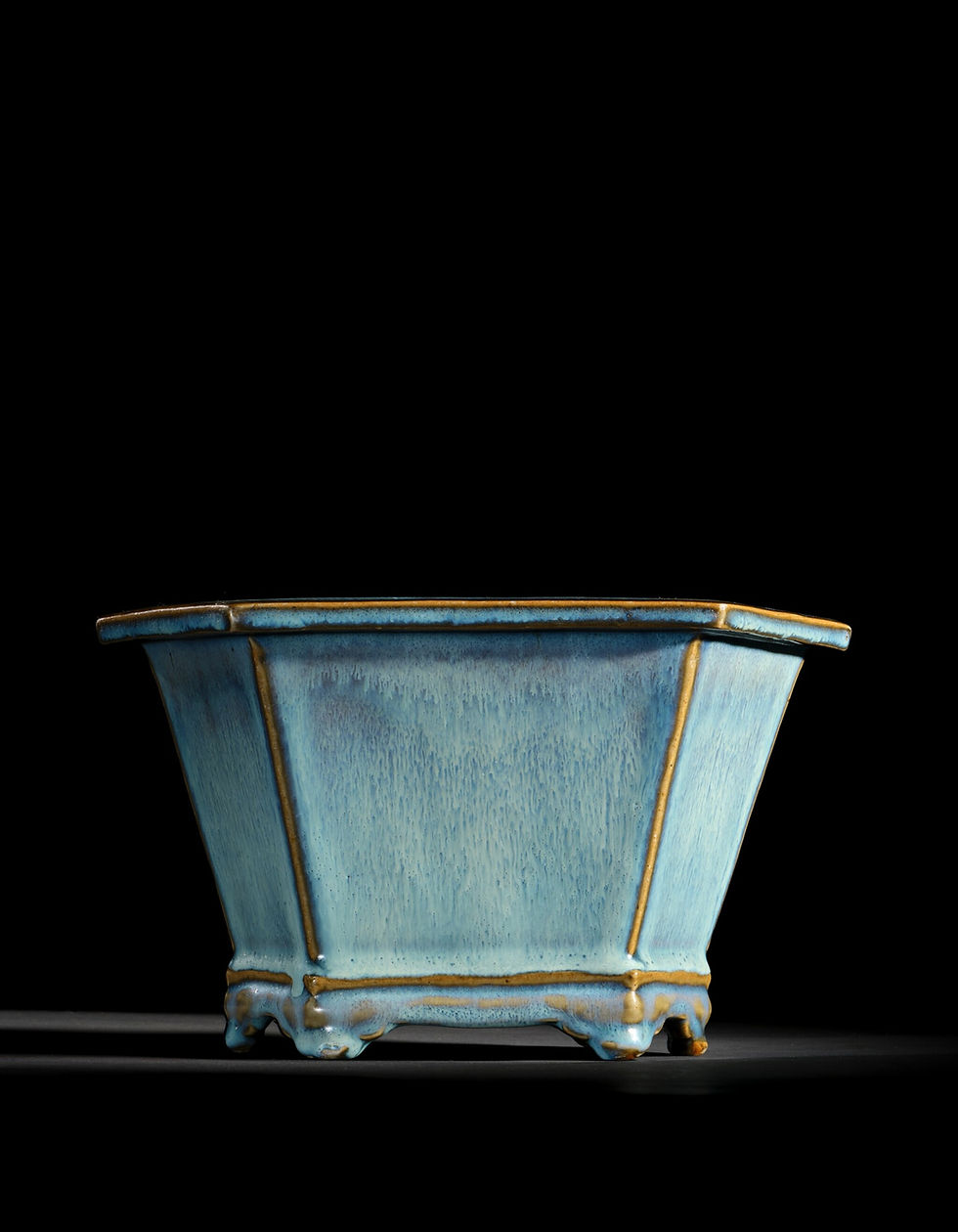
此宋至明初鈞窯天藍釉六方花盆,足刻「四」字,屬極為罕見的「編號鈞瓷」系列。其六角形制配六如意形足,造型端莊雄渾,釉色醇厚瀅潤,滿佈天然流紋與氣泡,邊緣薄釉處呈現菌褐色對比,充分展現御用器物的非凡氣度與高超工藝。
鈞窯編號器物的燒造年代素有爭議,部分學者傾向明初宮廷製品,然故宮博物院著名古陶瓷專家耿寶昌先生始終堅持傳統觀點,認為此類宮廷傳世鈞瓷確屬北宋無疑。此器六棱多接的複雜結構,燒成難度遠高於常見八方或圓形花盆,存世極稀。
美國早期重要收藏家Samuel T. Peters(煤業巨子、大都會藝術博物館信託人,著名玉器與中國瓷器收藏家)舊藏,編號201,早年多次展於紐約大都會藝術博物館及日本協會。
1982年紐約佳士得拍賣後,進入香港頌德堂珍藏,歷經四十餘載悉心守護,充分體現頌德堂作為香港經典古董商對宋瓷頂級御用器物的深刻理解與珍視。藏得住、高認知、經得起考驗的香港古董商已經不多了。
This extremely rare imperial Junyao sky-blue-glazed hexagonal jardinière, inscribed with the numeral “si” (four) on one foot, belongs to the celebrated yet enigmatic “Numbered Jun” group. Sturdily potted with six ruyi-shaped feet and straight sides flaring to an everted rim, it displays a rich, lustrous sky-blue glaze suffused with natural streaks and bubbles, thinning to a mushroom tone along the edges to accentuate its majestic silhouette and technical mastery. The dating of Numbered Jun wares has long been debated, with some scholars favoring an early Ming imperial attribution; however, the renowned ceramic expert Mr. Geng Baochang has consistently maintained the traditional view that these courtly Jun pieces are undoubtedly of Northern Song date. The complex hexagonal form with multiple joins presents far greater firing challenges than the more common octagonal or circular examples, rendering this shape exceptionally rare. Formerly in the collection of the prominent early 20th-century American connoisseur Samuel T. Peters (No. 201), a coal magnate, Trustee of the Metropolitan Museum of Art, and celebrated collector of Chinese jades and porcelains, it was exhibited at the Japan Society and the Metropolitan Museum of Art in New York. Acquired by Sung Tak Tong (頌德堂) at Christie’s New York in 1982, it has been cherished for over four decades, reflecting the gallery’s profound appreciation and discerning eye for the finest imperial Song ceramics.
鈞窰天藍釉六方花盆 足刻「四」字
宋至明初
An extremely rare imperial Junyao sky-blue-glazed hexagonal jardinière, Song - Early Ming dynasty
Live auction begins on:
2026 May 5, 11:30 AM HKT
Estimate
3,500,000 - 6,500,000 HKD
of hexagonal section, sturdily potted with straight sides flaring to a flat everted rim, supported on a stepped base with six ruyi-shaped feet, covered overall in a rich cascading sky blue glaze which thins to a mushroom tone along the edges, creating a striking contrast that accentuates the vessel’s silhouette, the base with a ring of spur marks and seven draining holes, one foot incised with the numeral si ('four'), wood stand
w. 25.8 cm


來源
Samuel T. Peters 收藏,編號201
紐約佳士得1982年6月23日,編號51
展覽
《Chinese, Corean and Japanese Potteries》,日本協會,紐約,1914年,編號295
S.C. Bosch Reitz,《Exhibition of Early Chinese Pottery and Sculpture》,大都會藝術博物館,紐約,1916年,編號125
《大繁若簡:宋金元朝的單色釉瓷》,香港大學美術博物館,香港,2012年,編號101
此件花盆滿施天藍釉,釉面密佈天然流紋與氣泡,屬於聲名顯赫卻秘不可測的「編號鈞瓷」之列。該類器皿體型碩大,造型典雅,釉色絢爛醇厚,底部刻有自一至十的數字編號,其具體燒造年代近年來引發學界熱烈爭議。
此類非凡器物自清代以降備受推崇與摹製,傳統上被歸為北宋(960–1127年)年間之物,與其它更為「經典」的鈞瓷並列,據傳乃為徽宗皇帝(1100–1126在位)營建開封郊外艮岳皇家宮苑所特製。然自考古進展與1964年河南禹州附近鈞台窰址發現以來,近代學者多傾向將其斷代於十五世紀,視作明初宮廷御製之器。正如霍吉淑所述《Ming 50 Years That Changed China》(明:改變中國的五十年),大英博物館,倫敦,2014年,第92–97頁,此類帶編號器皿除北京紫禁城外,未見於任何其他遺址,亦未如預期之宋代古物般發現於中國其他地方或墓葬中。此外,採用雙範模製花盆的工藝顯然直至十五世紀初方始出現,凡此種種,均支持該批器物當屬明初之論斷。
然而,無論其年代歸屬為何,本品無疑具備非凡的御窰品質。觀此花盆器型侈口、深腹,呈六角形制,不僅是釉彩的傑作,更是胎土塑形的奇觀。其比例勻稱,輪廓俐落清晰,釉料沿棱脊薄施處顯露出筋骨,與通體天藍釉形成鮮明對比,強化了造型的立體感。本品釉色絕倫,六角結構複雜多接,體現了製陶者對胎土濕度、燒成溫度及釉料配比的精湛掌控,唯有如此方能大規模燒造此類效果。正因製作此等莊重器型所需的技術挑戰,本品設計存世極為罕有,亦在情理之中。
誠然,已知的十四類編號鈞瓷器形,皆屬鳳毛麟角,而本品之六棱花盆連同其配套盆托,實為其中至為罕有之形制。迄今為止,如此瑰麗釉的六棱形制花盆,見諸出版者僅有六例。其中一例藏於北京故宮博物院清宮舊藏(館藏編號:故142994),器底刻「八」字,收錄於《故宮博物院藏文物珍品全集:兩宋瓷器(上)》,香港,1996年,圖版22。其餘五例亦幾乎悉數庋藏於公立機構:一例殘損較為嚴重、底刻「七」字的花盆連盆托,現藏於倫敦大英博物館大維德基金會(館藏編號:PDF,A.9),出版於畢宗陶,《Illustrated catalogue of Ru, Guan, Jun, Guangdong and Yixing wares in the Percival David Foundation of Chinese Art》(大維德基金會藏汝、官、鈞、廣鈞及宜興陶器圖錄),倫敦,1999年,頁52,編號A9;一例體量較小、施天藍釉、底刻「十」字者,曾售於倫敦蘇富比2011年11月9日,拍品編號365,後再次售於香港蘇富比2019年4月3日,拍品編號3308;另有三例現藏於劍橋哈佛藝術博物館,該館為北京和台北以外收藏編號鈞瓷最富之機構,其底部分別刻 「七」 字(館藏編號:1942.185.33)、「九」(館藏編號:1942.185.32.1)與「十」字(館藏編號:1942.185.34),館方網站載有圖錄。
此類六足六棱花盆的殘片亦於1974年在禹州鈞台鈞窰遺址出土,並刊載於《鈞瓷雅集:故宮博物院珍藏及出土鈞窯瓷器薈萃》,北京,2013年,圖版81。

Provenance
Collection of Samuel T. Peters, no. 201.
Christie's New York, 23rd June 1982, lot 51
Exhibited
Chinese, Corean and Japanese Potteries, Japan Society, New York, 1914, cat. no. 295.
S.C. Bosch Reitz, Exhibition of Early Chinese Pottery and Sculpture, Metropolitan Museum of Art, New York, 1916, cat. no. 125.
The Multiplicity of Simplicity: Monochrome Wares from the Song to the Yuan Dynasties, University Museum and Art Gallery, University of Hong Kong, Hong Kong, 2012, cat. no. 101.
Catalogue Note
Enrobed in an enchanting sky blue glaze, suffused with elemental streaks and bubbles, the present jardinière belongs to the famous yet mysterious group of wares known as Numbered Jun. Of large size, elegant modelling and rich and brilliant glaze, this group – inscribed to their bases with numerals from one to ten – have sparked much debate in recent years as to their dating.
Much admired and imitated from the Qing dynasty onwards, these extraordinary wares have traditionally been attributed to the Northern Song dynasty (960–1127) alongside other more ‘classical’ Jun wares, and are said to have been made to furnish the Genyue Garden of Emperor Huizong (r. 1100–1126) on the outskirts of Kaifeng. However, since the advancement of archaeology and the discovery of a kiln site at Juntai, near Yuzhou, Henan province, in 1964, more recent scholars tend to attribute these wares to the 15th century, as pieces designed for the imperial court of the nascent Ming dynasty (1368–1644). As Jessica Harrison-Hall explains (Ming 50 Years That Changed China, British Museum, London, 2014, pp 92-97), examples of this numbered group have not been found in any context other than the Beijing palace, nor have any been discovered elsewhere in China or in tombs as expected of Song dynasty antiques. Additionally, the method of using double moulds to construct flowerpots apparently did not exist until the early 15th century, all of which supports an early Ming attribution for the group.
However, regardless of its dating, the present group is unquestionably of extraordinary imperial quality. With a flared rim and deep cavernous body rendered in a regal hexagonal form, the present flowerpot is not just a triumph of glaze but a marvel of clay construction. Well-proportioned with fine and crisp outlining, as the glaze thins around the ridges of the pot, the exterior reveals a tan hue that contrasts vividly with the overall sky-blue glaze, enhancing its three-dimensional quality. With an exceptional glaze and complex hexagonal structure involving multiple junctions, the present pot speaks to the superb command of clay hydration, firing temperature and glaze make-up required to produce such effects at scale. As such, it is highly likely that the technical challenge of producing such a stately form contributed to the rarity of the present design.
Indeed, while all fourteen of the attested Numbered Jun forms are exceedingly rare, the present hexagonal flower-pot and its corresponding pot stand appear to be by far the rarest. To date, only one surviving flower pot of this enchanting hexagonal form appears to remain from the Qing Court Collection in the Palace Museum, Beijing (accession no. gu-142994), inscribed with the Chinese numeral ba (eight) on the base, and illustrated in The Complete Collection of Treasures of the Palace Museum. Porcelain of the Song Dynasty (I), Hong Kong, 1996, pl. 22. Beyond this, only five other examples are apparently published and almost all preserved in public institutions: a heavily damaged example, marked number seven (qi), preserved with its corresponding stand in the Percival David Collection at the British Museum, London (accession no. PDF,A.9) and illustrated in Stacey Pierson, Illustrated catalogue of Ru, Guan, Jun, Guangdong and Yixing wares in the Percival David Foundation of Chinese Art, London, 1999, p. 52, cat. no. A9; a smaller sky-blue glazed example, marked number ten (shi), sold in our London rooms, 9th November 2011, lot 365, and again in these rooms, 3rd April 2019, lot 3308; and three in the collection of the Harvard Art Museums, Cambridge – the largest collection of Numbered Jun outside of Beijing and Taipei – numbered seven (qi, accession no. 1942.185.33), nine (jiu, accession no. 1942.185.32.1), and ten (shi, accession no. 1942.185.34) respectively, and illustrated on the Museum’s website.
Shards of these six-footed hexagonal pots were also excavated from the Jun kilns of Juntai, Yuzhou, in 1974 and are illustrated in Selection of Jun Ware. The Palace Museum’s Collection and Archaeological Excavation, Beijing, 2013, pl. 81.


Comments