
拍賣筆記 vol.355 蘇富比香港2026:1638.4萬港元售出,唐三彩午馬俑,埃斯肯納齊 - Sotheby’s HK 2026, A Sancai Zodiac Horse Figure, Eskenazi, Tang Dynasty, Sold for 16.384m HKD

Updated: May 5
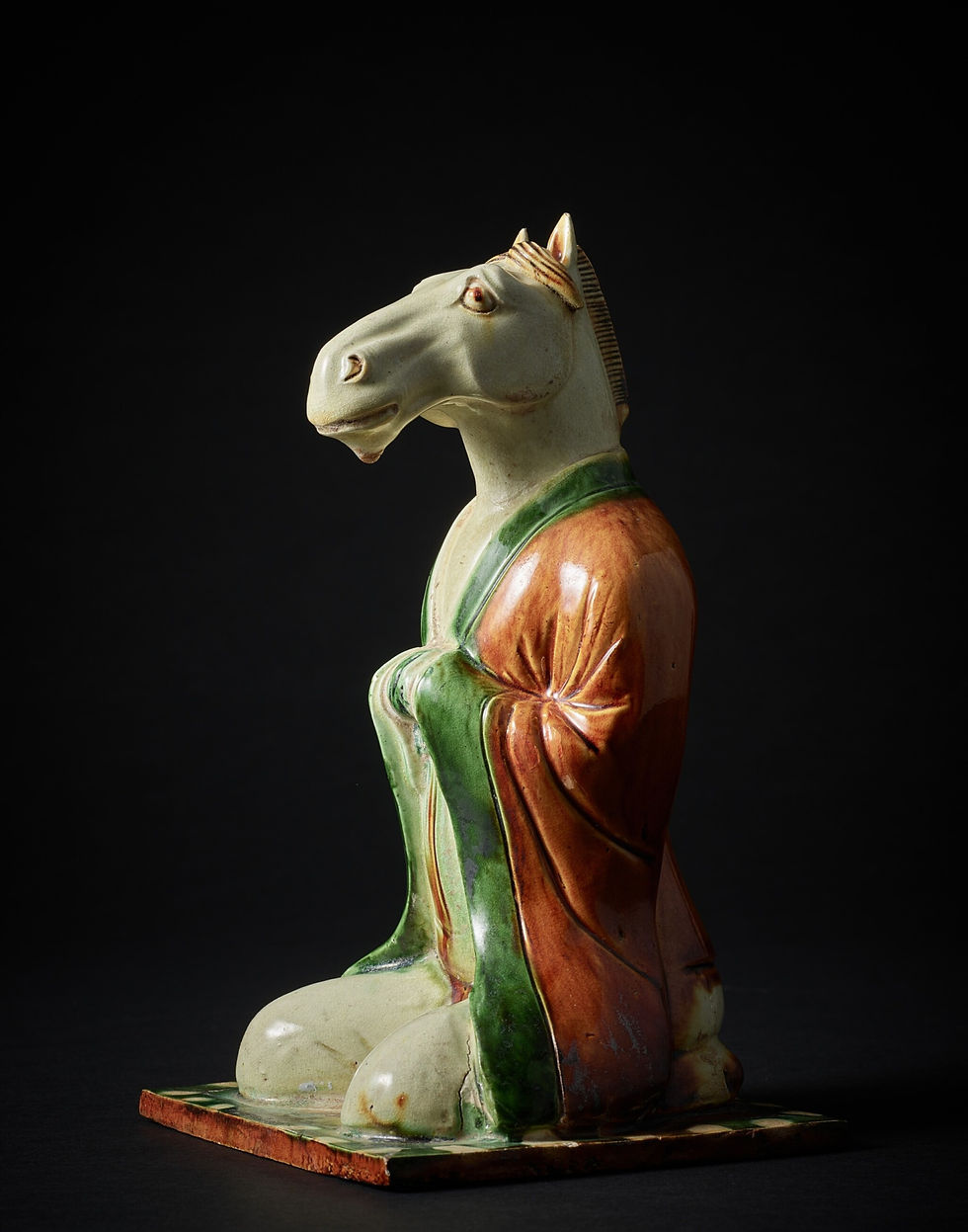
長期在eskenazi畫廊要價將近2000萬港元,在拍賣的宣傳下,近年認知提高,馬年加持,拍賣競爭激烈,圍繞外國電話和台灣電話之間爭奪。1280萬落槌chinyi,6990號牌。1638.4萬售出。
這件存世罕見、工藝卓越的唐三彩,極有可能是傳世孤品。其出身顯赫,源自倫敦傳奇古董商埃斯肯納齊(Giuseppe Eskenazi)的舊藏。多年來,埃斯肯納齊憑藉極具前瞻性的學術審美,始終堅守其價格體系與品質標準。
從藏家個體而言,低價買入固然是理想路徑;但從宏觀藝術市場的角度看,唯有創紀錄的高價拍出,方能推動唐三彩市場價值的重估與回歸。本次蘇富比上拍的這批藏品,若參考其過往成交數據,多數是以「虧損」估價上台。對於拍賣行而言,確保成交額與佣金才是核心指標,其商業邏輯中並不包含文化情懷。此次成交結果,無疑將引發市場對中國高古藝術品價值體系的深刻反思與重新定位。
This exceptionally rare Tang Sancai (tri-color glazed) piece, distinguished by its superb craftsmanship, may well be a unique extant specimen. It hails from the esteemed collection of Giuseppe Eskenazi, the legendary London-based dealer whose unwavering commitment to quality and price has long been underpinned by visionary academic insight.
While individual collectors naturally seek value at lower price points, from a broader market perspective, robust premium pricing is essential to drive a long-overdue valuation recovery for Tang ceramics. Notably, historical records suggest that several items in this Sotheby’s offering are priced at a loss. For auction houses, the primary metric remains transaction volume and commission fees; cultural sentiment rarely influences the bottom line. Consequently, the final hammers for this sale will serve as a critical bellwether, prompting a collective reflection on and a strategic repositioning of the Chinese antiquities market.
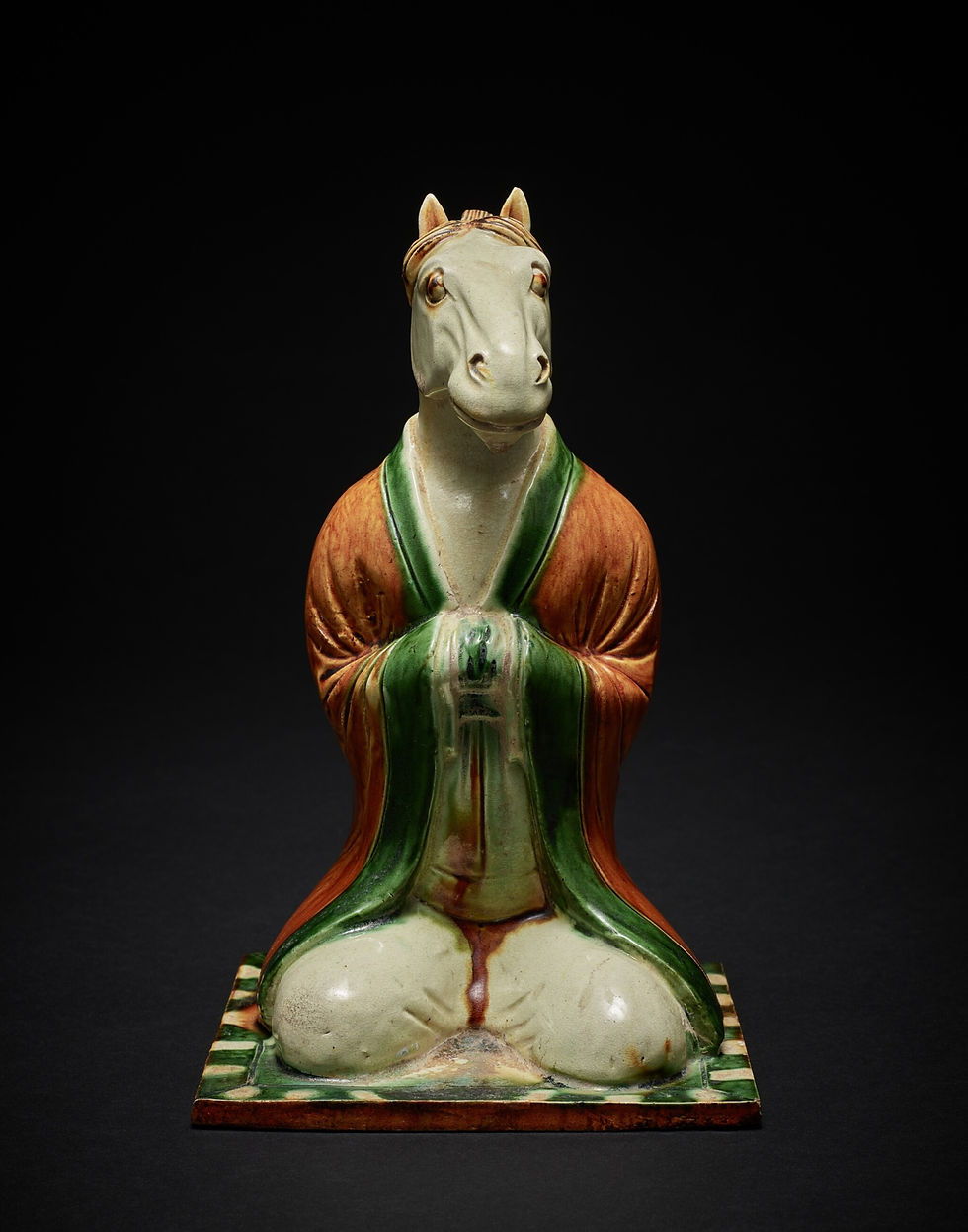
唐三彩午馬俑
A superb and extremely rare sancai zodiac horse figure, Tang dynasty
Premium Lot
Estimate
4,000,000 - 8,000,000 HKD
Description
22 cm
The dating of this lot is consistent with the results of the thermoluminescence test conducted by Oxford Authentication Ltd, report no. C100a92.
此拍品經熱釋光測定,結果與斷代吻合(牛津鑑定公司,報告編號:C100a92)。
整體品相良好。僅少處經潤飾,究其種類及年代屬正常,包括底座兩角、右耳尖及鬍子,以及頭頸接胎處稍經加固。邊緣處偶見數點小磕痕,屬正常。右背見一熱釋光測試孔,報告備索。
來源
埃斯卡納齊,倫敦
私人收藏,紐約
藍理捷,紐約
埃斯卡納齊,倫敦
展覽
《Tang Ceramic Sculpture》,埃斯卡納齊,紐約,2001年,編號10及封面
《龍隱:東方陶瓷學會會員稀珍藏品展》,東方陶瓷學會,倫敦,2016年,編號15
《唐:陶器、金屬器和雕塑》,埃斯卡納齊,紐約,2021年,編號37
出版
埃斯卡納齊,薛好佩整理,《中國藝術品經眼錄:埃斯卡納齊的回憶》,倫敦,2012年,中譯版,上海,2015年,2017年再版,圖235
康蕊君,〈China without Dragons. An Exhibition of the Oriental Ceramic Society〉,《美成在久》,2016年11/12月,頁93,圖2
Huang Yun 及朱塞佩.埃斯卡納齊,〈打開心扉:古董巨擘談文物買賣收藏〉,《美成在久》,2017年3月,頁87

此尊塑像造型碩大,工藝精湛,通體施亮麗的三彩,堪稱歷來現身藝術市場的唐代陶塑臻品之翹楚。作為迄今僅見的獨特之作,此作將十二生肖中的第七位午馬,呈現為儒生跪坐之姿,其姿雄健威儀,肩部線條卻柔婉自然,目光沉靜祥和。
與西方星座主要根植於月份劃分不同,中國的十二生肖代表著一個完整的宇宙觀體系,其本質建立在十二進位的基礎之上。從與十天干共同構成六十年週期的十二地支,到一日之中的十二個時辰,生肖至少自戰國時期起便已位居中國宇宙觀的核心。至漢代,一套與各時辰相配的固定動物體系已然形成。
至北魏晚期,將生肖時辰表現為動物形象的傳統已發展成熟,並開始製作立體的陶俑。這些早期生肖組像以黏土手塑成型,胎質粗樸,素胎無釉,僅施以簡率的彩繪,見於少數重要的早期墓葬遺址,可分為三個亞類:寫實動物、人攜動物,以及本作所屬的獸首儒生造型。其中最早出現的似乎是單純的動物形象,目前已知最早的實例出土於山東省臨淄崔氏家族墓葬群的M10號墓。然而,獸首儒生式樣亦緊隨其後出現。唐代陶匠既癡迷於塑造各類人像,從宮廷仕女、馬球手到天王護法、文武官員,又富於創造力且鍾情動物題材,二者交融,催生了唐代製作的「儒生」生肖俑,代表了此類設計的巔峰。其或跪、或坐、或立的姿態,在之後千年間持續啟發著宮廷生肖作品的設計。可比較紐約大都會藝術博物館藏一組十二件素胎立像(館藏編號2000.662.7a–l),斷代為八世紀,館方網站有圖示;以及十個世紀後的一組十二件玉雕生肖,應為宮廷御製品,藏於北京故宮博物院,載於《故宮博物院藏文物珍品全集·玉器(下)》,香港,1995年,圖版111。
隨著陶瓷工藝的進步,隨葬品的品質也同步提升。隨著氧化金屬釉與灰釉的出現,諸如米黃、琥珀及青釉等釉色的運用,生肖俑因施釉而更顯尊貴,它們從樸拙的塑像轉變為持久的象徵,在墓室深處熠熠生輝。可比較此時期Koger收藏的一件鉛釉立姿生肖牛俑,見John Ayers,《Chinese Ceramics:The Koger Collection》,倫敦,1985年,頁30,編號10;一件出土于河南馮營村的青釉龍俑,現藏老河口市博物館,圖見《中國出土瓷器全集》第13卷(湖北、湖南),北京,2008年,圖版7;以及四川萬縣一座唐墓出土的三件青釉生肖俑(包括一件馬俑),見高應民《四川萬縣唐墓》,《考古學報》,1980年,第4期,圖版4,圖1-3。
然而,採用所謂鐵褐、銅綠、白三彩釉色的可比生肖俑實例則極為罕見,更遑論具備如此明麗的色調與卓越塑形品質者。約西元七世紀末至八世紀初,三彩工藝臻于鼎盛,以鮮麗流暢、交融淋漓的釉彩裝飾貴重器皿,尤以隨葬器物為著,已成為高端陶作的主流。儘管如此,迄今為止,似未見其他以此方式通體施釉的同類存世品;幾乎所有已知可比物件的頭部均未施釉,僅覆以素白化妝土。可比較造型較本品粗樸、無裝飾底座且頭部未施釉的同類跪姿實例:1984年揚州農業科學研究所出土的一組九件不全生肖俑(包括雞、龍、蛇、馬),現藏揚州博物館,見館方網站及《揚州司徒廟鎮清理一座唐代墓葬》一文,載於《考古》,1985年,第9期,859–860頁,圖版六。另比較一件尺寸較小的唐生肖鼠俑,頭部施藍釉,袍呈栗色,售于紐約蘇富比1981年11月6日,編號142;以及一組釉彩斑駁的立姿生肖俑,雖氣韻奪目,然造型較本品簡率且更趨程式化,出自「靈璧石居」珍藏,售於香港保利2022年10月10日,編號3230。
Condition Report
The horse figure is in very good overall condition, with only occasional retouching typical for this type of material and its age, including two corners of the base, the tip of its right ear and goatee, and light reinforcement to the faint luting line around the neck. A few tiny expected nicks to the extremities. A small thermoluminescence (TL) test drilled hole to its right lower back; report available upon request.
Provenance
Eskenazi Limited, London.
A private collection, New York.
J.J. Lally & Co., New York.
Eskenazi Limited, London.
Exhibited
Tang Ceramic Sculpture, Eskenazi Limited, New York, 2001, cat. no. 10 and cover.
China Without Dragons: Rare Pieces from Oriental Ceramic Society Members, Oriental Ceramic Society, London, 2016, cat. no. 15.
Tang: Ceramics, Metalwork and Sculpture, Eskenazi Limited, New York, 2021, cat. no. 37.
Literature
Giuseppe Eskenazi in collaboration with Hajni Elias, A Dealer’s Hand. The Chinese Art World Through the Eyes of Giuseppe Eskenazi, London, 2012; Chinese edition, Shanghai, 2015, reprint, 2017, fig. 235.
Regina Krahl, 'China without Dragons. An Exhibition of the Oriental Ceramic Society', Orientations, November/December 2016, p. 93, fig. 2.
Huang Yun and Giuseppe Eskenazi, 'Dakai xinfei: Gudong ju'e tan wenwu maimai shoucang' [Opening the Heart: A Renowned Antique Dealer Talks about Antique Dealing and Collecting], Orientations (Chinese edition), March 2017, p. 87.
Masterfully sculpted to grand proportions and robed in a coat of vibrant sancai (‘three-colour’) glaze, the present figure is among the most important examples of Tang dynasty ceramic sculpture ever to come to market. An apparently unique example of its kind, the figure represents the seventh animal in the Chinese zodiac – the horse – as a kneeling scholar; its posture proud and magnificent but with softened shoulders and a serene gaze.
Unlike the Western zodiac, which remains largely rooted in the months of the year, the twelve figures of the Chinese zodiac represent a full cosmological system founded on their duodecimal nature. From the Twelve Earthy Branches which, together with Ten Heavenly Stems, dictate the sixty-year calendar, to the twelve double-hours in a day, the zodiac has sat at the very heart of Chinese cosmology since at least the Warring States period (ca. 475–221 BCE) with a formalised set of animals associated with each division emerging by the Han dynasty (206 BCE–220 CE).
By the late Northern Wei dynasty (386–534 CE), the tradition of depicting the zodiacal divisions as animals had matured into the production of three-dimensional ceramic figurines. Moulded crudely from clay by hand, left unglazed and casually painted, these prototypical sets of figures appear in a small number of important early tomb sites and can be divided into three sub-groups: naturalistic animals, humans carrying animals, and – the present design – of animal-headed scholars. The earliest of these types to emerge appears to be the straightforward animal depictions, of which the earliest currently known examples were uncovered from Tomb M10 of the Cui Family Tombs in Linzi, Shandong province. The present style, however, was not far behind. Blending the Tang potters’ fascination with the human form, from court ladies and polo players to Lokopala guardians and officials, with their creativity and penchant for animal imagery, the ‘scholar’ zodiac figures produced during the Tang dynasty represent the zenith of the design and – kneeling, seated and standing – continued to inspire imperial zodiac designs for the next millennium. Compare a set of twelve unglazed standing figures in the Metropolitan Museum of Art, New York (accession no. 2000.662.7a–l) attributed to the eighth century, illustrated on the Museum’s website; and a set of twelve, presumably imperial, jade interpretations of the design from ten centuries later, preserved in the Palace Museum, Beijing, in The Complete Collection of Treasures of the Palace Museum. Jade Ware (III), Hong Kong, 1995, pl. 111.
As ceramic production improved, the quality of tomb assemblages similarly developed. With the advent of oxide and ash-based glazes of cream, amber and celadon, zodiacal figures were given further prestige through glazing– transforming rudimentary figures into enduring symbols that would shine from the heart of the tomb. Compare a lead-glazed standing zodiacal figure of an ox in the Koger collection from this period in John Ayers, Chinese Ceramics. The Koger Collection, London, 1985, p. 30, cat. no. 10; a celadon-glazed dragon figure uncovered from Fengying village, now preserved in the Laohekou Municipal Museum, in The Complete Collection of Ceramic Unearthed in China, vol. 13: Hubei and Hunan, Beijing, 2008, pl. 7; and three celadon-glazed figures uncovered from a Tang tomb in Wanxian, Sichuan – including a horse – illustrated in Gao Yingmin, ‘Sichuan Wanxian Tang mu’, Kaogu Xuebao, 1980:4, pl. 4, figs 1-3.
Far more elusive, however, are comparable examples of zodiac figures glazed in the so-called sancai palette of iron orange, copper green and white, let alone one of such vibrant tone and sculptural quality. Flourishing around the late seventh and early eighth century, the technique of dressing prestige wares – particularly funerary wares – in bright swathes of sancai glazes which flow and mix around the form had become a mainstay of elite pottery production. That said, to date, no other examples of this kind fully glazed in this manner appear to survive, with almost all known comparable pieces left with heads unglazed, coated in a raw white slip. For kneeling examples of related type, cruder in modelling than the present, without a decorated pedestal and with heads unglazed, compare an incomplete group of nine figures – including a rooster, dragon, snake and horse – uncovered in 1984 by the Yangzhou Agricultural Science Research Institute, now in the Yangzhou Museum, and illustrated on the Museum’s website and in Yangzhou Museum, ‘Yangzhou Situmiaozhen qingli yizuo Tangdai muzang / Excavation of a Tang Tomb at Situmiaozhen near Yangzhou’, Kaogu, 1985, no. 9, pp 859–860, pl. VI. Also compare a smaller Tang zodiac figure of a rat, with a blue-glazed head and chestnut-coloured robe, sold in our New York rooms, 6th November 1981, lot 142; and an impressive blue-splashed standing set, though much simpler and more formulaic than the present, from the collection of The Ten-Views of Lingbi Rock Retreat Collection, sold in Poly Hong Kong, 10th October 2022, lot 3230.



Comments