
拍賣筆記 vol.295 蘇富比香港:1684.5萬港元售出,明永樂青花纏枝花卉紋執壺,岡田美術館 - An Okada Museum Blue And White 'Peony' Ewer, Ming Dynasty, Yongle Period, Sold For 16.845M HKD


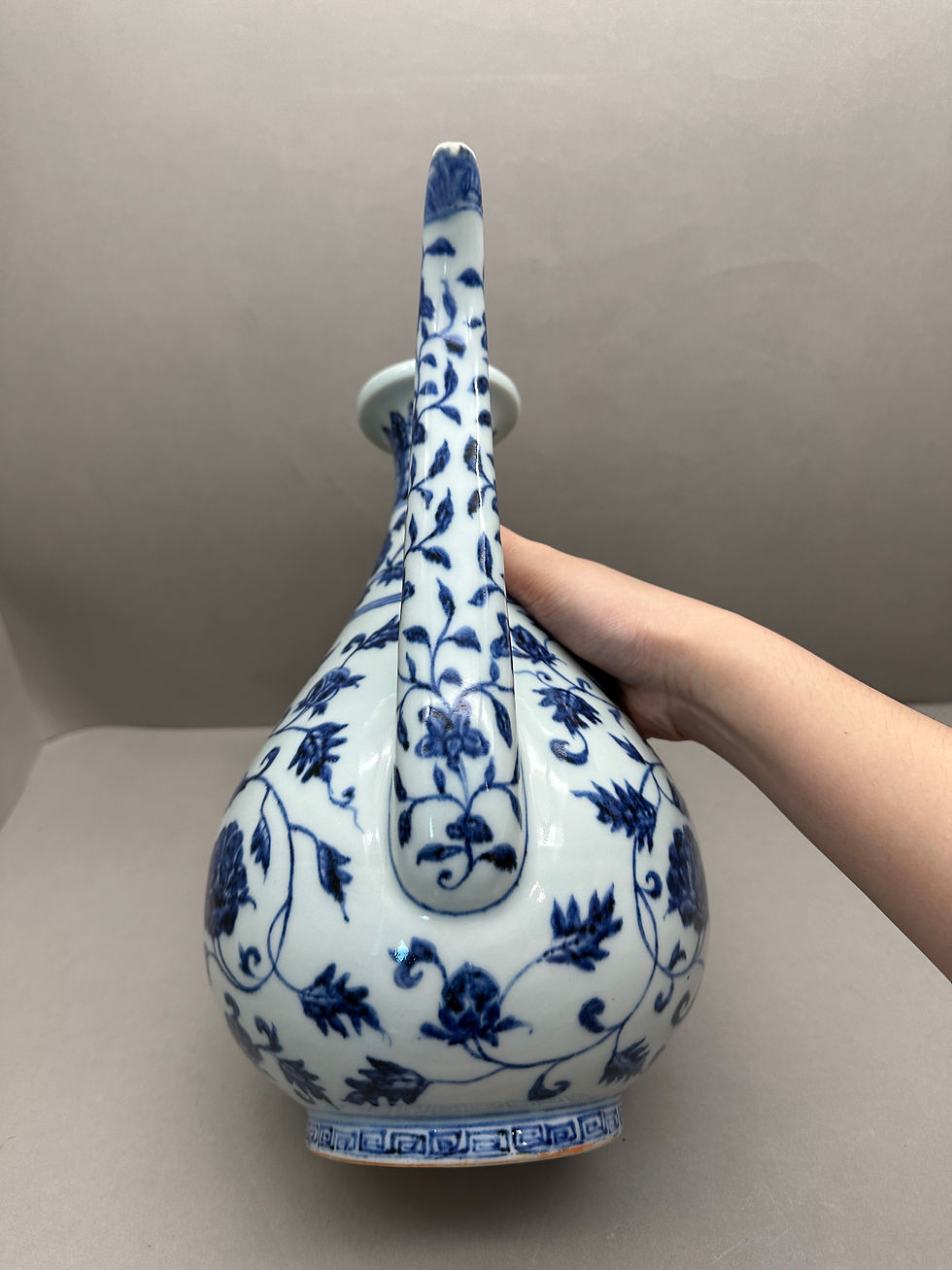
本件岡田美術館舊藏明永樂青花纏枝牡丹紋執壺,高30.6公分,出自景德鎮御窯,器形源承中東金屬盛酒器與南宋、元代卵形小執壺體系,在永樂一朝完成比例最為勻稱成熟的定型;其通體以蘇麻離青濃淡渲染纏枝牡丹,省去腹下垂瓣邊飾,令花葉在大面積留白上環繞舒展,與大英博物館、松岡美術館、托普卡匹宮與阿德比爾神祠、吉美博物館諸例,共同構成永樂御窯青花執壺的標準譜系。依現有出版與展覽記錄,本件早在《陶磁大系》《世界陶磁全集》以及《岡田美術館名品撰》中屢經著錄,並於2018–19年岡田美術館開館五周年展中展出,來源自日本重要私人收藏及東京壺中居。
就近二十年公開市場可比器物觀之:2025年香港蘇富比「岡田美術館珍品」專場中,本件以1,684.5萬港元成交,遠超400–800萬港元估價區間;而2018年香港佳士得一件尺幅、構圖相近之永樂青花纏枝牡丹紋執壺,成交價為610萬港元 Christie's+1,2012年倫敦佳士得一件保存較次(碎拼修復)且尺寸略小之同款執壺僅以34,850英鎊易手 Christie's;蘇富比方面,2011年香港一件永樂青花四季花卉紋梨形執壺成交價約458萬港元,2023年則有趙從衍舊藏永樂青花龍紋執壺以1.07億港元創出同類御窯執壺天價。在此價格光譜之中,岡田本壺兼具重要來源、完整出版與優異保存狀況,其1,684.5萬港元的成交水準,實已將「纏枝牡丹」題材的永樂御窯執壺推向中高段價位,與頂級龍紋例之天花板價值拉開層級,亦為今日學界與市場重新評估永樂御窯器內部「圖像—器形」層級提供一個清晰的標杆。

This Yongle imperial blue and white ewer with scrolling peonies from the Okada Museum of Art, 30.6 cm high, represents one of the most fully resolved developments of the pear-shaped metalware-derived form within the early Ming court repertoire. Painted in rich “Sumali qing” cobalt with a continuous peony scroll and without the conventional lappet border around the lower body, it belongs to the small group of Yongle ewers that define the type, alongside examples in the British Museum, the Matsuoka Museum of Art, the Topkapi Saray and Ardabil Shrine, and the Musée Guimet, many of which are documented in early modern diplomatic circulation between China, the Islamic world and Europe. Extensively published in standard references such as Fujioka’s Toji Taikei and Ceramic Art of the World, and Kobayashi’s Masterpieces of the Okada Museum of Art, and exhibited in Okada’s 5th anniversary “All-Stars” exhibition, the present ewer also benefits from a distinguished Japanese provenance via Kochukyo, Tokyo.
In market terms, its HK$16,845,000 result at Sotheby’s Hong Kong in 2025—more than double the presale estimate of HK$4,000,000–8,000,000—positions it clearly above the main cluster of comparable Yongle peony ewers, including the Christie's Hong Kong example sold in 2018 for HK$6,100,000 Christie's+1 and a smaller, more worn (repaired) London Christie's piece sold in 2012 for £34,850 Christie's, as well as related floral Yongle ewers at Sotheby’s (e.g. Hong Kong 2011, HK$4,580,000). At the same time, it remains significantly below the HK$107 million achieved in 2023 by the unique Yongle blue and white dragon ewer from the T.Y. Chao collection, thereby articulating a coherent hierarchy within the broader market for early Ming imperial ewers in which the Okada “peony” example marks the current upper tier for the scroll-floral subgroup.


明永樂青花纏枝花卉紋執壺
A blue and white 'peony' ewer, Ming dynasty, Yongle period
Premium Lots
Auction Closed
November 22, 07:38 PM JST
Estimate
4,000,000 - 8,000,000 HKD
Lot Sold
16,845,000 HKD
Description
Japanese wood box
30.6 cm
Condition Report
The handle eyelet restored. Otherwise, in good overall condition, with only a small flake (approx. 0.4cm) to the spout rim, and a minute burst bubble/flake to the outer mouth rim.
整體品相良好。唯柄頂端繫孔經修;流嘴尖見一淺小剝痕(約0.4公分);及壺外口沿見一小爆釉/剝痕。

來源
日本私人收藏
壺中居,東京
展覽
《開館5周年記念展―美のスターたち―光琳.若冲.北斎.汝窯など名品勢ぞろい》, 岡田美術館,箱根,2018-19年,展覽編號94(沒載圖)
出版
藤岡了一,《陶磁大系》,卷42:明の染付,東京,1975年,圖版30
藤岡了一及長谷部楽爾,《世界陶磁全集》,卷14:明,東京,1976年,圖版143
小林忠編,《岡田美術館名品撰》,卷1,東京,2013年,編號22
此執壺造形殊善,釉下青花大膽揮灑纏枝牡丹紋,婉轉流暢環飾壺身,足見永樂朝藝術與工藝成就。
梨形執壺之器形,據信源於中東金屬器造型,然實則可能演變自南宋時期燒造之卵形小執壺(其流口較短,且無分明頸部,故缺連接支柱)。元代已出現與本品相似之器形,可比較一例青瓷執壺,出自1323年沉沒於韓國新安海域之沉船,圖見《新安海底遺物:資料篇Ⅰ》,首爾,1985年,圖版125。此器形於永樂年間按比例繼續精煉,達至最成熟平衡之態,本品當燒造於這一黃金時間。
此類執壺紋飾靈感源自洪武時期釉裏紅執壺,例如一飾蓮紋之例,現藏倫敦大英博物館大維德基金會,館藏編號 PDF,A.696,圖見畢宗陶,《Illustrated Catalogue of Underglaze Blue and Copper Red Decorated Porcelains in the Percival David Foundation of Chinese Art, London》,倫敦,2004年,頁74,編號A696。然永樂執壺與早期洪武器物相較,常省略環飾下腹之垂瓣紋邊飾,使窰工得以運用更大空間,營造纏枝花卉更流暢之姿。
博物館收藏之相關實例包括倫敦大英博物館藏一例,原屬奧古斯都·沃拉斯頓·弗蘭克斯爵士收藏,刊載於霍吉淑,《Ming Ceramics in the British Museum》,倫敦,2001年,編號3:16;另一例售於倫敦蘇富比,1973年11月27日,編號215,現藏東京松岡美術館,圖見葉義與譚靄華,《中國青花瓷》,新加坡,1978年,圖4。另見兩件相關例,其一售於倫敦蘇富比,1985年6月18日,編號102;另一例原屬東京萬野美術館舊藏,售於香港佳士得,2018年11月28日,編號2095。
同類執壺飾以折枝牡丹而非如本品之纏枝紋飾者,包括伊斯坦堡托普卡匹皇宮博物館藏一例(流口橋鈕及柄環缺失),圖見康蕊君及約翰·艾爾斯編,《Chinese Ceramics in the Topkapi Saray Museum, Istanbul》,卷2,倫敦,1986年,編號619;另一例流口部分殘損,原屬阿德比爾神廟,現藏德黑蘭伊朗國家博物館,刊載於三杉隆敏,《Chinese Porcelain Collections in the Near East: Topkapi and Ardebil》,卷3,香港,1981年,圖版A80;第三例現藏巴黎吉美博物館(館藏編號MA12714),曾展於《東西匯流:中歐陶瓷對話》,上海博物館,上海,2021-2022年,據傳曾於1547年由弗朗索瓦·德·菲梅爾攜至法國,菲氏乃法王亨利二世任命至君士坦丁堡蘇萊曼一世宮廷之外交使節。永樂、宣德時期之御製青花瓷於明朝外交中扮演重要角色,而吉美博物館此件執壺自中國流傳至中東,繼而轉至歐洲,正體現近代早期複雜之全球網絡與交流。
Provenance
A Japanese private collection.
Kochukyo Co., Ltd, Tokyo.
Exhibited
5th Anniversary Exhibition. All-Stars of the Okada Collection: Masterworks of Korin, Jakuchu, Hokusai and the Ru Ware Kilns, Okada Museum of Art, Hakone, 2018-19, exh. no. 94 (unillustrated).
Literature
Ryoichi Fujioka, Toji Taikei [Complete Series of Ceramics], vol. 42: Ming dynasty blue and white porcelain, Tokyo, 1975, pl. 30.
Ryoichi Fujioka and Gakuji Hasebe, Ceramic Art of the World, vol. 14: Ming dynasty, Tokyo, 1976, pl. 143.
Kobayashi Tadashi, ed., Masterpieces of the Okada Museum of Art, vol. 1, Tokyo, 2013, no. 22.
Catalogue Note
Superbly potted and boldly painted with a flowering peony scroll fluidly meandering around the body, the current ewer testifies to the artistic and technological brilliance of the Yongle reign.
The form of the pear-shaped ewers which is believed to emanate from a Middle Eastern metal shape, may in fact have developed from small egg-shaped ewers produced in the Southern Song dynasty (1127-1279), which had shorter spouts and no separate neck and therefore lacked the joining strut. In the Yuan dynasty (1279-1368) already a form similar to the present one had appeared. Compare, for example, a celadon ewer recovered from a shipwreck sunk off Shinan, Korea in 1323, illustrated in Relics Salvaged from the Seabed off Sinan. Materials I, Seoul, 1985, pl. 125. The form was then refined in proportions and reached its most mature, balanced shape in the Yongle reign (1403-24), when this vessel was made.
The decoration of such ewers was inspired by earlier copper-red decorated ewers from the Hongwu period, such as one adorned with lotus motifs and preserved in the Sir Percival David Foundation in the British Museum, London, no. PDF,A.696 and illustrated in Stacey Pierson, Illustrated Catalogue of Underglaze Blue and Copper Red Decorated Porcelains in the Percival David Foundation of Chinese Art, London, 2004, p. 74, no. A696. The Yongle ewers, however, compared to the earlier Hongwu vessels, often lack the lappet border encircling the lower body, allowing the potters to utilise a larger space to create a more fluid portrayal of the flowering scrolls.
Related examples housed in museum collections include one preserved in the British Museum, London, formerly from the collection of Sir Augustus Wollaston Franks, published in Jessica Harrison-Hall, Ming Ceramics in the British Museum, London, 2001, no. 3:16, and another sold in our London rooms, 27th November 1973, lot 215, now in the Matsuoka Museum of Art, Tokyo, illustrated in Yeo and Jean Martin, Chinese Blue and White Ceramics, Singapore, 1978, fig. 4. See also two related examples, one sold in our London rooms, 18th June 1985, lot 102, and another formerly from the Manno Art Museum, Tokyo, sold at Christie’s Hong Kong, 28th November 2018, lot 2095.
Similar ewers decorated with a large peony instead of a flowering scroll like the present vessel include one with the bridge to the spout and loop on the handle missing, in the Topkapi Saray Museum, Istanbul, is illustrated in Regina Krahl and John Ayers, Chinese Ceramics in the Topkapi Saray Museum, Istanbul, vol. II, London, 1986, no. 619; another missing part of its spout, from the Ardabil Shrine and now in the National Museum of Iran, Tehran, published in Takatoshi Misugi, Chinese Porcelain Collections in the Near East: Topkapi and Ardebil, vol. III, Hong Kong, 1981, pl. A80; and a third, today in the collection of Musée Guimet, Paris (accession no. MA12714), recently included in the exhibition West Encounters East: A Cultural Conversation between Chinese and European Ceramics, Shanghai Museum, Shanghai, 2021-2022, is reputed to have been brought to France in 1547 by François de Fumel, who was appointed by Henry II of France as a diplomat to the court of the Ottoman sultan Suleiman I in Constantinople. While imperial blue and white wares from the Yongle and Xuande (1426-35) periods played a vital role in diplomacy for the Ming court, the fact that the Guimet ewer travelled from China to the Middle East and subsequently to Europe exemplifies the intricate global network and exchange in the early modern period.


Comments