
拍賣筆記 vol.286 蘇富比香港:1843.1萬港元售出,明永樂青花葡萄紋折沿菱口盤,岡田美術館 - An Exceptional And Rare Blue And White Barbed 'Grape' Charger, Ming Dynasty, Yongle Period, Sold for 18.431m HKD

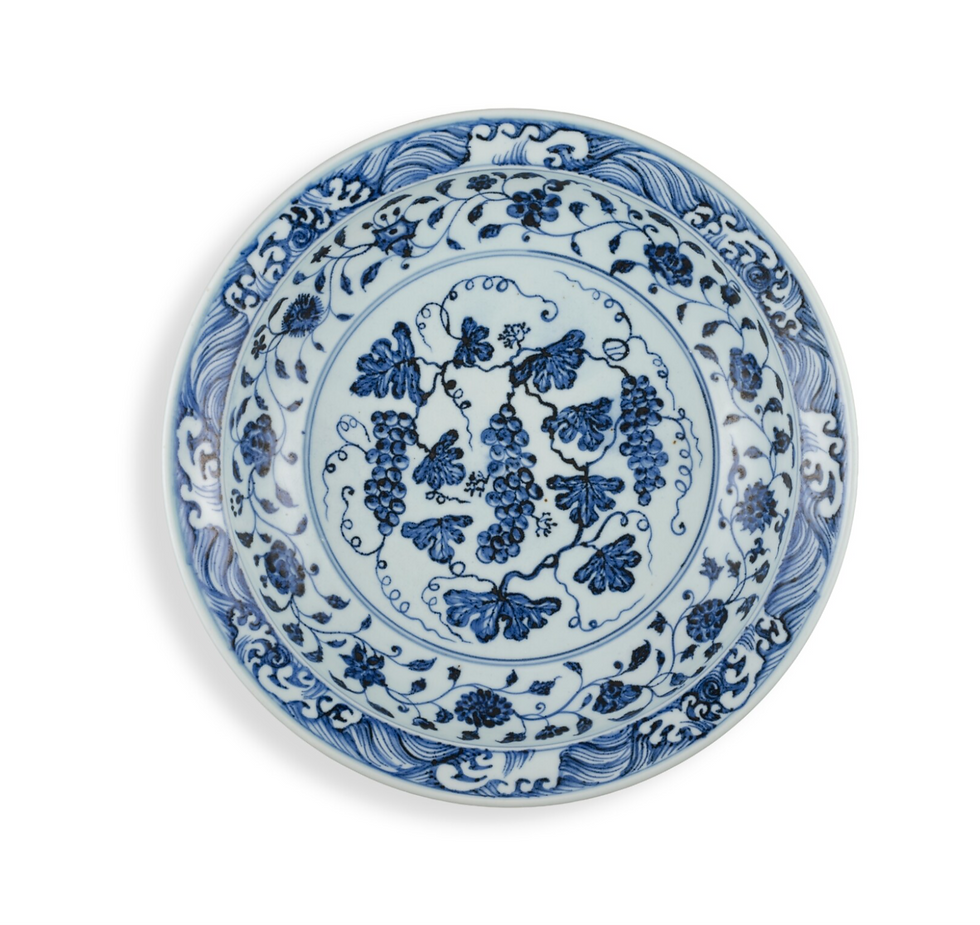
在過去十餘年裡,永樂青花葡萄紋折沿菱口盤在蘇富比與佳士得的表現,一直是衡量早期宮廷青花行情的風向標:38 公分左右的佳士得香港舊藏盤式器,成交多在約五百萬至九百萬港元區間;紐約場次亦約折合數百萬港元的水準。2021 年,蘇富比香港一件 44 公分葡萄菱口大盤以 1,711.5 萬港元成交,曾被視為此類器物的高位標杆。岡田美術館舊藏本件直徑 45.2 公分的青花葡萄紋折沿菱口盤,最終以 1,843.1 萬港元落槌,不僅輕鬆越過 6–1,200 萬港元的預估區間,也在兩大國際拍行既有成交譜系之上,再向前推高了一小個台階,顯示頂級永樂葡萄盤在當下市場中,正在被重新校準其「宮廷核心圖像」的價值位置。

佳士得2018年拍賣,874萬港元
Over the past decade, barbed Yongle blue-and-white “grape” chargers have established a remarkably consistent price corridor at the two major international houses. At Christie’s Hong Kong, examples around 38 cm in diameter have generally traded in the HKD 5–9 million range, while a closely comparable 37.8 cm dish sold in 2022 for HKD 5.04 million; a 38 cm dish offered in New York in 2022 realised about USD 491,400, broadly in line with this band. At Sotheby’s, the benchmark had long been set by a 44 cm barbed “grape” charger that fetched HKD 17.115 million in Hong Kong in 2021. Against this backdrop, the Okada Museum of Art’s 45.2 cm charger, estimated at HKD 6–12 million and ultimately sold for HKD 18.431 million, edges past the 2021 result and effectively marks a new upper tier for the type within the Sotheby’s/Christie’s ecosystem, signalling a renewed valuation of Yongle imperial grape dishes as core images of early Ming blue-and-white.
明永樂 青花葡萄紋折沿菱口盤
An exceptional and rare blue and white barbed 'grape' charger, Ming dynasty, Yongle period
Premium Lots
Auction Closed
2025 November 22, 06:38 PM HKT
Estimate
6,000,000 - 12,000,000 HKD
Lot Sold
18,431,000 HKD

出版
小林忠編,《岡田美術館名品撰》,卷2,東京,2018年,編號11
青花葡萄紋飾典雅,代表永樂時期經典典範,彰顯明初景德鎮御窰瓷匠與畫師之卓絕成就。永樂一朝,瓷器品質與風格精妙程度皆達空前高度,其於宮廷之價值亦從皇室精美日用器,昇華為兼具經濟與外交潛力的帝王御用珍品。
永樂皇帝是一位具有遠見卓識的君主,其在位期間曾多次派遣官方使團遠赴海外。江西景德鎮御窰廠承製青花大盤,其燒造過程受嚴格監製。此類瓷器專為宮廷燒造,制式由宮廷審定,品質受宮廷監控,流通經宮廷統籌並通過官方管道確保。此時期不僅品質管控極為嚴苛,務求瓷器臻于完美,紋飾設計亦受嚴密保護,杜絕地方窰場仿製混淆真品,從而維護御瓷聲譽與皇家威儀。
永樂青花葡萄紋盤,其葡萄紋必以單枝生出三串果實的構圖呈現,僅通過少數特徵即可區分:盤壁或呈圓弧形或作花口式,口沿或為直邊或具波折狀。在現存同類瓷器中,本品以其精良胎土、瑩潤釉質與飽滿果紋尤為出眾,完美展現蘇麻離青料「堆垛積聚」的典型特徵,此乃明初官窰青花瓷備受推崇的工藝標誌,後世仿製不絕。
清宮舊藏一件同式菱口折沿盤,現藏北京故宮博物院,刊於耿寶昌編,《故宮博物館藏明初青花瓷》,北京,2002年,下冊,圖版133,同錄一件尺寸較小之葡萄紋圓形折沿盤,圖版135。
經洪武年間之中斷,永樂皇帝與帖木兒王朝統治者沙哈魯(1405-1447年在位)重建邦交,遂使兩大帝國間奢侈品往來日趨頻繁,青花瓷亦列其中。類同紋飾瓷盤,曾供奉於阿德比爾聖殿,現藏德黑蘭伊朗國家博物館,刊於 John Alexander Pope,《Chinese Porcelains from the Ardebil Shrine》,華盛頓,1956年,圖版38,編號29.58。伊斯坦堡托普卡比宮殿博物館也有藏,載於康蕊君,《Chinese Ceramics in the Topkapi Saray Museum, Istanbul》,倫敦,1986年,卷2,圖版605。巴黎吉美國立亞洲藝術博物館藏品(編號: MA1645),則可參見 Daisy Lion-Goldschmidt,《Ming Porcelain》,弗里 堡,1978年,圖版25。另可參考倫敦大英博物館 Walter Sedgwick 舊藏例(編號1968,0422.27),收入霍吉淑,《Catalogue of Late Yuan and Ming Ceramics in the British Museum》,倫敦,2001年,圖版3:36。香港天民樓亦有藏,見《天民樓珍藏青花瓷器》,上海,1996年,編號24。
葡萄紋飾於中國藝術品中較為罕見,因該作物主要植根於中亞地區。此紋樣初現于唐朝,時值絲綢之路開啟與該地區密切往來,元代再度復興,當期中國與西方重現諸多經濟文化紐帶,至永樂朝終漸臻盛行。

Description
superbly painted on the interior in rich cobalt-blue tones with three bunches of grapes borne from a gnarled vine issuing broad furled leaves detailed with veining and delicately coiling tendrils, the cavetto subtly lobed in twelve panels and depicting floral sprigs alternating with leafy lingzhi sprigs, the barbed rim encircled by band of a blackberry-lily scroll, the reverse with similar floral sprays within the bracket-lobed panels, the base unglazed, Japanese wood box, accompanied by a note dated 1977 from Kochukyo Co., Ltd
45.2 cm
Condition Report
Good overall condition, with only occasional tiny rim frits/flakes to the pointed tips of the barbed rim.
整體品相良好。口沿棱尖處偶見毛口及小剝痕。
Literature
Kobayashi Tadashi, ed., Masterpieces of the Okada Museum of Art, vol. 2, Tokyo, 2018, no. 11.
Catalogue Note
The elegant design of this dish represents one of the great classic patterns of the Yongle period that demonstrate the achievement of Jingdezhen’s potters and painters in the early Ming dynasty. Under the Yongle Emperor not only did the quality of porcelain and stylistic sophistication reach unprecedented heights, its value to the court also evolved from that of an exquisite practical item of the imperial household to becoming a commodity with economic and diplomatic potential to the Emperor.
The Yongle Emperor was an outward-looking monarch, and his reign was marked by numerous official expeditions abroad. Large dishes painted in underglaze blue were made at the imperial kilns in Jingdezhen, Jiangxi province, where production was carefully monitored. Porcelains here were produced for the court, its specifications defined and quality monitored by the court, and its distribution organised by the court and assured through official channel. While quality control was stringent in this period, so as to make porcelains impeccable, designs were carefully guarded, so no copies could be made by lesser kilns that might be confused with the original and in this way harm the repute and prestige of the production.
Dishes painted with this motif, always featuring three clusters of grapes issuing from a single stem, vary in few but distinct ways: the sides are either rounded or lobed and the rims are straight or barbed. Among surviving examples, the present piece is particularly outstanding for its fine potting, smooth, tactile glaze and lush fruit pattern that beautifully displays the characteristic ‘heaping and piling’ of the cobalt blue – a much-copied trademark of imperial blue and white porcelains from the early Ming dynasty.

Dishes of this design made for the court include one from the Qing court collection and still in Beijing, illustrated in Geng Baochang ed., Gugong Bowuyuan cang. Ming chu qinghua ci [Early Ming blue and white porcelain in the Palace Museum], Beijing, 2002, vol. II, pl. 133, together with a slightly smaller circular dish of this design, pl. 135.
After an interruption in the Hongwu reign, the Yongle Emperor re-established relations with the Timurid ruler Shahrukh Mirza (r. 1405-1447), which led to frequent mutual exchanges of luxury goods between the two empires, including blue and white porcelains. A dish of this design formerly in the Ardebil Shrine and now in the National Museum of Iran, Tehran, is illustrated in John Alexander Pope, Chinese Porcelains from the Ardebil Shrine, Washington D.C., 1956, pl. 38. A similar dish is also found in the Topkapi Saray Museum, Istanbul, illustrated in Regina Krahl, Chinese Ceramics in the Topkapi Saray Museum, Istanbul, London, 1986, vol. II, pl. 605; a further example is in the Musée Guimet, Paris (accession no. MA1645), illustrated in Daisy Lion-Goldschmidt, Ming Porcelain, Fribourg, 1978, pl. 25; another one from the collection of Walter Sedgwick is now in the British Museum, London (accession no. 1968,0422.27), included in Jessica Harrison-Hall, Catalogue of Late Yuan and Ming Ceramics in the British Museum, London, 2001, pl. 3:36; and another barbed charger included in the exhibition Tianminlou qinghua ci tezhan [Special exhibition of blue and white porcelain from the Tianminlou collection], Shanghai Museum, Shanghai, 1996, cat. no. 24.
The grape motif is comparatively rare on Chinese works of art as the fruit was mainly grown in Central Asia. It was first introduced in the Tang dynasty when the Silk Road enabled a close contact with this region, and re-appeared in the Yuan dynasty, when China again had many economic and cultural ties with the West, before becoming increasingly popular during the Yongle reign.


Comments