
青銅筆記 vol.43 普林斯頓大學藝術博物館:藍理捷,秦人型銅燈 - Princeton University Art Museum, J.J.Lally, A Large Bronze Figural Lamp, Qin/ Early Western Han Dynasty


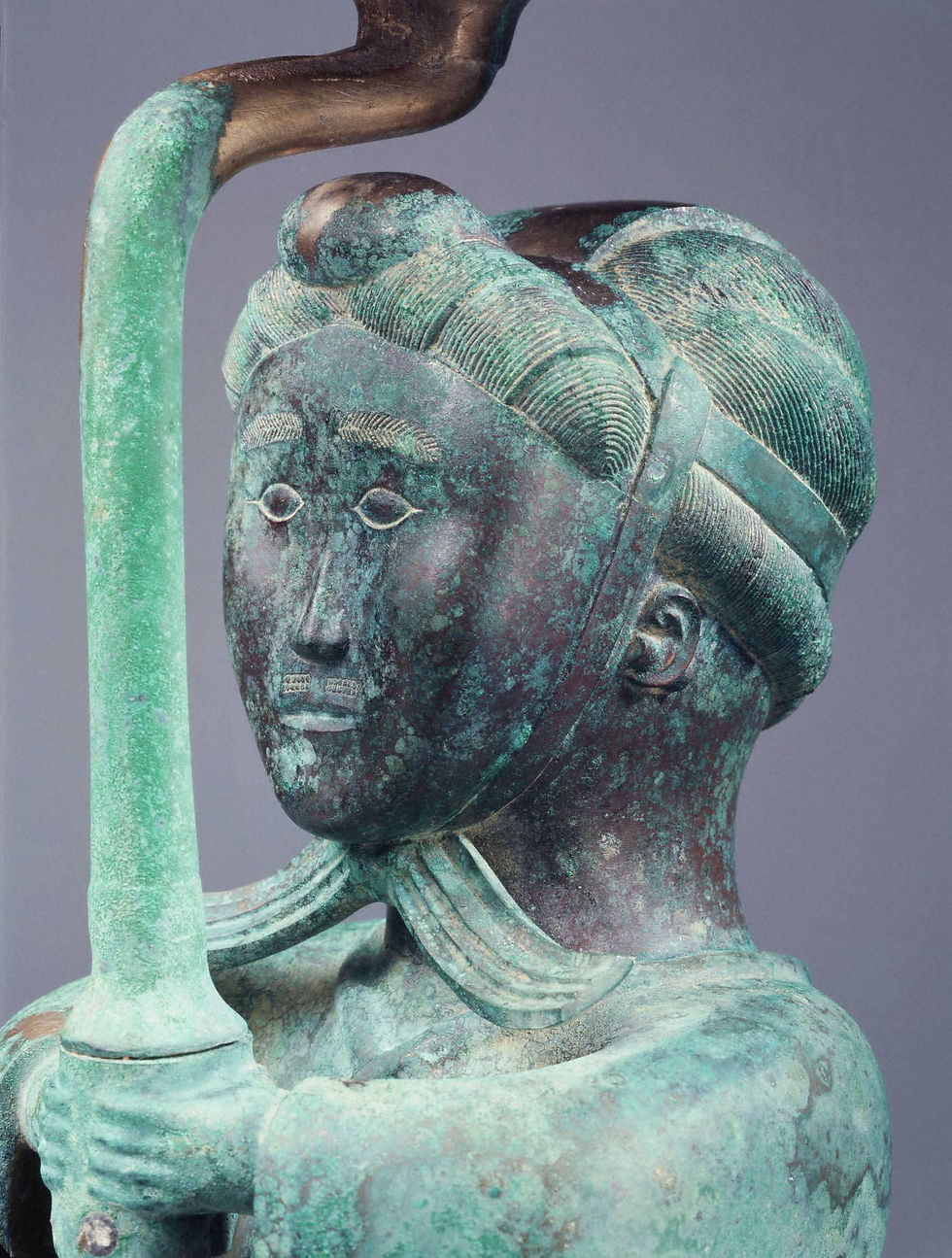
此件秦代至西漢初期的青銅人物燈具,造型雄健,鑄造精良,是藍理捷(J.J. Lally)2003年在紐約展銷的古代中國燈具傑作。此件北方中國青銅燈具以一士兵形象為主體,士兵高舉一盤狀燈盤於頭頂,腰間長劍插入腰帶之中。士兵雙耳穿戴栓狀耳飾,頭髮部分為冠帽所覆,冠帽的繫帶於頷下打結。
自進入普林斯頓大學藝術博物館收藏以來,對此器進行的廣泛技術分析顯示,該燈具並非一次性整體鑄成,而是透過多次連續澆鑄(succession of pours)完成。此工藝允許匠師使用不同成分的金屬合金,從而達到豐富的多色(polychromatic)效果。在中國,此類燈具常見於青銅時代晚期精英墓葬之中,或用於喪葬儀式,亦可能意在照亮逝者通往來世的旅程。
This northern Chinese bronze lamp features a soldier holding a dish-shaped pan above his head, a long sword tucked into his belt sash. The soldier’s ears are pierced with plug ornaments, and his hair is partially covered with a headdress tied under his chin. Extensive technical analysis conducted on this object since it entered the Museum’s collections has revealed that the lamp was not cast in one piece but rather was created through a succession of pours, allowing the artist to use different metal alloy compositions to achieve a polychromatic effect. In China, lamps like this have been found in the tombs of late Bronze Age elites and may have been intended for use in funerary ceremonies or to light the deceased’s journey in the afterlife.

青銅人物燈具
秦 / 西漢初期,約公元前3至2世紀
此燈具以厚重鑄造的高大人物為主體,呈立姿侍衛狀,雙臂前舉於胸前,雙手握持一圓筒,筒上承接長而彎曲的燈杆,頂端托起一盤狀油燈,燈盤邊沿飾有凹槽,中央設有燈芯插針,正位於人物頭頂上方。
侍衛面容寬闊,雙目呈杏形大睜,目光炯炯有神;眉毛刻劃為程式化的羽狀,以人字形紋組成;短髭刻成棋盤格紋,覆於表情肅穆的唇上。雙耳穿有栓狀耳飾。頭髮鑄成細密平行的束狀,梳成整齊的髮髻,部分被緊貼頭部的冠帽所覆蓋,帽帶於頷下打結,帶端呈褶襉狀絲帶,向兩側對稱外卷。身著長素袍,腰間束以褶襉腰帶,於中央打結,帶端下垂,形制與頷帶相呼應。腰側佩長劍,置於合身的劍鞘中,以小型矩形扣鉤掛於腰帶之上。外袍止於腳踝,上衣之下另以較暗青銅分鑄長內袍,垂落地面,底邊呈圓形平直展開,前方開衩,可見雙足並立,露出長褲下緣的凹槽紋飾及簡潔圓頭鞋履。
青銅質地保存極佳,大面積呈現未生銅鏽時原有的淡金色澤,表面覆有一層薄薄的鮮綠色斑斕銅鏽,分佈不均,平滑細膩,並帶有少量墓葬土痕。
高 13 1⁄4 英寸(33.7 厘米)

說明
中國古代青銅油燈的鑄造,尤其是以人物作為燈座的雕塑形式,在戰國時期(公元前475–221年)已高度發展,並延續至漢代。近年中國考古發現多例人物青銅燈具,博物館藏品亦有發表,但本器體量更大、鑄造更為繁複精細,超越多數已知實例。
比較資料
可比較1975年河南出土的一件跪姿人物油燈,人物著簡素袍服與類似冠帽,現藏河南博物院。初刊於《文物》1976年第3期,頁54,圖4,後廣為發表並多次展出。1981年曾參加在蘇黎世美術館開幕的巡迴展覽,收錄於H. Brinker 與 R. Goepper 編《Kunstschätze aus China》,蘇黎世,1980年,頁99,圖19,同時刊載明尼阿波利斯藝術館Pillsbury舊藏跪姿持燈男子及1964年河北晚戰國遺址出土的立姿持燈人物等相關例證。關於中國古代青銅燈具的綜合研究,可參見葉小燕〈戰國秦漢的燈及有關問題〉,《文物》1983年第7期,頁78–86。


Princeton University Art Museum
Dimensions
h. 33.8 cm., w. 13.5 cm., diam. dish 13.0 cm, 10.1 lb. (13 5/16, 5 5/16, 5 1/8 in., 4.6 kg) h. to top of head approximately: 28.5 cm. (11 1/4 in.)
Credit Line
Museum purchase (2003), Fowler McCormick, Class of 1921, Fund
Bronze and Gold in Ancient China
March 24 - April 12, 2003

A LARGE BRONZE FIGURAL LAMP
Qin/ Early Western Han Dynasty, circa 3rd/2nd Century B.C.
the tall, heavily cast figure shown standing as a sentry with his arms held up in front of his chest, grasping a cylinder fitted with the stem of a long curving shaft supporting a dish-shaped oil lamp with fluted sides and central spike raised directly over his head, the sentry's broad face with wide open almond-shaped eyes, shown staring intently under stylized feather-like brows engraved as rows of herringbone pattern and with a short moustache engraved in a checkered pattern over his expressionless lips, his ears pierced with plug-shaped ornaments, his hair in rows of finely cast parallel strands gathered into a neat chignon and partially covered with a close-fitting headdress which is tied under his chin with a knot, the ends of his chin-strap shown as pleated ribbons which curl out symmetrically to either side, wearing long plain robes tied at the waist with a pleated sash knotted at the center, with symmetrically down-curved ends matching his chin-strap, a long sword at his waist in a fitted scabbard with small rectangular buckle hooked over the sash, his tunic ending above his ankles, his long under-robe separately cast from darker bronze falling to the ground and fanning out to a straight hem of circular outline, parted at the front to show his feet positioned close together and revealing the fluted bottoms of his long pantaloons and the simple rounded toes of his shoes, the bronze very well preserved, with large areas showing the original pale golden color of the unpatinated metal and with a thin layer of brightly mottled green patination unevenly spread over the smooth surface, and with traces of earth from burial.
Height 13 1⁄4 inches (33.7 cm)
The casting of elaborate sculptural bronze oil lamps, including bronze figures to serve as lamp standards, is a Chinese art form which was highly developed in the Warring States period (475-221 B.C.) and continued well into the Han Dynasty. Several examples of figural bronze lamps have been revealed by recent archaeology in China, and other examples in various museum collections have been published, but the present figure is larger and more elaborately cast than most of the known examples.
Compare the oil lamp cast in the form of a kneeling figure wearing simple robes and a headdress similar to the present example which was discovered in Henan in 1975 and now is in the Henan Provincial Museum; it was first published in Wenwu, 1976, No. 3, p.54, fig.4, and it has been widely published and included in several exhibitions. It was exhibited in a travelling exhibition which opened at the Kunsthaus in Zurich, 1981, and is illustrated in the catalogue by H. Brinker and R. Goepper entitled Kunstchatze aus China, Zurich, 1980, on p.99, no. 19, together with related examples of a kneeling man holding cylinders to receive the stem of a lamp, from the Pillsbury Collection in the Minneapolis Institute of Arts, and another standing figure of a lamp bearer discovered at a late Warring States site in Hebei province in 1964.
For a survey of the subject of bronze lamps in ancient China, see the article entitled 'Zhangguo Qin Han de Deng ji Youguan Wenti' (Issues Regarding Lamps of the Warring States, Qin and Han) by Ye Xiaoyan in Wenwu, 1983, No. 7, pp.78-86.


Comments