
拍賣筆記 vol.440 蘇富比紐約2026:遼三彩魚紋盤一對,郎朗老師格拉夫曼收藏 - Sotheby’s Hong Kong 2026, A pair of polychrome 'fish' dishes, Liao dynasty
- SACA

- 16 minutes ago
- 11 min read
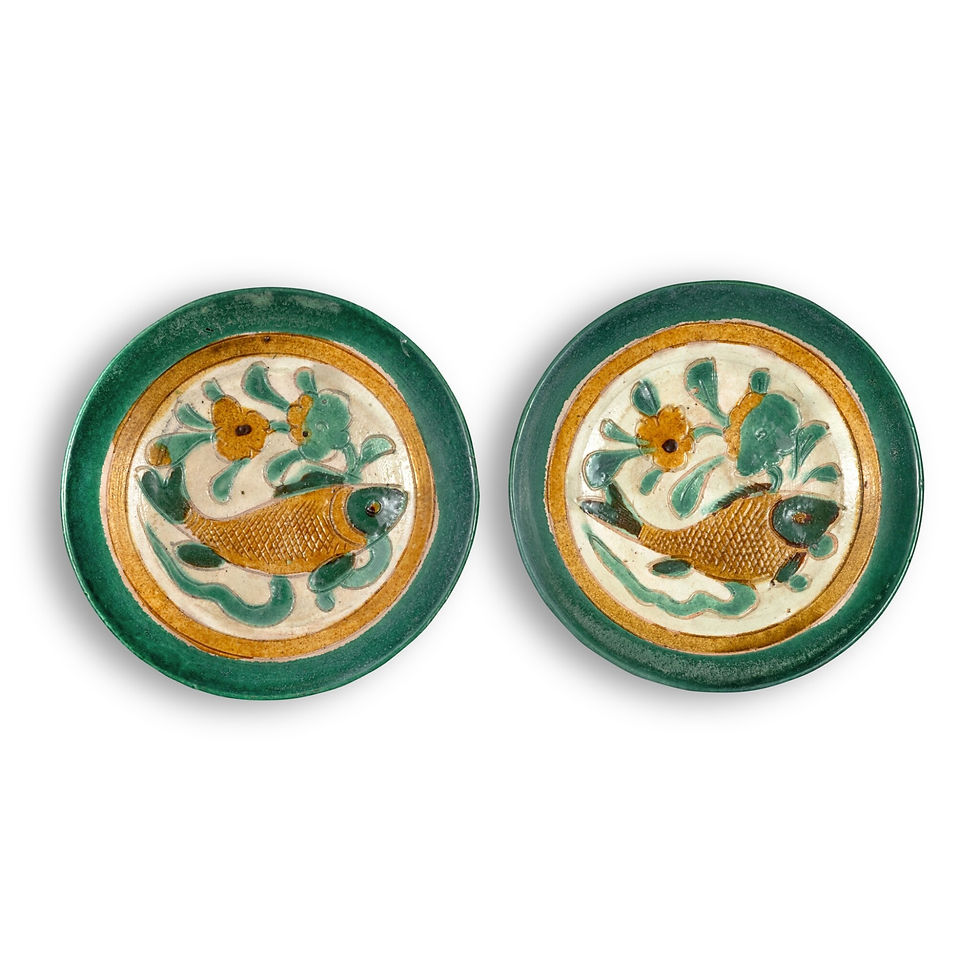
遼三彩魚紋盤一對。口徑14.8公分。蘇富比紐約,「加里·格拉夫曼珍藏中國藝術品,所得惠於蓋瑞及娜歐蜜·格拉夫曼基金會」,2026年9月16日,拍品20。估價4,000–6,000美元。二盤成對,口徑同為5⅞英寸(14.8公分)。盤心以綠、琥珀、乳白三色鉛釉寫游魚,屬遼三彩印花/點彩小盤系統。動物母題是遼三彩盤的主體之一。此類盤常見兩種尺寸:約15公分的中型,另有約10–11.5公分的小品。經典動物紋有野兔、鵝、鶴、魚。來源:香港Sing’s Antique Gallery,1996年7月25日。
SACA觀察
動物母題是遼三彩盤的主角。15公分一檔屬中型,另有約10公分的小品。野兔、鵝、魚是最常見的幾種,盤心小、釉色對比強,適於案頭近觀。本件來自郎朗老師格拉夫曼的收藏。西方藏家對自然與動物母題素有偏愛,遼三彩的寫生意味正好對上這一趣味。
遼三彩此類品種仍在低估階段。相對動輒上百萬的宋瓷,這類小品是入門藏家與資深藏家都值得放在案頭的器物。SACA已在《拍賣筆記 vol.147》寫過同一邏輯:佳士得紐約2025年3月27日,遼三彩瑞獸盤兩件(兔盤17.5公分、鶴盤16.8公分),估3,000–5,000美元,成交8,190美元。當時即指出:同樣的錢去買龍泉,幾乎顆粒無收;買這對特殊動物盤,對藏家是合理入口。本件估4,000–6,000美元,尺度略小、題材為魚,與那對兔、鶴盤同屬一系。
可比材料應分三層。第一層,同題材、近尺寸:蘇富比香港2019年天民樓專場拍品5,遼至金三彩刻魚紋盤,口徑14.6公分,估60,000–80,000港元,20萬港元售出,1983年購於香港,1992年東京《中國名陶展》著錄。第二層,同窯系、動物盤:佳士得2025年兔、鶴一對,成交8,190美元。第三層,館藏形制:大都會藝術博物館藏遼三彩雙魚紋海棠式盤(1991.382),長28.3公分,尺度更大,可作母題參照,不可作價格換算。伊勢收藏遼三彩雙魚花卉紋硯(口徑20.5公分,蘇富比香港估180,000–360,000港元)是文具系統,與本件食盤功能不同,17.78萬港元售出。
遼三彩在器物脈絡上屬於北方草原政權的日常用器,鉛釉施彩、印花或刻花裝飾,動物紋樣多置於盤心;本件成對保存,1996年於香港入藏,其後再經郎朗老師收藏,流傳經歷是加分項,斷代與品相評級則可從釉色分色是否清晰、魚紋圖案是否完整、口沿有無傷損三方面切入。至於估價是否偏低,應以2025年佳士得動物紋盤成交價與2019年天民樓魚紋盤估價作為參照坐標,而非套用宋瓷五大名窯的行情邏輯來推算——單件港幣20萬元屬過去的基本行情水位,但天民樓當年因主人涉入詐騙案急需變現而釋出藏品,反而因此獲得大批藏家出於同情與惜才心理的支持,疊加其作為老牌香港收藏體系的品牌溢價,成交價明顯墊高;相較之下,這次郎朗老師的收藏釋出,是否也能得到類似性質、類似規模的藏家群體支持與品牌加成,仍屬未知,且自天民樓那場拍賣至今已逾七年,藏家群體對遼三彩本身的認知與接受度是否已有變化,都是評估這次估價合理區間時需要一併納入考量的變數。
關於藏家與早期經手
加里·格拉夫曼(Gary Graffman,1928–2025),費城柯蒂斯音樂學院出身,後任院長。1979年右手局灶性肌張力障礙後,轉向左手曲目與教學。郎朗、王羽佳、張昊辰皆出其門下。其中國藝術收藏始於鋼琴家Julius Katchen的引導,繼以巴黎購藏、哥倫比亞大學修習,並自1981年起多次訪華。本場收益歸蓋瑞及娜歐蜜·格拉夫曼基金會。郎朗2025年12月28日所撰,可作收藏史背景,而非斷代依據。本件1996年購自香港Sing’s Antique Gallery,入藏時間清楚。

遼 三彩魚紋盤一對
年代:遼(907–1125)
尺寸:口徑14.8 cm(5⅞ in.)
件數:2
估價:4,000–6,000美元
來源:Sing’s Antique Gallery,香港,1996年7月25日
專場:The Collection of Gary Graffman Sold to Benefit the Gary and Naomi Graffman Foundation
拍賣:蘇富比紐約,2026年9月16日
拍品號:20
FAQ
Q1:遼三彩盤為什麼常見魚、兔、鵝?
遼代陶瓷繼承唐三彩鉛釉系統,同時吸收北方金銀器與遊牧生活中的動物觀察。盤心面積小,適合單個動物或雙魚。魚有豐產、雙魚有成對之意;兔、鵝(鶴)則是草原與水澤常見物象。這不是宋瓷的文人花鳥系統,是器用上的寫生。
Q2:15公分與10公分如何分檔?
約14.5–17.5公分為中型常用盤;約10–11.5公分為小品,如遼白釉印鴨紋方盤常見於此檔。本件14.8公分,屬中型。中型更適於成對陳設,小品更偏案頭把玩。
Q3:和宋瓷比,為什麼說低估?
同一估價區間,宋龍泉、青白往往只能買到普通殘器或小件;遼三彩動物盤卻能買到完整母題、成對保存。市場把注意力集中在五大名窯,遼金三彩長期被視為「邊地鉛釉」。認知一旦分開,價格結構才會分開。SACA vol.147對2025年佳士得8,190美元成交,已持同一判斷。
Q4:看什麼決定級別?
釉色分色、動物輪廓是否被傷釉切斷、口沿一圈是否連續、是否成對。來源層累是加分,不能替代釉面判斷。
A pair of polychrome ‘fish’ dishes, Liao dynasty. Diameter 5⅞ in. (14.8 cm). Sotheby’s New York, The Collection of Gary Graffman Sold to Benefit the Gary and Naomi Graffman Foundation, 16 September 2026, lot 20. Estimate US$4,000–6,000.
A matched pair. The wells are dressed in green, amber and cream lead glazes over swimming fish. Animal subjects dominate this class of Liao sancai dish. Two sizes recur: a mid-size group near 15 cm, and a smaller group near 10–11.5 cm. The stock animals are the hare, the goose (or crane), and the fish. These plates sit in the mid-size band. Provenance: Sing’s Antique Gallery, Hong Kong, 25 July 1996.
SACA Observation
Animals are the principal subject of Liao sancai dishes. Fifteen centimetres is the mid-size; another group sits around ten. Hares, geese and fish are the familiar types. The well is small, the glaze contrast high, and the object is meant to be read at desk distance. The pair comes from the collection of Gary Graffman, Lang Lang’s teacher. Western collectors have long favoured nature and animals; Liao sancai, with its observational animals, meets that taste directly.
The category remains undervalued. Against Song wares that move into seven figures, these small dishes are desk pieces for both new and experienced collectors. SACA stated the same case in Auction Notes vol. 147: Christie’s New York, 27 March 2025, two Liao sancai animal dishes (hare 17.5 cm, crane 16.8 cm), estimate US$3,000–5,000, sold for US$8,190. The same money would buy almost nothing in Longquan; it bought a pair of specific animal plates. The present estimate of US$4,000–6,000 belongs to that band. The subject is fish, the diameter slightly smaller.
Comparanda fall in three tiers. First, same subject and near size: Sotheby’s Hong Kong, Tianminlou, 2019, lot 5, a Liao–Jin incised sancai fish dish, 14.6 cm, estimate HK$60,000–80,000, acquired in Hong Kong in 1983, exhibited Tokyo 1992. Second, same kiln family, animal dishes: the 2025 Christie’s hare and crane pair at US$8,190. Third, museum form: the Metropolitan Museum oblong Liao sancai twin-fish dish (1991.382), 28.3 cm long—useful for motif, not for price. The Ise Collection sancai fish inkstone (20.5 cm, estimate HK$180,000–360,000) is a scholar’s object, not a pair of food dishes.
Liao sancai should not be priced as a reduced Tang horse, nor as a fraction of Song guan or ru. It belongs to the daily table of a northern regime: lead glaze, moulded or incised animals in the well. The pair, the 1996 Hong Kong invoice, and the musician’s collection are additions. Rank is decided by colour separation, completeness of the fish, and the state of the rim. Whether the estimate is conservative should be tested against the 2025 Christie’s result and the 2019 Tianminlou fish dish, not against the Song market.
On the collector and the early trade
Gary Graffman (1928–2025) trained at the Curtis Institute and later served as its president. After focal dystonia ended two-handed performance in 1979, he developed a left-hand repertoire and a teaching line that includes Lang Lang, Yuja Wang and Haochen Zhang. His interest in Chinese art began with Julius Katchen, continued in Paris and at Columbia, and through travel to China from 1981. Proceeds benefit the Gary and Naomi Graffman Foundation. Lang Lang’s statement of 28 December 2025 is background to the collection, not a criterion of dating. The dishes were purchased from Sing’s Antique Gallery, Hong Kong, on 25 July 1996.
FAQ
Q1: Why fish, hare and goose on Liao dishes?
Liao potters inherited Tang lead glaze and took animals from metalwork and from steppe and wetland life. The well is small; one animal, or a pair of fish, fills it. Fish carry abundance; hares and geese are things seen. This is not Song literati bird-and-flower painting. It is observation on a usable plate.
Q2: How do the two sizes divide?
About 14.5–17.5 cm is the mid-size service dish; about 10–11.5 cm is the small desk piece (white-glazed moulded duck dishes often sit there). At 14.8 cm these plates are mid-size. Pairs work better at this scale.
Q3: Why call the category undervalued against Song?
In the same dollar band, Song Longquan or qingbai often yields a damaged or minor piece. Liao animal dishes still yield a complete motif, sometimes a pair. Attention has stayed on the Five Great Kilns; Liao and Jin sancai have been filed as provincial lead glaze. Once the categories are separated, the prices can separate. That was the argument of SACA vol. 147 at US$8,190 in 2025.
Q4: What decides rank?
Separation of the three colours, whether damage cuts the animal, continuity of the rim, and pairing. Provenance adds; it does not replace the glaze. The unpublished condition report must be read before bidding.
Title: A pair of polychrome ‘fish’ dishes, Liao dynasty
Date: Liao dynasty (907–1125)
Dimensions: Diameter 5⅞ in., 14.8 cm
Number of pieces: 2
Estimate: US$4,000–6,000
Provenance: Sing’s Antique Gallery, Hong Kong, 25 July 1996
Sale: The Collection of Gary Graffman Sold to Benefit the Gary and Naomi Graffman Foundation
Auction: Sotheby’s New York, 16 September 2026
Lot: 20
SACA學會相關筆記 / SACA Notes
拍賣筆記 vol.147 佳士得紐約:遼三彩瑞獸盤兩件(兔17.5 cm、鶴16.8 cm),成交8,190美元
拍賣筆記 vol.439 蘇富比紐約2026:唐褐黃釉陶豕一對,格拉夫曼收藏
同場、同一藏家。動物母題由唐墓明器轉入遼代案頭盤。
參考文獻 / References
館藏與研究
The Metropolitan Museum of Art, acc. no. 1991.382. Oblong Liao sancai dish with twin fish, second half of the 11th century, 28.3 × 16.5 cm. Gift of Mr. and Mrs. George J. Fan. https://www.metmuseum.org/art/collection/search/36443
Yuzo Sugimura, Tōji taikei: Ryō no tōji [Liao Dynasty Ceramics], vol. 40, Tokyo, 1974.
拍賣(蘇富比、佳士得)
3. Christie’s New York, 27 March 2025. Two sancai-glazed pottery dishes, Liao dynasty. Hare 17.5 cm, crane 16.8 cm. Estimate US$3,000–5,000. Sold US$8,190. Provenance: Hong Kong private collection, 1990s; Sotheby’s New York, 29 September 2021, lot 1060.
4. Sotheby’s Hong Kong, Tianminlou – A Small History of Chinese Ceramics, 2019, lot 5.
An incised sancai ‘fish’ dish, Liao–Jin dynasty, 14.6 cm. Estimate HK$60,000–80,000. Provenance: acquired in Hong Kong, 1983. Exhibited: Tokyo, 1992, cat. no. 37. Solf for 200,000 HKD
5. Sotheby’s Hong Kong, 25 November 2022, lot 418. A moulded green-glazed pottery dish, Liao dynasty, 14.7 cm. Sold HK$32,760. Provenance: Sotheby’s New York, 18 March 2017, lot 1360 (then sold US$11,875).
6. Sotheby’s Hong Kong, Ise Collection, a sancai-glazed ‘fish’ inkstone, Liao dynasty, 20.5 cm. Estimate HK$180,000–360,000. Sold for 177,800 HKD
SACA
7. SACA,《拍賣筆記 vol.147 佳士得紐約:遼三彩瑞獸盤兩件》,2025年3月28日。https://www.artsaca.com/post/auction147
收藏史
8. Sotheby’s, sale page and Lang Lang statement, 28 December 2025.
蘇富比資料:
遼 三彩魚紋盤一對
現場拍賣開始:
September 16, 09:00 PM HKT
估價
4,000 - 6,000 USD
描述
(2)
Diameter 5⅞ in., 14.8 cm
出處
聚古軒,香港,1996年7月25日
琴韻•師道•雅懷
加里•格拉夫曼珍藏中國藝術品
所得收益將惠於蓋瑞及娜歐蜜•格拉夫曼基金會
「他深愛中國文化,傾力扶持中國學子,畢生專注於中國藝術收藏,一生曾近百次踏上中國土地。這份情誼,無懼山海之遙,使他與這片土地永結不解之緣。」
郎朗,2025年12月28日
本中國藝術珍藏由加里・格拉夫曼 (1928–2025年) 集成,格拉夫曼以卓越琴藝蜚聲國際,其對中國藝術之熱愛則鮮為人知,花數十年心血集成珍藏,精品琳琅。
格拉夫曼七歲進入費城柯蒂斯音樂學院,師從伊莎貝爾・文格洛娃,1980年重返母校任教,1995年出任院長。
格拉夫曼,意志堅毅,篤志於樂。1979年,其右手罹患局限性肌張力障礙,演奏生涯戛然而止。然此疾未能摧其志,亦未斷其愛,格拉夫曼遂轉而專注左手曲目,錘鍊出一套卓絕琴藝。而其所留最為深遠之遺澤,並非舞台風華,而在於作育英才,桃李芬芳。
除了個人無數成就之外,格拉夫曼更以提攜後進、賞識英才獨具慧眼而備受推崇。他深受學生愛戴,門下英才輩出,郎朗、王羽佳、張昊辰皆曾親炙其教誨;格拉夫曼畢生既傾心於鋼琴藝術,亦篤志於栽培人才,提攜無數後學,成就今日樂壇多位名家,其對鋼琴藝術與音樂教育之貢獻,為世所稱頌。
鮮為人知者,乃格拉夫曼對亞洲藝術之熱愛,此或與其深厚學養及高雅審美一脈相承。其收藏之緣,肇於友人及鋼琴家 Julius Katchen(1926–1969年)啟迪,自巴黎偶然購藏數器後興趣漸濃,及至事業成熟後期,更專心致力蒐羅,遂成一批廣博、優質且彰顯個人品味之珍藏。格拉夫曼曾在哥倫比亞大學修習,並早於1981年前往中國,憑藉音樂家特有之敏銳感悟、求知精神與藝術熱忱,深究中國藝術之堂奧。今所呈諸器,正是其數十載潛心收藏之結晶,不僅映照其鑑賞眼光,亦見證其對藝術終身不渝之情。
PIANIST. MENTOR. AESTHETE. THE COLLECTION OF GARY GRAFFMAN SOLD TO BENEFIT THE GARY AND NAOMI GRAFFMAN FOUNDATION
A pair of polychrome 'fish' dishes, Liao dynasty
Live auction begins on:
September 16, 09:00 PM HKT
Estimate
4,000 - 6,000 USD
Description
(2)
Diameter 5⅞ in., 14.8 cm
Provenance
Sing's Antique Gallery, Hong Kong, 25th July 1996.
PIANIST. MENTOR. AESTHETE.THE COLLECTION OF GARY GRAFFMAN SOLD TO BENEFIT THE GARY AND NAOMI GRAFFMAN FOUNDATION
“He loved Chinese culture, wholeheartedly supported Chinese students, devoted himself to collecting Chinese art, and visited China nearly a hundred times in his lifetime. This bond, which transcended oceans and mountains, forever tied him to this land.”
LANG LANG, 28TH DECEMBER 2025
Assembled through decades of joy and discernment, the following collection of Chinese art presents a much overlooked but beloved passion of the late Gary Graffman (1928–2025).
World-renowned for his extraordinary skill at the piano, Graffman began his musical career at the Curtis Institute of Music in Philadelphia at the age of seven, where he studied under Isabelle Vengerova and to whence he would return in 1980 as a member of faculty and, by 1995, as the Institute’s president.
A man of indomitable spirit and passion for music, Graman’s performing career was cut short in 1979 with the development of a debilitating condition in his right hand known as focal dystonia. However, despite his inability to perform with his right hand, Graman’s career and passion for the piano were far from over. Graffman continued to express his passion, honing a remarkable repertoire of left-handed pieces, and forged his ultimate legacy — the cultivation of others.
Today, beyond his countless individual successes, Graffman is most celebrated for the skills he noticed and cultivated in others. Beloved by his students, including Lang Lang, Yuja Wang and Haochen Zhang, Graffman is rightly credited with a dual devotion to the music of the piano and those that play it; nurturing young talent and shaping the internationally celebrated musicians of today.
Less well-known but doubtless inspired by the same academic background and refined sensibility was Graman’s fascination with Asian art. First sparked by his friend and fellow pianist Julius Katchen (1926–1969), Graffman soon became a devoted collector. Initially buying casually in Paris, Graman’s interest continued to develop into a passionate endeavor by his later career, assembling a collection of remarkable breadth, quality and character. Attending courses at Columbia University and traveling to China as early as 1981, Graffman delved into the world of Chinese art with a musician’s combination of intellectual curiosity and passion. The result – the following collection – stands as a testament to the musical giant, his careful eye and untiring devotion to the arts.


Comments