
漢代筆記 vol.34 西雅圖藝術博物館:東周至西漢穀紋玉璧 - Seattle Art Museum, Jade Bi Disc with Grain Pattern, Estern Zhou to Western Han Dynasty


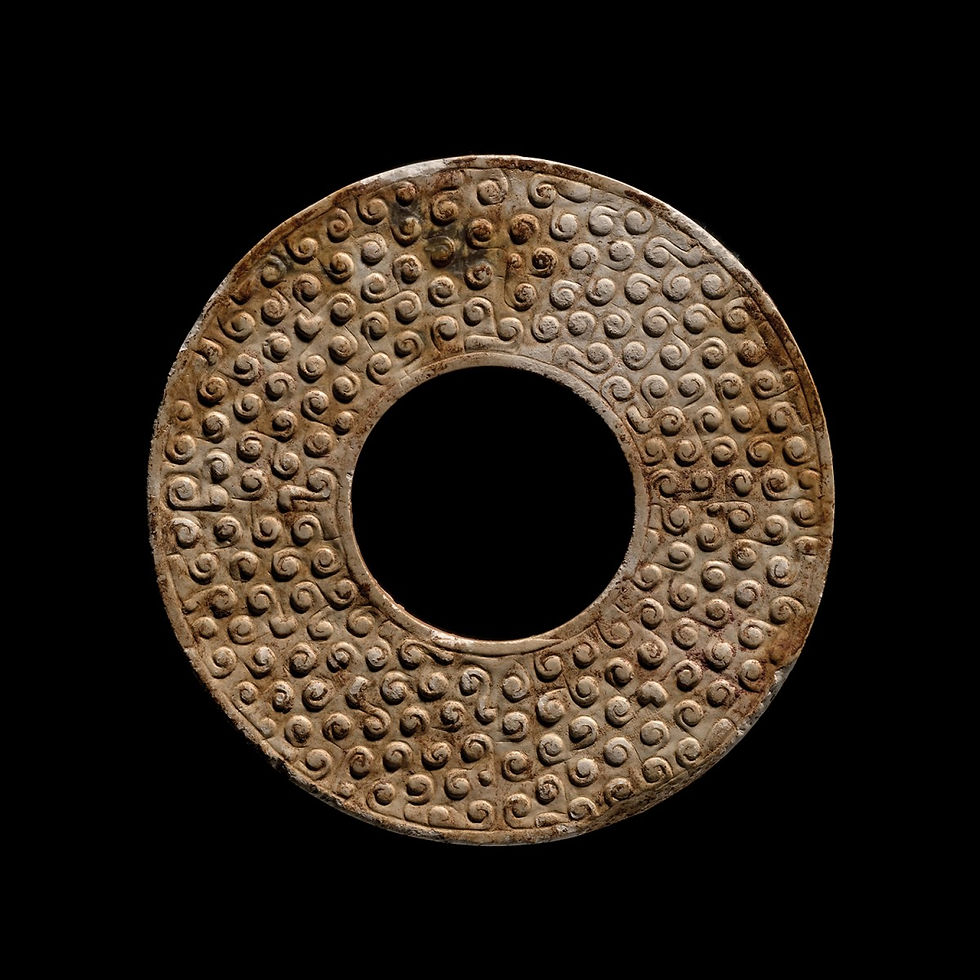
這件玉璧是Eugene Fuller Memorial Collection舊藏(編號:33.1408),呈圓形扁平狀,中有圓孔。表面已明顯鈣化(白化),但仍可清楚辨識紋飾。紋飾以浮雕穀紋為主,但細節與標準整齊排列的穀紋略有不同:部分穀紋之間有連結線,部分則尾巴拖長,形成類似渦紋或雲紋的過渡形態,十分有趣。
雲紋到穀紋的過渡
「穀紋」是漢代對這種凸起螺旋紋的標準稱呼,形似穀粒發芽。《周禮·春官·典瑞》註中已有「穀璧」的提法,漢代正式確立此名稱。
其演變脈絡清晰:
源頭:春秋晚期,浮雕虺龍紋開始解體。原本具象的龍首、龍身逐漸簡化,圓眼消失,身體分解成雲紋、長尾蝌蚪紋、S紋等抽象元素,形成「雲穀相雜紋」。
過渡期(戰國早期至中期):雲紋與穀紋混雜並存(雲穀相雜)。紋飾排列仍較隨意,部分單元尾巴拖長、互相連結,尚未完全規律化。吳棠海等學者指出,這是從春秋晚期浮雕虺龍紋向戰國規律紋飾轉變的關鍵階段。
成熟期(戰國中晚期至西漢):穀紋逐漸獨立,排列愈趨整齊,出現打格子定位,最終形成西漢常見的標準浮雕穀紋。西漢晚期進一步簡化為乳丁紋。
本件部分紋飾帶有連結與拖尾,正屬於「雲穀相雜」向標準穀紋過渡的特徵,更能反映這一演變過程。商周青銅器的雲雷紋底紋中,早已出現類似的渦旋與連結處理,顯示母題有更深遠的淵源。

參考藍理捷同款,谷紋過渡期互相連結的表達方式,定為東周:https://www.jjlally.com/exhibitions/ancient-chinese-jade/an-archaic-jade-disc-bi02/
SACA觀察
這件雖有明顯鈣化,但紋飾細節(連結與拖尾)反而增加了可讀性與學術趣味。標準穀紋璧在漢代較為常見,但這種帶過渡特徵的例子更能反映紋飾從雲渦紋向穀紋演變的過程。作為Eugene Fuller Memorial Collection早期入藏的玉璧,來源清楚。市場上穀紋璧價格差異極大,主要取決於玉質、鈣化程度、紋飾規整度與尺寸;過渡型或帶連結特徵的例子相對少見。
關於藏家(詳細)
Eugene Fuller Memorial Collection以Eugene Fuller(1858–1930,紐約著名泌尿外科醫生)命名。真正推動收藏並建立博物館的是其子Richard E. Fuller(1897–1976)與母親Margaret MacTavish Fuller(1860–1953)。Richard 出生於紐約,早年隨家人多次遊歷亞洲。1919年家族赴日旅行時,他因急性闌尾炎在日光緊急手術(由兄長Duncan執刀、父親協助),休養期間全家開始大量購藏玉器、netsuke等,奠定日後收藏基礎。1923年家族遷居西雅圖後,Richard在華盛頓大學取得地質學學位,並與母親持續收集中國古玉、瓷器與鼻煙壺。
1933年,母子二人共同出資約25萬美元,在Volunteer Park建造西雅圖藝術博物館並捐贈給城市,Richard擔任館長長達四十年卻從不支薪。他特別重視亞洲藝術,早期收藏以古玉為核心之一,使該館成為美國重要的中國玉器收藏地。Eugene Fuller Memorial Collection即是為紀念其父而命名的這批早期捐贈與購藏。
FAQ
Q1:什麼是穀紋?名稱始於何時?
穀紋是凸起的螺旋狀紋飾,形似穀粒發芽。漢代正式以此名稱稱呼。戰國晚期已大量流行,西漢達到高峰。
Q2:本件紋飾有何特別?
部分穀紋之間有連結,部分尾巴拖長,不完全是標準整齊的獨立穀粒。這更接近早期雲紋/渦紋向穀紋過渡的形態。
Q3:鈣化對價值有何影響?
鈣化(白化)是古玉常見現象,嚴重者會降低市場價格,但若紋飾清晰、整體完整,仍具學術與收藏價值。
Q4:市場情況如何?
穀紋玉璧在蘇富比、佳士得、邦瀚斯拍賣會上常見,價格從數千至數十萬美元不等。過渡型或帶連結特徵的例子相對少見。
名稱:玉璧(Ring)
年代:戰國晚期至漢代(約公元前3–1世紀)
材質:玉
尺寸:館方未公開詳細數據
來源:Eugene Fuller Memorial Collection
館藏編號:33.1408
This jade bi disc is from the Eugene Fuller Memorial Collection. It is a flat circular disc with a central aperture. The surface shows clear calcification, yet the decoration remains readable. The primary motif is raised grain pattern, but with notable variations: some units are linked, while others have elongated tails, creating a transitional effect between pure grain pattern and earlier spiral/cloud motifs.
The Transition from Cloud Pattern to Grain Pattern
“Grain pattern” (guwen) is the standard Han-dynasty term. The evolutionary sequence is:
Origins: Late Spring and Autumn period — high-relief coiled-dragon motifs disintegrate into cloud patterns, long-tailed tadpole motifs and S-scrolls, producing the mixed “cloud-and-grain” pattern.
Transitional phase (early–mid Warring States): Cloud and grain elements coexist freely; some units retain elongated tails and interlinking lines. Scholars such as Wu Tanghai identify this as the critical stage of change.
Mature phase (mid–late Warring States to Western Han): Grain pattern becomes independent and highly regular, culminating in the classic Western Han raised-grain bi.
The linked and elongated elements on the present disc belong to this transitional stage. Similar spiral treatments already appear as ground patterns on Shang–Zhou bronzes.
SACA Observation
Despite calcification, the decorative details enhance scholarly interest. Transitional examples better illustrate the evolution from cloud/whorl motifs to classic grain pattern. As an early Eugene Fuller Memorial Collection piece, provenance is clear.
About the Collector
The collection is named after Eugene Fuller (1858–1930), a prominent New York urologist. The actual builders were his son Dr. Richard E. Fuller (1897–1976) and mother Margaret MacTavish Fuller (1860–1953).
Richard’s passion for Asian art was formed during family travels. In 1919, while the family was in Japan, he suffered acute appendicitis in Nikkō; his brother Duncan performed emergency surgery assisted by their father. During the three-month recovery the family began buying jades and other antiquities in quantity. After moving to Seattle in 1923, Richard earned geology degrees at the University of Washington and continued collecting Chinese jades, ceramics and snuff bottles with his mother.
In 1933 mother and son jointly donated approximately $250,000 to construct the Seattle Art Museum in Volunteer Park and presented it to the city. Richard served as unpaid director for forty years. Asian art, especially early jades, formed a core strength of the founding collection, which was named the Eugene Fuller Memorial Collection in honour of his father.
FAQ
Q1: What is grain pattern (guwen), and when was the term established?
It is a raised spiral motif resembling sprouting grain. The name became standard in the Han dynasty. The motif itself was already widespread by the late Warring States period and reached its height in the Western Han.
Q2: What is special about the decoration on this piece?
Some grain units are linked by connecting lines, while others have elongated tails. This is not the fully regular, isolated grain pattern of classic examples. It is closer to the transitional phase from earlier cloud and whorl patterns, and shows affinity with Shang–Zhou bronze ground patterns.
Q3: How does calcification affect value?
Calcification (whitening) is common on ancient jades and can lower market prices when severe. However, if the decoration remains clear and the overall piece is intact, it still retains scholarly and collecting value. This example is markedly calcified, yet the pattern is still legible.
Q4: How are these regarded on the market?
Grain-pattern bi discs appear regularly at Sotheby’s, Christie’s and Bonhams. Prices range from a few thousand to several hundred thousand US dollars, depending on material quality, size, carving precision and provenance. Transitional or linked examples are less common; complete pieces with clear provenance attract greater attention.
參考文獻 / References
學術
《周禮·春官·典瑞》及漢代註疏。
吳棠海:春秋晚期浮雕虺龍紋解體 → 戰國雲穀相雜紋 → 穀紋獨立的演變序列。
James C.Y. Watt & Michael Knight, Chinese Jades from the Collection of the Seattle Art Museum, Seattle Art Museum, 1989.
拍賣實例(附連結與成交價)
Bonhams London, 7 June 2021, lot 424
Archaic green and russet jade bi with comma spirals, Warring States/Han, diam. 12.5 cm.
Sold for £6,120 (inc. premium).
Bonhams Cornette de Saint Cyr Paris, 25 October 2022, lot 5 (Robert & Jean-Pierre Rousset Collection)
Yellow jade ‘grain’ bi, Warring States/Han, diam. 12.1 cm.
Sold for €14,025 (inc. premium).
Bonhams London, 18 May 2023, lot 23
Archaic jade bi with dense raised bumps in hexagonal grid, Warring States, diam. 7.6 cm.
Sold for £11,475 (inc. premium).
https://www.bonhams.com/auction/27991/lot/23/an-archaic-jade-disc-bi-warring-states-period/
Bonhams Hong Kong, 29 May 2024, lot 431
Jade bi with neatly arranged comma spirals, Warring States/Western Han, diam. 6.8 cm.
Sold for HK$217,600 (inc. premium).
Christie’s New York, 19–20 September 2013, lot 1730
Greyish-green jade bi with comma spirals, Warring States/Han (comparable example cited in Bonhams catalogues).
Sotheby’s New York – dark green jade bi with spiral/grain pattern, Late Warring States/Western Han (ex J.J. Lally & Stein Collection; previous Christie’s provenance).
J.J. Lally & Co., Ancient Chinese Jade 展覽(2018年3月)
No. 99:東周(約前5–4世紀)玉璧,直徑9 cm。兩面浮雕「sprouting grain」捲曲紋,部分成對連結,部分帶長尾或緊密螺旋,玉質因埋葬呈乳白鈣化。
https://www.jjlally.com/exhibitions/ancient-chinese-jade/an-archaic-jade-disc-bi02/
No. 96:東周(前4–3世紀)玉璧,直徑7.1 cm。浮雕逗號形「sprouting grain」紋。
https://www.jjlally.com/exhibitions/ancient-chinese-jade/an-archaic-jade-disc-bi01/
No. 102:東周晚期(約前3世紀)玉璧,直徑8.6 cm。格狀凸起逗號螺旋紋,帶陰刻捲線。
https://www.jjlally.com/exhibitions/ancient-chinese-jade/an-archaic-jade-disc-bi03/
No. 117:東周晚期–漢(約前3世紀)大型玉璧,直徑20 cm。密集「sprouting grain」逗號螺旋紋。
https://www.jjlally.com/exhibitions/ancient-chinese-jade/a-large-archaic-jade-disc-bi05/
No. 119:西漢玉璧,直徑16.2 cm。低浮雕螺旋穀紋。https://www.jjlally.com/exhibitions/ancient-chinese-jade/an-archaic-jade-disc-bi06/


Comments