
拍賣筆記 vol.442 蘇富比紐約2026:10240美元售出,唐代陶加彩男優伶俑崑崙奴,郎朗老師格拉夫曼收藏 - Sotheby’s New York 2026, A Painted Pottery Figure Of A Foreign Dancer ‘Kunlun Slave’, Tang Dynasty, Sold for US$10240

Updated: Sep 17

唐加彩男優伶俑。高26.4公分。木座。蘇富比紐約,「加里·格拉夫曼珍藏中國藝術品,所得惠於蓋瑞及娜歐蜜·格拉夫曼基金會」,2026年9月16日。估價8,000–12,000美元。1995年或之前購於香港。
俑作舞姿:曲膝、扭軀、一臂揚起。捲髮、深目,上身袒露或披帛交叉,下著短裙式裹衣,頸、腕、踝飾環。此為唐代明器中的胡人舞俑一系,蘇富比圖錄稱之為「Foreign Dancer」,並援引「崑崙」舊稱。品相:頸與雙腿經修復;衣前可能有補彩;凸起裝飾見磨損與小失;殘存顏料磨失較重。(SACA觀察,2026年8月31日)
拍賣結果:10240美元,物美價廉。
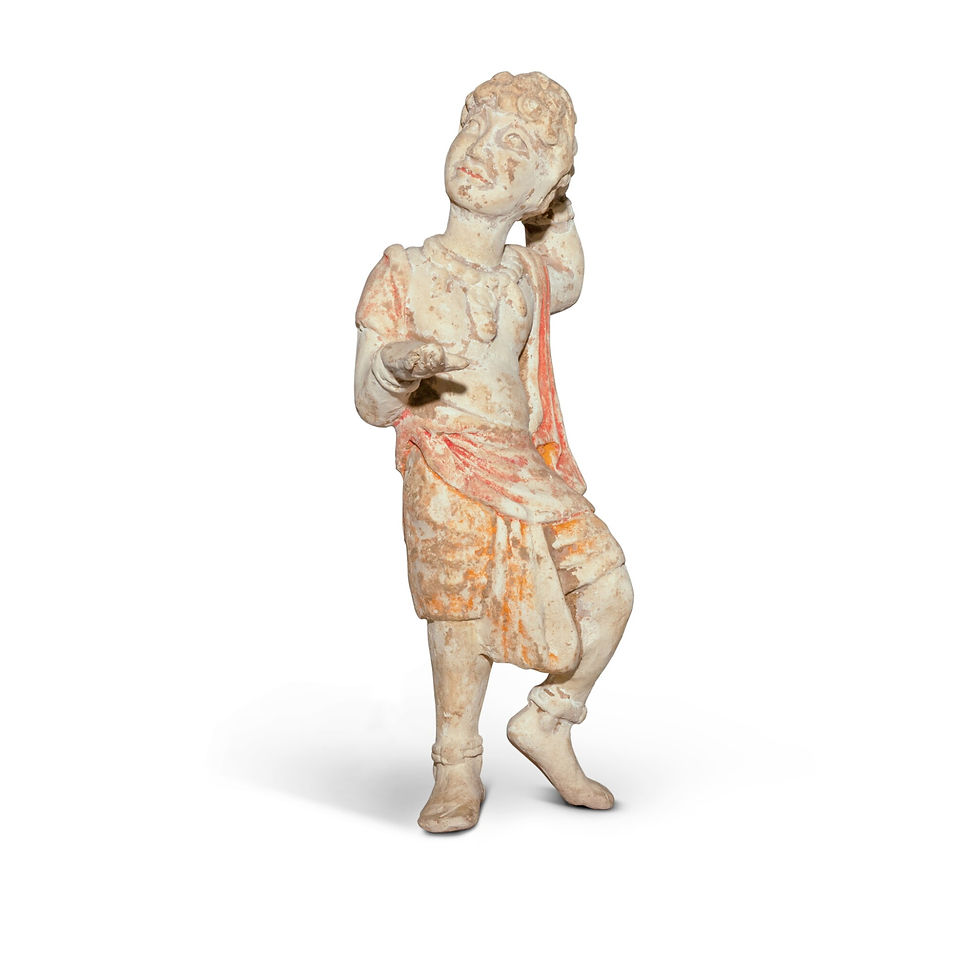


SACA觀察
本件不是道州「矮奴」系統。道州貢侏儒見白居易《道州民》與《新唐書·陽城傳》,形象是短軀、常著幞頭翻領,功能近宮廷俳優。本件是捲髮、舞姿、半裸披帛的胡人優伶,與咸陽出土崑崙舞俑、大都會1981.470.1、維多利亞與艾伯特博物館 C.827-1936 同型。葛承雍等討論的「崑崙」,在文獻裡指膚色深、來自南海或崑崙以南非漢人群;陶俑所見則是宮廷宴會上的樂舞供奉,不是地方土貢的矮民。兩類都進入長安娛樂,來源與身體語言不同,不宜混稱。
唐代宮廷的樂舞分「健舞」「軟舞」。胡旋、胡騰屬前者,來自西域;本件揚臂曲膝,近健舞,而非長袖仕女的軟舞。長安墓俑把這類形象做成明器,是把宴席上的胡樂胡舞帶進墓室。漢代已有說唱俑、銅鎮,功能是宴樂;唐俑把表演者的族屬寫清楚:捲髮、深目、短裙、瓔珞。市場長期把牠們與加彩仕女、三彩馬放在同一「唐俑」籃子裡。仕女看體態與彩繪,馬看釉與體量;本件看的是舞姿是否完整、捲髮與瓔珞是否還在、修復是否切到面相。
館藏對例尺度接近。大都會藝術博物館1981.470.1,高26.7公分,約翰·韋伯夫婦捐贈,定為七世紀南亞或東南亞舞人。V&A C.827-1936,高25.8公分,Eumorfopoulos舊藏,館方寫作680–750年,並明言或即文獻中的「崑崙兒」。本件高26.4公分,與兩件館藏同在一尺上下。拍場可見者:佳士得紐約2018年12月12日網上拍賣拍品8,S. Marsh Tenney舊藏胡人舞俑,高35.6公分,1949年前入藏,成交8,750美元。Falk舊藏加彩描金胡人舞俑,高34公分,1945年Mathias Komor經手,曾借展大都會。體量更大、彩金更完整者,價格並未脫離五位數。本件估8,000–12,000美元,與Tenney一例相當,須扣除頸、腿修復。
這類俑在市場上仍被低估,原因不是稀缺,而是題材未被單獨理解。它記錄的是唐代宮廷娛樂中不可省略的一部分:胡樂、胡舞、崑崙供奉。漢代說唱俑、錯金銀鎮,已經把「宴席上的身體」做成藝術品;唐俑把族屬與宮廷宴會生活注入陶瓷。同場唐三彩野豬、遼三彩魚盤,均來自格拉夫曼,該品其於1995年前入藏。
關於藏家
加里·格拉夫曼(1928–2025),費城柯蒂斯音樂學院出身,後任院長。1979年右手局灶性肌張力障礙後,轉向左手曲目與教學。郎朗、王羽佳、張昊辰出其門下。中國藝術收藏始於Julius Katchen,繼以巴黎與哥倫比亞大學,1981年起多次訪華。本場收益歸蓋瑞及娜歐蜜·格拉夫曼基金會。郎朗2025年12月28日所撰,可作收藏史背景。本件1995年或之前購於香港。
唐代陶加彩男優伶俑(胡人舞俑/崑崙奴)
年代:唐代(618–907)
尺寸:高26.4 cm(10⅜ in.)
配件:木座(2)
估價:8,000–12,000美元
品相:頸與雙腿修復;衣前或有補彩;凸起裝飾磨損;顏料磨失較重
來源:1995年或之前購於香港
專場:The Collection of Gary Graffman
拍賣:蘇富比紐約,2026年9月16日
FAQ
Q1:崑崙奴與道州侏儒是否一事?
不是。道州貢矮奴是湖南地方土貢,短軀,文獻見白居易、陽城。崑崙指膚色深的南海或西域非漢供奉,陶俑多捲髮舞姿。本件屬後者。故宮所藏侏儒俑(幞頭、短軀)是另一型。
Q2:蘇富比稱「pearl divers」是否準確?
圖錄沿用英文舊說,把崑崙與採珠並提。文獻中的崑崙兒更多見於樂舞、雜伎與家奴,採珠只是其中一說。本件姿勢是舞,不是入水。宜以樂舞供奉理解。
Q3:修復如何減分?
頸與雙腿是承重與觀瞻的關鍵。接縫若穿過面部或髮際,減分大於衣褶補彩。顏料本已大面積磨失,補彩限於衣前,屬次要。須看修復是否老實、是否遮蓋二次斷裂。
Q4:與三彩胡人俑如何比?
三彩胡人多為牽馬、牽駝、立侍,釉色決定價格。本件是素陶加彩舞俑,級別在塑形與姿態,不在釉。二者題材相近,器類不同。


大都會博物館,唐代崑崙奴加彩陶俑,1981.470.1 - The Metropolitan Museum of Art, acc. no. 1981.470.1. Foreign dancer, Tang dynasty, 7th century, H. 26.7 cm. Gift of Dr. and Mrs. John C. Weber, 1981.


維多利亞與阿爾伯特博物館(V&A),唐代崑崙奴加彩陶俑,東方陶瓷學會創始會長喬治·尤摩弗帕勒斯收藏,編號:C.827-1936 / Victoria and Albert Museum, C.827-1936. Dancing boy, Tang dynasty, 680–750, H. 25.8 cm. Eumorfopoulos Collection.
參考文獻 / References
館藏
The Metropolitan Museum of Art, acc. no. 1981.470.1. Foreign dancer, Tang dynasty, 7th century, H. 26.7 cm. Gift of Dr. and Mrs. John C. Weber, 1981. https://www.metmuseum.org/art/collection/search/49552
Victoria and Albert Museum, C.827-1936. Dancing boy, Tang dynasty, 680–750, H. 25.8 cm. Eumorfopoulos Collection. https://collections.vam.ac.uk/item/O90670/figure-unknown/
文獻
3. 白居易,〈道州民〉。
4. 《新唐書·陽城傳》。
5. 張籍,〈崑崙兒〉;蘇頲,〈詠崑崙奴〉。
6. 葛承雍等,關於唐代崑崙奴與胡人樂舞的研究;V&A talk, Tang Cosmopolitanism: Kunlun Dancers at the Tang Court.
7. 故宮博物院藏唐侏儒俑說明,馮賀軍撰。
拍賣
8. Christie’s New York, 12 December 2018, lot 8.
A pottery figure of a dancing foreigner, Tang dynasty, 35.6 cm.
Provenance: Dr S. Marsh Tenney, acquired before 1949.
Sold US$8,750.
9. Christie’s, 16 Oct 2001, The Falk Collection. A painted and gilded pottery figure of a foreign dancer, Tang dynasty, 34 cm. Provenance: Mathias Komor, May 1945. https://www.christies.com/en/lot/lot-3045443
收藏史
10. Sotheby’s, sale essay and Lang Lang statement, 28 December 2025.


崑崙奴的歷史背景
在中國唐代的歷史文獻與考古研究中,「崑崙奴」是指一類極具特色的外來群體。根據《舊唐書·南蠻西南蠻傳》記載,「自林邑以南,皆捲髮黑身,通號為『崑崙』」;同時《隋書·劉方傳》在記載進攻林邑國(今越南中部)時,亦形容當地土著「深目高鼻,髮拳色黑」。這些正史記載表明,唐朝人所稱之「崑崙」並非指西域的崑崙山,而是對南海群島、中南半島以及印度半島一帶深膚色族群(如尼格利陀人或馬來棕色人種)的統稱。後世如清代徐繼畬在《瀛寰志略》中也考證指出,真臘民色甚黑,號為崑崙,即唐時所謂之崑崙奴,蓋因崑崙為南洋往來必由之路,遂相沿為諸番之統稱。
關於其日常生活與外貌服飾,唐代高僧義淨在前往印度取經途中留居南海多年,其著作《南海寄歸內法傳》留下了珍貴的實錄,指出南海諸洲居民多「赤腳敢曼」(其中「敢曼」為梵語 Kambala 的音譯,指一種圍在腰間的橫幅沙龍布料)。這一文獻與現代在長安、洛陽等地出土的「唐三彩崑崙奴俑」高度吻合——這些陶俑造型大多上身赤裸、下著短褲、斜披帛帶且頭髮捲曲,進一步從考古學層面證實了其主體並非非洲黑人,而是源自南海的亞洲族群。
崑崙奴進入唐代宮廷與權貴府中,主要經由南海諸國朝貢或由阿拉伯、波斯商人透過海上絲綢之路販運。《冊府元龜·外臣部·朝貢》中便留有「崑崙國遣使貢方物」等頻繁的官方記錄。他們在宮廷與貴族府中不僅承擔繁重的勞役,更因獨特的文化與生理天賦而擔任專業職責。一方面,他們樂感極佳且身手敏捷,被編入宮廷伎樂體系,負責表演異國風情的「崑崙樂」與「崑崙舞」,或在宴會中進行滑稽雜耍。另一方面,因其來自海島而極擅水性,《太平廣記》引文便指出其「善探水,與崑崙白水同屬一族」,在官方及民間船隊中多擔任水手或修船工,書中更詳細記載了富豪陶峴派遣其崑崙奴「摩訶」潛入深水探尋海底珍寶的傳奇。此外,部分崑崙奴還具備高超的馭獸能力,在官方廄中負責照料和訓練珍禽異獸與駿馬。
在法律與經濟層面,唐代律法將奴婢視為「資產」的一種,買賣需遵循嚴格的程序。根據《唐律疏議·賊盜律》規範,凡在合法「人市」買賣奴婢,必須在三日內由官方「牙人」中介並簽署官方契約,稱為「市券」。雖然文獻未留下直接的崑崙奴價格表,但白居易的諷刺詩《道州民》以及嶺南地區的「南口問題」史料側面印證了其身價——當時常有地方官將反抗的本地漢人「按崑崙奴的價格低價賤賣」。由於海路運送成本極高且數量稀少,崑崙奴在北方長安與洛陽的流轉價格被哄抬至天價,唯有皇親國戚、頂級門閥(如太平公主等)才能負擔,成為當時社交圈競相展示的頂級炫富工具。
除了冰冷的史料,崑崙奴在唐代中後期的文學作品中被浪漫化與俠義化。晚唐裴鉶所著並收錄於《太平廣記·豪俠二》的著名傳奇小說《崑崙奴》(又稱《崑崙奴傳》),講述了一位名為「磨勒」的崑崙老僕,他因感念主人崔生之恩,展現出「持匕首飛出高垣,疾若翅翎,瞥同鷹隼」的絕頂武功,冒死幫主人救出被禁錮的歌妓紅綃。這反映出崑崙奴在唐代民間文化中,逐漸脫離了單純的奴隸標籤,轉而具有「忠誠、耿直、重情重義且身懷異術」的正面俠客形象,成為中古時期海上貿易繁榮與中外文化深度交融的具體歷史縮影。
參考書目
劉昫等撰。《舊唐書》。北京:中華書局,1975年。(參見卷一百九十七〈南蠻西南蠻傳〉有關林邑以南「卷髮黑身,通號為『崑崙』」之記載)。
魏徵等撰。《隋書》。北京:中華書局,1973年。(參見卷五十三〈劉方傳〉對林邑土著「深目高鼻,髮拳色黑」的外貌描述)。
(唐)義淨撰,王邦維校注。《南海寄歸內法傳校注》。北京:中華書局,1995年。(參見卷二關於南洋居民「赤腳敢曼」之衣著與生活實錄)。
(宋)李昉等編。《太平廣記》。北京:中華書局,1961年。(參見卷一百九十四〈豪俠二·崑崙奴〉之俠義小說;卷二百三十二〈水族〉及卷四百二十〈珍寶〉關於崑崙奴善水與潛水之記載)。
(宋)王欽若等編。《冊府元龜》。北京:中華書局,1960年。(參見卷九百七十〈外臣部·朝貢三〉關於南海崑崙國向唐廷進貢之記錄)。
(唐)長孫無忌等撰,劉俊文點校。《唐律疏議》。北京:中華書局,1983年。(參見〈賊盜律〉關於奴婢買賣、人市交易與「市券」之法律規範)。
葛承雍。〈唐代長安黑人考〉。《中華文史論叢》第81輯(2006年):頁245–282。(本論文對唐代長安「崑崙奴」的族屬、來源路線及出土陶俑進行了系統性的學術考證)。
張星烺編。《中西交通史料匯編》第二冊。北京:中華書局,2003年。(詳細梳理了古代中國文獻中關於「崑崙」一詞的演變以及古代南海黑奴貿易的歷史背景)。
陝西省考古研究院編。《唐長安城考古發現與研究》。北京:科學出版社,2006年。(收錄了西安及周邊唐墓出土的「唐三彩崑崙奴俑」之體質人類學數據與考古發掘報告)。
English Bibliography
Historical Background of Kunlun Slave
In the historical chronicles and archaeological scholarship of the Chinese Tang Dynasty, "Kunlun Nu" (Kunlun Slaves) refers to a highly distinctive group of foreign individuals who occupied a unique niche in medieval Chinese society. According to the Old Book of Tang (Jiu Tangshu), "all populations south of Linyi have curly hair and dark bodies, generally designated as 'Kunlun'." Furthermore, the Book of Sui (Suishu) describes the natives of Linyi (present-day central Vietnam) as having "deep-set eyes, high nose bridges, and dark, tightly curled hair." These official records demonstrate that the term "Kunlun" did not refer to the Kunlun Mountains of the Western Regions, but was instead a generic ethnonym applied by the Tang people to dark-skinned populations originating from the Southeast Asian archipelago, the Indochina Peninsula, and the Indian subcontinent. This geographical definition was sustained by later scholars; for instance, Xu Jiyu’s Qing Dynasty survey Yinghuan Zhilüe confirms that the inhabitants of Zhenla were dark-skinned and called Kunlun, directly equating them with the Kunlun slaves of the Tang era and noting that because Kunlun was a crucial maritime thoroughfare, it became a collective name for various southern maritime groups.
Regarding their daily life and material culture, the eminent Tang Buddhist monk Yijing, who resided in the South Seas for years during his pilgrimage to India, provided an authentic eyewitness account in his text Nanhai Jigui Neifa Zhuan, noting that the inhabitants of these maritime islands usually went barefoot and wore ganman (a phonetic transliteration of the Sanskrit Kambala, referring to a sarong-like cloth wrapped around the waist). This textual evidence aligns precisely with the Tang Sancai (three-color glazed) Kunlun figurines unearthed in the ancient capitals of Chang'an and Luoyang. These archaeological artifacts consistently depict figures with tightly curled hair, scantily clad in loincloths or short trousers with silk sashes draped across their bare chests, thereby reinforcing through material culture that their origins lay within maritime Southeast Asia rather than Africa.
Kunlun individuals entered the Tang imperial court and aristocratic households primarily through diplomatic tribute networks or maritime slave trade routes managed by Arab and Persian merchants along the Maritime Silk Road. The Cefu Yuangui contains numerous official entries documenting that the Kunlun Kingdom sent envoys to present local products as tribute. Within the imperial palaces and elite estates, they were not merely assigned to menial labor but held highly specialized roles tailored to their cultural and physical talents. Possessing an innate aptitude for rhythm, many were integrated into the official court entertainment system (Jile) to perform exotic "Kunlun Music and Dance" or act as comedic acrobats at imperial banquets. Moreover, coming from island environments, they possessed exceptional maritime skills; the Taiping Guangjiexplicitly notes that they were expert divers and belonged to the same maritime lineages as the "White-Water Kunlun." They were widely employed as sailors and shipwrights in both official and private fleets, and the same text details the aquatic exploits of a Kunlun slave named "Mohe," who was commanded by his wealthy master Tao Xian to dive into deep waters to retrieve submerged treasures. Others demonstrated advanced expertise in equestrianism and the taming of exotic beasts sent as tribute from foreign kingdoms.
In legal and economic terms, Tang jurisprudence classified slaves as a form of chattel, meaning their transactions were governed by strict legal protocols. According to the Tanglü Shuyi (Tang Code), any purchase of slaves within the authorized human markets (Renshi) had to be brokered by official middlemen (Yaren) and formalized within three days through a legally binding contract known as a Shiquan. Although precise price ledgers for Kunlun slaves have not survived, their immense economic value is reflected in contemporary literature and administrative records, such as Bai Juyi’s satirical poem Daozhou Min and accounts of corruption in the Lingnan region, which state that rebellious local Han citizens were often illegally sold off "at the baseline market price of a Kunlun slave." Due to the exorbitant costs of maritime transportation and their relative scarcity, the market price of Kunlun slaves skyrocketed upon reaching the northern capitals of Chang'an and Luoyang, rendering them an ultra-luxury commodity affordable only to the imperial family and elite clans, such as Princess Taiping, who utilized them as ultimate symbols of status and affluence.
Beyond empirical administrative records, the Kunlun slave was romanticized and elevated into a chivalric figure in the Chuanqi (marvel tales) fiction of the late Tang period. A prominent example is the celebrated short story The Kunlun Slave by Pei Xing, anthologized in Chapter 194 of the Taiping Guangji. The narrative centers on an elderly Kunlun servant named "Mole," who, out of fierce loyalty to his young master Cui Sheng, displays extraordinary martial arts—described as "leaping over high walls with a dagger, moving as swiftly as a feathered wing and striking like a falcon"—to rescue a bonded singing girl, Hongxiao, from a powerful official's compound. This literary portrayal indicates that in Tang popular culture, the Kunlun slave transcended the stigma of servitude to become a idealized hero defined by loyalty, righteousness, and supernatural martial prowess. Ultimately, the phenomenon of the Kunlun Nu serves as a historical microcosm of the thriving Tang maritime economy and a vivid emblem of deep cross-cultural synthesis in the medieval world.
Ge, Chengyong. "Tangdai Chang'an Heiren Kao" [A Study on Black People in Tang Chang'an]. Journal of Chinese Literature and History, no. 81 (2006): 245–282.
Li, Fang, et al., eds. Taiping Guangji [Extensive Records of the Taiping Era]. Beijing: Zhonghua Book Company, 1961.
Liu, Xu, et al. Jiu Tangshu [Old Book of Tang]. Beijing: Zhonghua Book Company, 1975.
Shaanxi Provincial Institute of Archaeology, ed. Tang Chang'an Cheng Kaogu Faxian yu Yanjiu[Archaeological Discoveries and Research on Tang Chang'an]. Beijing: Science Press, 2006.
Wang, Qinruo, et al., eds. Cefu Yuangui [Prime Tortoise of the Record Bureau]. Beijing: Zhonghua Book Company, 1960.
Wei, Zheng, et al. Suishu [Book of Sui]. Beijing: Zhonghua Book Company, 1973.
Wilensky, Julie. "The Magical Kunlun: 'Black' Poetry of the Tang Dynasty." Sino-Platonic Papers, no. 122 (2002): 1–24.
Yijing (Tang Dynasty). Nanhai Jigui Neifa Zhuan Xiaozhu [Account of Buddhism Sent from the South Seas, Annotated]. Annotated by Wang Bangwei. Beijing: Zhonghua Book Company, 1995.
Zhang, Xinglang, ed. Zhongxi Jiaotong Shiliao Huibian [Collection of Historical Materials on Intercourse Between China and the West], Vol. 2. Beijing: Zhonghua Book Company, 2003.
Zhangsun, Wuji, et al. Tanglü Shuyi [The Tang Code with Commentaries]. Edited by Liu Junwen. Beijing: Zhonghua Book Company, 1983.
A painted pottery figure of a foreign dancer, Tang dynasty.
Height 10⅜ in. (26.4 cm). Wood stand. Sotheby’s New York, The Collection of Gary Graffman Sold to Benefit the Gary and Naomi Graffman Foundation, 16 September 2026. Estimate US$8,000–12,000. Acquired in Hong Kong by 1995.
The figure is caught in a dance: bent knee, turned torso, one arm raised. Curly hair, deep-set eyes, a scarf crossed on a bare or lightly draped chest, a short wrapped skirt, rings at neck, wrist and ankle. The type is the Tang tomb figure of a foreign entertainer. The catalogue uses ‘Foreign Dancer’ and cites the older name Kunlun. Condition: repaired breaks at the neck and both legs; possible touch-up on the front of the robes; wear and small losses to raised ornament; considerable loss of pigment. The repairs fall on load-bearing parts and should be examined at the preview.
SACA Observation
This is not a Daozhou ‘dwarf slave’. The Daozhou tribute is recorded in Bai Juyi’s Daozhou min and in the Xin Tang shu biography of Yang Cheng: short-statured men sent as local tribute, often in futou and a tight coat, used as court jesters. The present figure is a curly-haired dancer in a crossed scarf and short wrap, of the same type as the Kunlun dancer excavated at Xianyang, Metropolitan Museum 1981.470.1 and V&A C.827-1936. Scholarship on Kunlun (Ge Chengyong and others) treats the name as a Tang label for dark-skinned, non-Han people from south of the Kunlun or from the southern seas. What the tomb figures show is banquet performance, not the Hunan tribute of short men. Both entered palace entertainment. Their origin and body language are not the same.
Tang court dance was divided into vigorous (jianwu) and soft (ruanwu) forms. The huxuan and huteng belong to the former and came from the Western Regions. The raised arm and bent knee of this figure belong with the vigorous dances, not with the long-sleeved female ruanwu. Chang’an workshops put the type into tombs so that the banquet music would continue underground. Han tombs had already made entertainers into mingqi—storyteller figures, gilt-bronze weights. The Tang figure writes ethnicity into the clay: curls, deep eyes, short skirt, beads. The market still files these with painted court ladies and sancai horses. Ladies are judged by silhouette and pigment; horses by glaze and scale. This type is judged by whether the dance pose survives, whether the hair and jewellery remain, and whether the breaks cut the face.
Museum examples sit at the same height. The Metropolitan figure, 1981.470.1, is 26.7 cm, given by Dr and Mrs John C. Weber, and identified as a seventh-century dancer from South or Southeast Asia. The V&A figure, C.827-1936, is 25.8 cm, from the Eumorfopoulos collection, dated 680–750, and described as possibly one of the ‘Kunlun boys’ of the texts. The present figure is 26.4 cm. At auction: Christie’s New York, 12 December 2018, lot 8, a dancing foreigner from the collection of Dr S. Marsh Tenney, 35.6 cm, acquired before 1949, sold for US$8,750. The Falk painted and gilt foreign dancer, 34 cm, from Mathias Komor in 1945, was lent to the Metropolitan Museum. Larger examples with more colour and gold have not left the five-figure range. The present estimate of US$8,000–12,000 matches the Tenney result and must be read against the repaired neck and legs.
The type is still priced as a minor Tang tomb figure because the subject has not been isolated. It records a necessary part of Tang court entertainment: foreign music, foreign dance, Kunlun performers. Han storyteller figures and inlaid weights had already made the performing body into a burial object. The Tang potter added the ethnicity and the dance. A standard example with a dated invoice should be valued as a type, not as a worn ‘foreigner’. Graffman acquired it in Hong Kong by 1995, in the same collection as the glazed boars and the Liao fish dishes: animals, foreigners and small desk objects were not excluded.
On the collector
Gary Graffman (1928–2025) trained at the Curtis Institute and later served as its president. After focal dystonia ended two-handed performance in 1979, he developed a left-hand repertoire and a teaching line that includes Lang Lang, Yuja Wang and Haochen Zhang. His interest in Chinese art began with Julius Katchen, continued in Paris and at Columbia, and through travel to China from 1981. Proceeds benefit the Gary and Naomi Graffman Foundation. Lang Lang’s statement of 28 December 2025 is background to the collection. The figure was bought in Hong Kong by 1995.
FAQ
Q1: Are Kunlun slaves and Daozhou dwarfs the same?
No. Daozhou tribute was a Hunan levy of short men, described by Bai Juyi and ended, in the record, by Yang Cheng. Kunlun names dark-skinned performers from the southern seas or the far west; the tomb figures have curls and a dance pose. This lot belongs to the second group. Palace Museum dwarf figures in futou are another type.
Q2: Is the catalogue’s ‘pearl divers’ accurate?
It repeats an older English gloss that links Kunlun with diving. The texts more often place Kunlun boys in music, acrobatics and household service. The pose here is a dance. The figure should be read as a banquet performer.
Q3: How should the repairs be weighed?
Neck and legs carry both structure and the silhouette of the dance. A join across the face or hairline is more serious than paint on the robe. Pigment is already largely gone; touch-up limited to the front of the dress is secondary. The question is whether the restoration is frank and whether it hides a second break.
Q4: How does this stand beside sancai foreigners?
Sancai foreigners are usually grooms and camel-pullers; price follows glaze. This is an unglazed painted dancer; rank follows modelling and pose. The subjects neighbour each other. The wares do not.
Title: A painted pottery figure of a foreign dancer, Tang dynasty
Date: Tang dynasty (618–907)
Dimensions: Height 10⅜ in., 26.4 cm
Accessories: wood stand (2)
Estimate: US$8,000–12,000
Condition: repaired breaks to neck and both legs; possible touch-up to robes; wear to raised decoration and pigments
Provenance: acquired in Hong Kong, by 1995
Sale: The Collection of Gary Graffman
Auction: Sotheby’s New York, 16 September 2026
蘇富比資料:
PIANIST. MENTOR. AESTHETE. THE COLLECTION OF GARY GRAFFMAN SOLD TO BENEFIT THE GARY AND NAOMI GRAFFMAN FOUNDATION
唐 陶加彩男優伶俑
A Painted Pottery Figure Of A Foreign Dancer, Tang Dynasty
現場拍賣開始:
September 16, 09:00 PM HKT
估價
8,000 - 12,000 USD
Live auction begins on:
September 16, 09:00 PM HKT
Estimate
8,000 - 12,000 USD
Description
wood stand (2)
Height 10⅜ in., 26.4 cm
Condition Report
Repaired breaks to the neck and both legs, and additional areas of possible touchup to the fronts of the robes. Wear and small losses to raised decoration. Considerable wear to remaining pigments.
Provenance
Acquired in Hong Kong, by 1995.
Catalogue Note
The present work is closely related to several extant examples of Tang-dynasty pottery figures depicting foreigners from south or western Asia, all wearing the same dress and holding a similar pose. Although not visible in the current example, such figures are typically depicted with dark skin, and it has been suggested they depict ‘Kunlun’ boys, an ill-defined group of non-Chinese sometimes employed during the Tang dynasty as pearl divers. Compare the present figure with examples in the Metropolitan Museum of Art and the Victoria & Albert Museum, illustrated on the Museum’s websites (accession nos. 1981.470.1 and C.827-1936, respectively). See, also, an example formerly from the collection of Dr. S, Marsh Tenney sold at Christie’s New York, 12th December 2018, lot 18.
“He loved Chinese culture, wholeheartedly supported Chinese students, devoted himself to collecting Chinese art, and visited China nearly a hundred times in his lifetime. This bond, which transcended oceans and mountains, forever tied him to this land.”
LANG LANG, 28TH DECEMBER 2025
Assembled through decades of joy and discernment, the following collection of Chinese art presents a much overlooked but beloved passion of the late Gary Graffman (1928–2025).
World-renowned for his extraordinary skill at the piano, Graffman began his musical career at the Curtis Institute of Music in Philadelphia at the age of seven, where he studied under Isabelle Vengerova and to whence he would return in 1980 as a member of faculty and, by 1995, as the Institute’s president.
A man of indomitable spirit and passion for music, Graman’s performing career was cut short in 1979 with the development of a debilitating condition in his right hand known as focal dystonia. However, despite his inability to perform with his right hand, Graman’s career and passion for the piano were far from over. Graffman continued to express his passion, honing a remarkable repertoire of left-handed pieces, and forged his ultimate legacy — the cultivation of others.
Today, beyond his countless individual successes, Graffman is most celebrated for the skills he noticed and cultivated in others. Beloved by his students, including Lang Lang, Yuja Wang and Haochen Zhang, Graffman is rightly credited with a dual devotion to the music of the piano and those that play it; nurturing young talent and shaping the internationally celebrated musicians of today.
Less well-known but doubtless inspired by the same academic background and refined sensibility was Graman’s fascination with Asian art. First sparked by his friend and fellow pianist Julius Katchen (1926–1969), Graffman soon became a devoted collector. Initially buying casually in Paris, Graman’s interest continued to develop into a passionate endeavor by his later career, assembling a collection of remarkable breadth, quality and character. Attending courses at Columbia University and traveling to China as early as 1981, Graffman delved into the world of Chinese art with a musician’s combination of intellectual curiosity and passion. The result – the following collection – stands as a testament to the musical giant, his careful eye and untiring devotion to the arts.
琴韻•師道•雅懷
加里•格拉夫曼珍藏中國藝術品
所得收益將惠於蓋瑞及娜歐蜜•格拉夫曼基金會
「他深愛中國文化,傾力扶持中國學子,畢生專注於中國藝術收藏,一生曾近百次踏上中國土地。這份情誼,無懼山海之遙,使他與這片土地永結不解之緣。」
郎朗,2025年12月28日
本中國藝術珍藏由加里・格拉夫曼 (1928–2025年) 集成,格拉夫曼以卓越琴藝蜚聲國際,其對中國藝術之熱愛則鮮為人知,花數十年心血集成珍藏,精品琳琅。
格拉夫曼七歲進入費城柯蒂斯音樂學院,師從伊莎貝爾・文格洛娃,1980年重返母校任教,1995年出任院長。
格拉夫曼,意志堅毅,篤志於樂。1979年,其右手罹患局限性肌張力障礙,演奏生涯戛然而止。然此疾未能摧其志,亦未斷其愛,格拉夫曼遂轉而專注左手曲目,錘鍊出一套卓絕琴藝。而其所留最為深遠之遺澤,並非舞台風華,而在於作育英才,桃李芬芳。
除了個人無數成就之外,格拉夫曼更以提攜後進、賞識英才獨具慧眼而備受推崇。他深受學生愛戴,門下英才輩出,郎朗、王羽佳、張昊辰皆曾親炙其教誨;格拉夫曼畢生既傾心於鋼琴藝術,亦篤志於栽培人才,提攜無數後學,成就今日樂壇多位名家,其對鋼琴藝術與音樂教育之貢獻,為世所稱頌。
鮮為人知者,乃格拉夫曼對亞洲藝術之熱愛,此或與其深厚學養及高雅審美一脈相承。其收藏之緣,肇於友人及鋼琴家 Julius Katchen(1926–1969年)啟迪,自巴黎偶然購藏數器後興趣漸濃,及至事業成熟後期,更專心致力蒐羅,遂成一批廣博、優質且彰顯個人品味之珍藏。格拉夫曼曾在哥倫比亞大學修習,並早於1981年前往中國,憑藉音樂家特有之敏銳感悟、求知精神與藝術熱忱,深究中國藝術之堂奧。今所呈諸器,正是其數十載潛心收藏之結晶,不僅映照其鑑賞眼光,亦見證其對藝術終身不渝之情。


Comments