
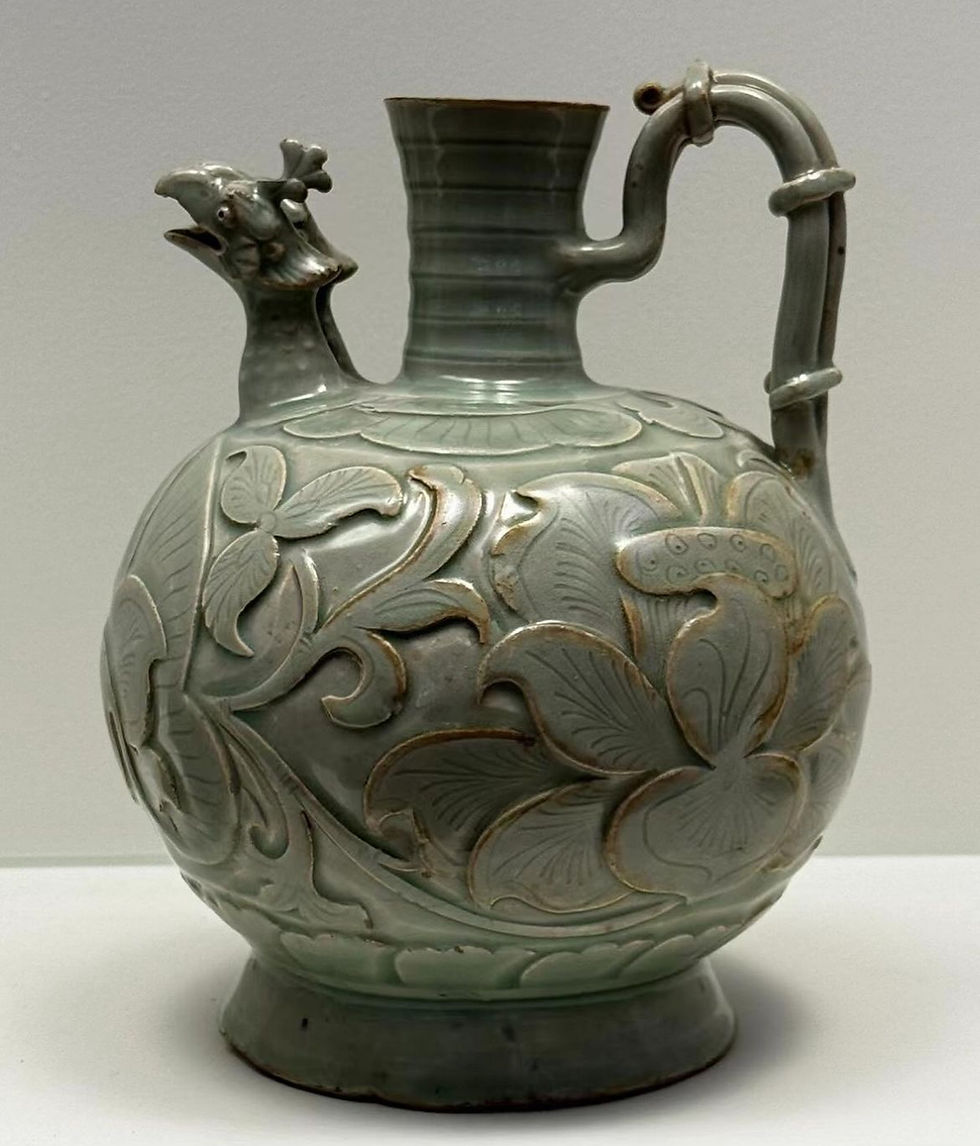
拍賣筆記 vol.419 蘇富比香港2026:五代至北宋耀州青釉刻纏枝牡丹紋執壺,壺中居,岡田博物館 - Sotheby’s 2026, Okada Sales Part 2, A Yaozhou Celadon 'Peony' Ewer, Five Dynasties – Northern Song Dynasty
- SACA

- 23 hours ago
- 4 min read

五代耀州窯青瓷向來備受藏家重視,其深剔刻花與橄欖青釉色,在北方青瓷中獨樹一幟。值得留意的是,這類器物在市場上真正被大幅推高並引起廣泛關注,是在前數年北京保利的拍場——尤其2019年春拍中一件五代至北宋青釉剔刻花卉蓮瓣口葫蘆執壺,以逾三千萬人民幣成交,創下當時耀州窯拍賣紀錄。其後市場對此類高價成交的持續性與支撐力,始終存在討論。近年亦有媒體報道保利拍賣內部人員涉價格操控與赝品交易的相關案件,並已進入司法程序。此前北京成交的3000萬如今要打一個問號。本品估價30-60萬港元,此次在國際市場的成交價格可以成為以後判斷此類價值的一個標準。
本品本身極為珍罕,屬五代至北宋耀州窯早期精細刻花執壺一類。其來源清晰可靠:出自日本重要古美術商浦上蒼穹堂(Uragami Sokyu-do),並曾於2002年紐約國際亞洲藝術博覽會展出,亦著錄於浦上蒼穹堂三十周年紀念圖錄及浦上滿先生相關著述中。雖牛津熱釋光測試證書現已遺失(可重新送測補發),然以浦上蒼穹堂之擔保與長期信譽,來源應屬穩妥。
五代至北宋耀州青釉刻纏枝牡丹紋執壺
A finely carved Yaozhou celadon 'peony' ewer, Five Dynasties – Northern Song dynasty
Estimate
300,000 - 600,000 HKD
Description
Japanese wood box
h. 19.5 cm
Condition Report
Minor retouching to the tip of the spout (approx. 1.5cm), and to a tiny flake (approx. 0.5cm) on the exterior mouth rim. Otherwise in good overall condition. There is a triangular thermoluminescence (TL) test drill hole on the footring; the report has unfortunately been misplaced.
流口尖(約1.5公分)及外口沿一小剝釉(約0.5公分)經潤飾。除此以外,整體品相良好。圈足處見熱釋光測試孔(報告佚失)。
來源
浦上蒼穹堂,東京
展覽
《The International Asian Art Fair》,紐約,2002年
出版
《浦上蒼穹堂30周年記念》,浦上蒼穹堂,東京,2009年,頁113
浦上満,《古美術商にまなぶ中国.朝鮮古陶磁の見かた、選びかた》,京都,2011年,頁91


Provenance
Uragami Sokyu-do Co., Ltd, Tokyo.
Exhibited
The International Asian Art Fair, New York, 2002.
Literature
The 30th Anniversary of Uragami Sokyu-do, Uragami Sokyu-do Co., Ltd, Tokyo, 2009, p. 113.
Uragami Mitsuru, Kobijutsusho ni manabu Chugoku Chosentoji no Mikata Erabikata [A Dealer's Eyes: Appreciating and Collecting Chinese and Korean Ceramics], Kyoto, 2011, p. 91.
Five Dynasties Yaozhou celadon has long been highly regarded by collectors for its deep relief carving and distinctive olive-green glaze, standing out among northern celadons. It is worth noting that this category of wares was significantly elevated in market attention and price only in recent years at Beijing Poly auctions—most notably in the 2019 spring sale, when a Five Dynasties to Northern Song celadon ewer with carved floral decoration and lotus-petal mouth in double-gourd form achieved over RMB 30 million, setting a then-record for Yaozhou ware. Subsequent discussion has continued regarding the sustainability and underlying support for such high results. In recent years, media reports have also covered cases involving Poly Auction staff in price manipulation and transactions of counterfeit pieces, some of which have entered judicial proceedings, underscoring ongoing concerns about integrity in the auction process.
The present piece is itself extremely rare, belonging to the early group of finely carved Yaozhou ewers of the Five Dynasties to Northern Song period. Its provenance is clear and reliable: it comes from the important Japanese dealer Uragami Sokyu-do, was exhibited at the International Asian Art Fair in New York in 2002, and is published in the 30th-anniversary catalogue of Uragami Sokyu-do as well as in related writings by Mitsuru Uragami. Although the Oxford thermoluminescence test certificate has been lost (and can be reissued upon retesting), the guarantee and long-standing reputation of Uragami Sokyu-do provide strong assurance regarding its authenticity and origin.
Likely made during the early development of the Yaozhou celadon production, this exceptional ewer, remarkably potted and carved, belongs to a rare group of northern celadons inspired by Tang dynasty metalwork.
The Yaozhou kilns at Huangpu, southwest of Tongchuan city in Shaanxi province, which had gained renown through their pale green vessels with deep, large-scale carving in the Five Dynasties period (907-960), became China’s major suppliers of high-quality celadon wares in the Northern Song dynasty (960-1127). While production of bowls and dishes with incised or moulded designs was executed on a vast scale, a small number of vessels in other shapes, such as the current ewer, received particular attention.
A closely related covered ewer, excavated in 1972 from the Huangbaozhen kiln site in Tongchuan County, Shaanxi province, and now preserved in the Yaozhou Ware Museum, was included in The Masterpieces of Yaozhou Ware, Osaka, 1997, cat. no. 142. Two further comparable ewers, both lacking their original covers, are illustrated in Kanzo Meihin Sen / Selected Masterpieces from the Idemitsu Collection, vol. 3, Tokyo, 1996, pl. 102, and Regina Krahl, Chinese Ceramics from the Meiyintang Collection, vol. III (II), London, 2006, no. 1472.
For other related Yaozhou celadon ewers, compare a double-spouted example from the Charles Bain Hoyt Collection, now preserved in the Museum of Fine Arts, Boston, accession no. 50.2009, another with a double spout in the form of two phoenix from the Ernest Grandidier Collection and now housed in the Musée Guimet, Paris, accession no. G 5119, and another with a singular lion-shaped spout in the Cleveland Museum of Art, accession no. 1948.220.




Comments